
Mapa mental
Long term physiological
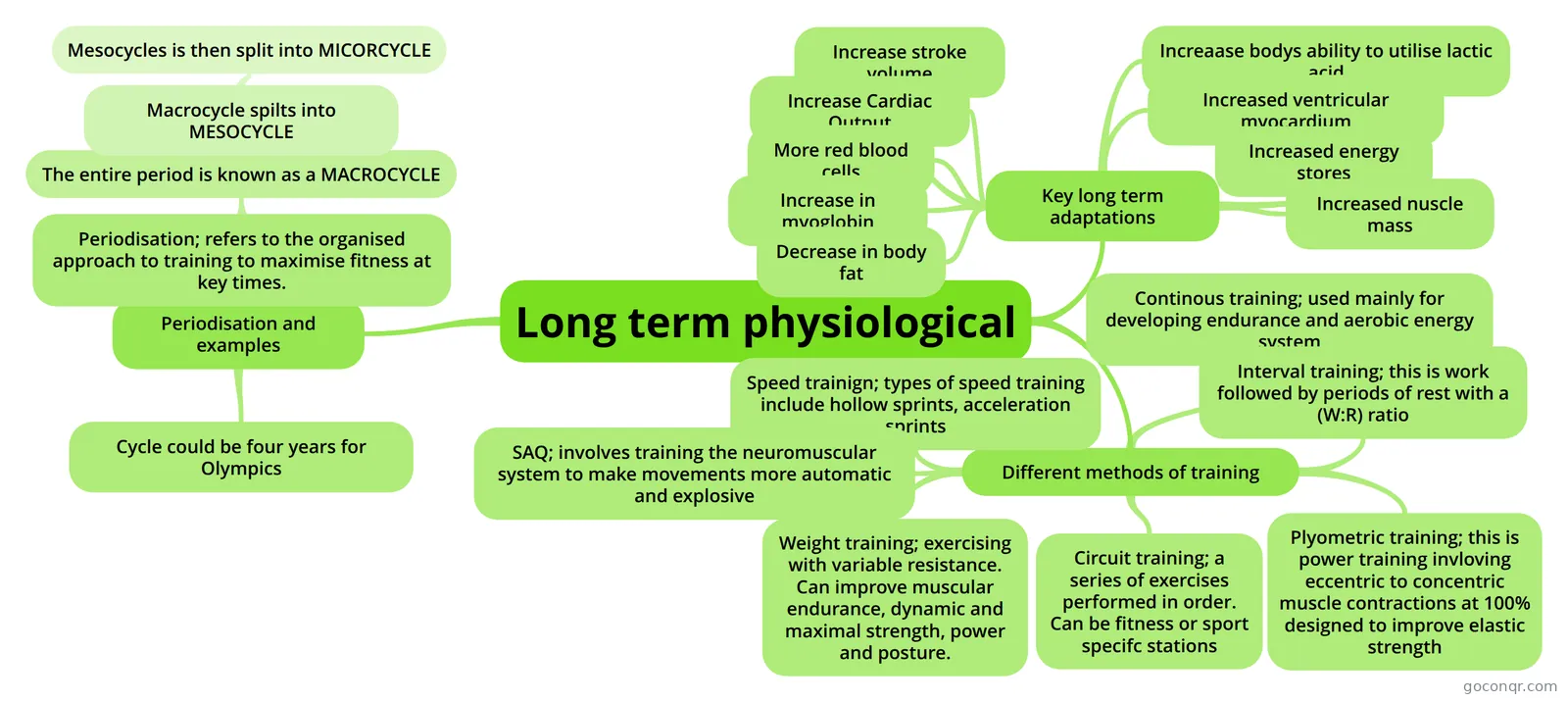
Mind map: long term physiological adaptations to training
Contenido del mapa
Long term physiological
Key long term adaptations
- Increase stroke volume
- Increase Cardiac Output
- More red blood cells
- Increase in myoglobin
- Decrease in body fat
- Increaase bodys ability to utilise lactic acid
- Increased ventricular myocardium
- Increased energy stores
- Increased nuscle mass
Different methods of training
- Continous training; used mainly for developing endurance and aerobic energy system
- Interval training; this is work followed by periods of rest with a (W:R) ratio
- Plyometric training; this is power training invloving eccentric to concentric muscle contractions at 100% designed to improve elastic strength
- Circuit training; a series of exercises performed in order. Can be fitness or sport specifc stations
- Weight training; exercising with variable resistance. Can improve muscular endurance, dynamic and maximal strength, power and posture.
- Speed trainign; types of speed training include hollow sprints, acceleration sprints
- SAQ; involves training the neuromuscular system to make movements more automatic and explosive
Periodisation and examples
- Periodisation; refers to the organised approach to training to maximise fitness at key times.
- The entire period is known as a MACROCYCLE
- Macrocycle spilts into MESOCYCLE
- Mesocycles is then split into MICORCYCLE
- Macrocycle spilts into MESOCYCLE
- The entire period is known as a MACROCYCLE
- Cycle could be four years for Olympics
- Periodisation; refers to the organised approach to training to maximise fitness at key times.
Información
- Descripción
- A-Levels (Long term preparation) P.E Mapa Mental sobre Long term physiological, creado por harry_bygraves el 29/05/2013.
- Creado por
- harry_bygraves
- Visitas
- 91
- Etiquetas
- Valoración