
Mapa mental
Alternative Dispute Resolution
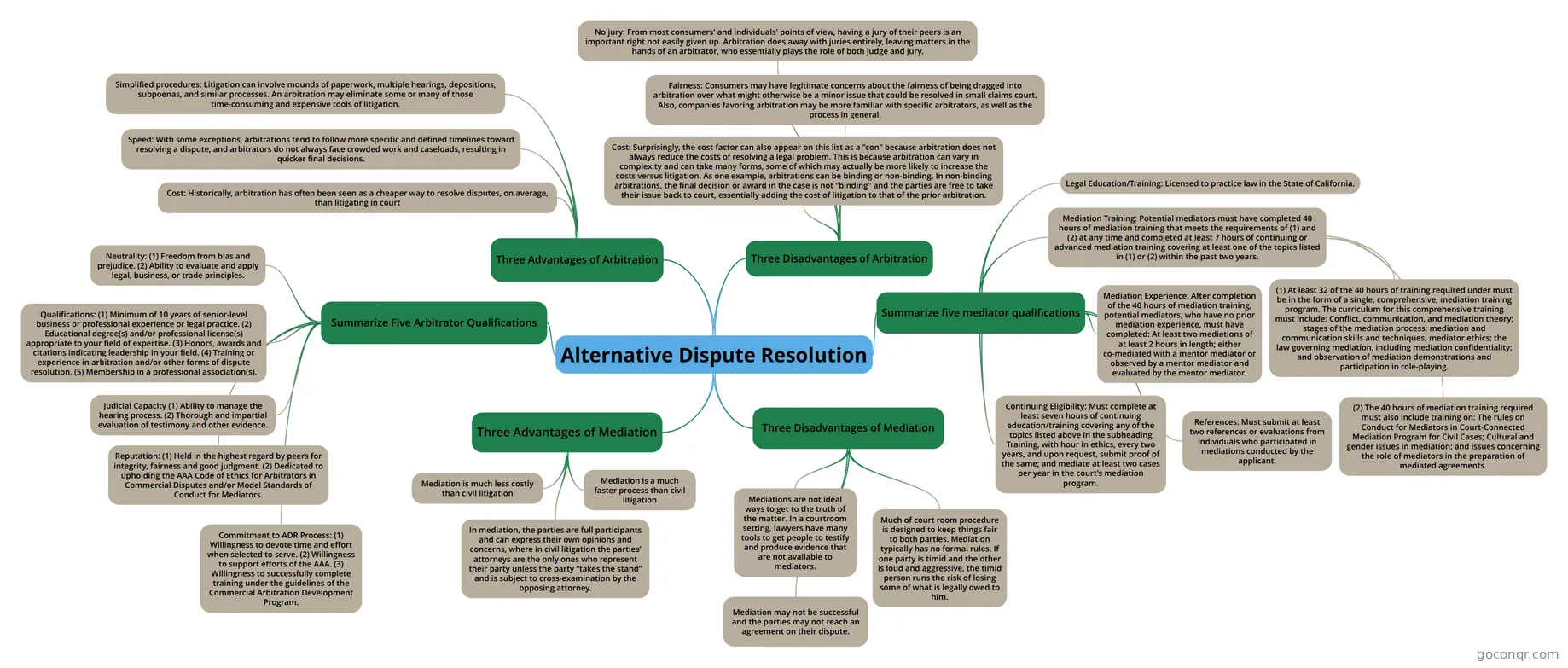
Mind map: Alternative dispute resolution
Contenido del mapa
Alternative Dispute Resolution
Three Advantages of Mediation
- Mediation is much less costly than civil litigation
- Mediation is a much faster process than civil litigation
- In mediation, the parties are full participants and can express their own opinions and concerns, where in civil litigation the parties’ attorneys are the only ones who represent their party unless the party “takes the stand” and is subject to cross-examination by the opposing attorney.
Three Disadvantages of Mediation
- Mediations are not ideal ways to get to the truth of the matter. In a courtroom setting, lawyers have many tools to get people to testify and produce evidence that are not available to mediators.
- Much of court room procedure is designed to keep things fair to both parties. Mediation typically has no formal rules. If one party is timid and the other is loud and aggressive, the timid person runs the risk of losing some of what is legally owed to him.
- Mediation may not be successful and the parties may not reach an agreement on their dispute.
Summarize five mediator qualifications
- Legal Education/Training: Licensed to practice law in the State of California.
- Mediation Training: Potential mediators must have completed 40 hours of mediation training that meets the requirements of (1) and (2) at any time and completed at least 7 hours of continuing or advanced mediation training covering at least one of the topics listed in (1) or (2) within the past two years.
- (1) At least 32 of the 40 hours of training required under must be in the form of a single, comprehensive, mediation training program. The curriculum for this comprehensive training must include: Conflict, communication, and mediation theory; stages of the mediation process; mediation and communication skills and techniques; mediator ethics; the law governing mediation, including mediation confidentiality; and observation of mediation demonstrations and participation in role-playing.
- (2) The 40 hours of mediation training required must also include training on: The rules on Conduct for Mediators in Court-Connected Mediation Program for Civil Cases; Cultural and gender issues in mediation; and issues concerning the role of mediators in the preparation of mediated agreements.
- Mediation Experience: After completion of the 40 hours of mediation training, potential mediators, who have no prior mediation experience, must have completed: At least two mediations of at least 2 hours in length; either co-mediated with a mentor mediator or observed by a mentor mediator and evaluated by the mentor mediator.
- References: Must submit at least two references or evaluations from individuals who participated in mediations conducted by the applicant.
- Continuing Eligibility: Must complete at least seven hours of continuing education/training covering any of the topics listed above in the subheading Training, with hour in ethics, every two years, and upon request, submit proof of the same; and mediate at least two cases per year in the court’s mediation program.
Three Advantages of Arbitration
- Cost: Historically, arbitration has often been seen as a cheaper way to resolve disputes, on average, than litigating in court
- Speed: With some exceptions, arbitrations tend to follow more specific and defined timelines toward resolving a dispute, and arbitrators do not always face crowded work and caseloads, resulting in quicker final decisions.
- Simplified procedures: Litigation can involve mounds of paperwork, multiple hearings, depositions, subpoenas, and similar processes. An arbitration may eliminate some or many of those time-consuming and expensive tools of litigation.
Three Disadvantages of Arbitration
- Cost: Surprisingly, the cost factor can also appear on this list as a "con" because arbitration does not always reduce the costs of resolving a legal problem. This is because arbitration can vary in complexity and can take many forms, some of which may actually be more likely to increase the costs versus litigation. As one example, arbitrations can be binding or non-binding. In non-binding arbitrations, the final decision or award in the case is not "binding" and the parties are free to take their issue back to court, essentially adding the cost of litigation to that of the prior arbitration.
- Fairness: Consumers may have legitimate concerns about the fairness of being dragged into arbitration over what might otherwise be a minor issue that could be resolved in small claims court. Also, companies favoring arbitration may be more familiar with specific arbitrators, as well as the process in general.
- No jury: From most consumers' and individuals' points of view, having a jury of their peers is an important right not easily given up. Arbitration does away with juries entirely, leaving matters in the hands of an arbitrator, who essentially plays the role of both judge and jury.
Summarize Five Arbitrator Qualifications
- Qualifications: (1) Minimum of 10 years of senior-level business or professional experience or legal practice. (2) Educational degree(s) and/or professional license(s) appropriate to your field of expertise. (3) Honors, awards and citations indicating leadership in your field. (4) Training or experience in arbitration and/or other forms of dispute resolution. (5) Membership in a professional association(s).
- Neutrality: (1) Freedom from bias and prejudice. (2) Ability to evaluate and apply legal, business, or trade principles.
- Judicial Capacity (1) Ability to manage the hearing process. (2) Thorough and impartial evaluation of testimony and other evidence.
- Reputation: (1) Held in the highest regard by peers for integrity, fairness and good judgment. (2) Dedicated to upholding the AAA Code of Ethics for Arbitrators in Commercial Disputes and/or Model Standards of Conduct for Mediators.
- Commitment to ADR Process: (1) Willingness to devote time and effort when selected to serve. (2) Willingness to support efforts of the AAA. (3) Willingness to successfully complete training under the guidelines of the Commercial Arbitration Development Program.
Información
- Descripción
- Human Resources Mapa Mental sobre Alternative Dispute Resolution, creado por Jason Jones el 10/04/2018.
- Creado por
- Jason Jones
- Visitas
- 0
- Historial
-
- Creado por Jason Jones · 9 abr 2018
- Copiado por Jason Jones · 10 abr 2018
- Valoración
Más sobre Mediation and Conciliation