
Mapa mental
K101 Block 1 Unit 1 "Who Cares"
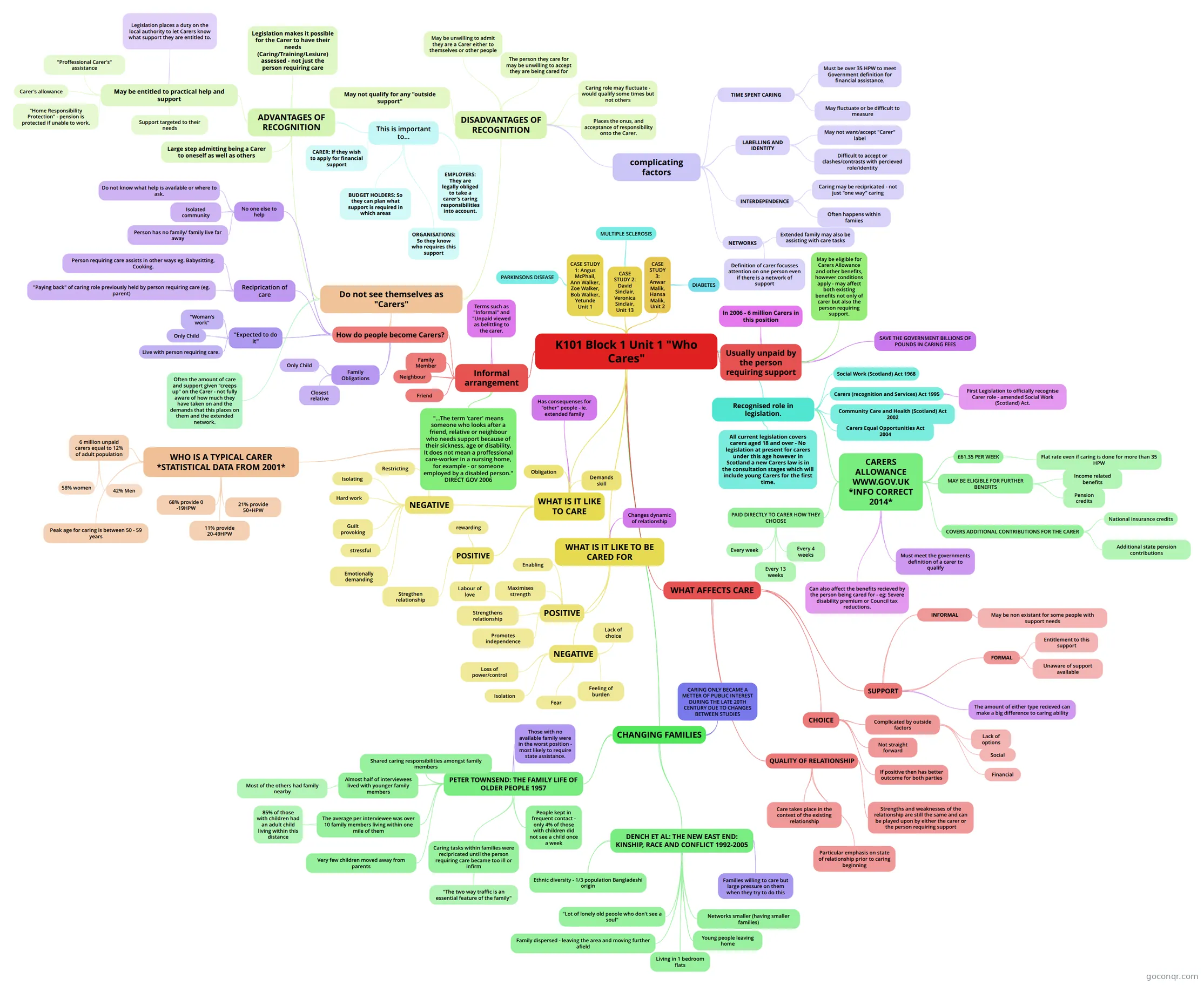
Mind map: K101 Block 1 Unit 1 Who Cares
Contenido del mapa
K101 Block 1 Unit 1 "Who Cares"
Informal arrangement
- Family Member
- Neighbour
- Friend
- Terms such as "Informal" and "Unpaid viewed as belittling to the carer.
- "...The term 'carer' means someone who looks after a friend, relative or neighbour who needs support because of their sickness, age or disability. It does not mean a proffessional care-worker in a nursing home, for example - or someone employed by a disabled person." DIRECT GOV 2006
- WHO IS A TYPICAL CARER *STATISTICAL DATA FROM 2001*
- 6 million unpaid carers equal to 12% of adult population
- 58% women
- 42% Men
- Peak age for caring is between 50 - 59 years
- 68% provide 0 -19HPW
- 11% provide 20-49HPW
- 21% provide 50+HPW
- 6 million unpaid carers equal to 12% of adult population
- WHO IS A TYPICAL CARER *STATISTICAL DATA FROM 2001*
- How do people become Carers?
- Family Obligations
- Only Child
- Closest relative
- Reciprication of care
- Person requiring care assists in other ways eg. Babysitting, Cooking.
- "Paying back" of caring role previously held by person requiring care (eg. parent)
- "Expected to do it"
- "Woman's work"
- Only Child
- Live with person requiring care.
- No one else to help
- Person has no family/ family live far away
- Isolated community
- Do not know what help is available or where to ask.
- Do not see themselves as "Carers"
- Often the amount of care and support given "creeps up" on the Carer - not fully aware of how much they have taken on and the demands that this places on them and the extended network.
- ADVANTAGES OF RECOGNITION
- This is important to...
- CARER: If they wish to apply for financial support
- BUDGET HOLDERS: So they can plan what support is required in which areas
- ORGANISATIONS: So they know who requires this support
- EMPLOYERS: They are legally obliged to take a carer's caring responsibilities into account.
- May be entitled to practical help and support
- Carer's allowance
- Support targeted to their needs
- "Proffessional Carer's" assistance
- "Home Responsibility Protection" - pension is protected if unable to work.
- Legislation places a duty on the local authority to let Carers know what support they are entitled to.
- Legislation makes it possible for the Carer to have their needs (Caring/Training/Lesiure) assessed - not just the person requiring care
- Large step admitting being a Carer to oneself as well as others
- This is important to...
- DISADVANTAGES OF RECOGNITION
- complicating factors
- TIME SPENT CARING
- Must be over 35 HPW to meet Government definition for financial assistance.
- May fluctuate or be difficult to measure
- LABELLING AND IDENTITY
- May not want/accept "Carer" label
- Difficult to accept or clashes/contrasts with percieved role/identity
- INTERDEPENDENCE
- Caring may be recipricated - not just "one way" caring
- Often happens within famiies
- NETWORKS
- Extended family may also be assisting with care tasks
- Definition of carer focusses attention on one person even if there is a network of support
- TIME SPENT CARING
- May not qualify for any "outside support"
- May be unwilling to admit they are a Carer either to themselves or other people
- The person they care for may be unwilling to accept they are being cared for
- Caring role may fluctuate - would qualify some times but not others
- Places the onus, and acceptance of responsibility onto the Carer.
- complicating factors
- Family Obligations
Usually unpaid by the person requiring support
- May be eligible for Carers Allowance and other benefits, however conditions apply - may affect both existing benefits not only of carer but also the person requiring support.
- In 2006 - 6 million Carers in this position
- SAVE THE GOVERNMENT BILLIONS OF POUNDS IN CARING FEES
Recognised role in legislation.
- Carers (recognition and Services) Act 1995
- First Legislation to officially recognise Carer role - amended Social Work (Scotland) Act.
- Carers Equal Opportunities Act 2004
- Community Care and Health (Scotland) Act 2002
- Social Work (Scotland) Act 1968
- All current legislation covers carers aged 18 and over - No legislation at present for carers under this age however in Scotland a new Carers law is in the consultation stages which will include young Carers for the first time.
- CARERS ALLOWANCE WWW.GOV.UK *INFO CORRECT 2014*
- £61.35 PER WEEK
- Flat rate even if caring is done for more than 35 HPW
- MAY BE ELIGIBLE FOR FURTHER BENEFITS
- Income related benefits
- Pension credits
- PAID DIRECTLY TO CARER HOW THEY CHOOSE
- Every week
- Every 4 weeks
- Every 13 weeks
- COVERS ADDITIONAL CONTRIBUTIONS FOR THE CARER
- National insurance credits
- Additional state pension contributions
- Can also affect the benefits recieved by the person being cared for - eg: Severe disability premium or Council tax reductions.
- Must meet the governments definition of a carer to qualify
- £61.35 PER WEEK
- Carers (recognition and Services) Act 1995
CASE STUDY 1: Angus McPhail, Ann Walker, Zoe Walker, Bob Walker, Yetunde Unit 1
- PARKINSONS DISEASE
CASE STUDY 2: David Sinclair, Veronica Sinclair, Unit 13
- MULTIPLE SCLEROSIS
CASE STUDY 3: Anwar Malik, Hansa Malik, Unit 2
- DIABETES
WHAT IS IT LIKE TO CARE
- Demands skill
- Obligation
- Has consequenses for "other" people - ie. extended family
- POSITIVE
- rewarding
- Labour of love
- Stregthen relationship
- NEGATIVE
- Hard work
- Restricting
- Isolating
- Emotionally demanding
- Guilt provoking
- stressful
WHAT IS IT LIKE TO BE CARED FOR
- POSITIVE
- Enabling
- Maximises strength
- Strengthens relationship
- Promotes independence
- NEGATIVE
- Loss of power/control
- Lack of choice
- Feeling of burden
- Fear
- Isolation
- Changes dynamic of relationship
- POSITIVE
WHAT AFFECTS CARE
- QUALITY OF RELATIONSHIP
- Care takes place in the context of the existing relationship
- Particular emphasis on state of relationship prior to caring beginning
- Strengths and weaknesses of the relationship are still the same and can be played upon by either the carer or the person requiring support
- CHOICE
- If positive then has better outcome for both parties
- Not straight forward
- Complicated by outside factors
- Financial
- Social
- Lack of options
- SUPPORT
- INFORMAL
- May be non existant for some people with support needs
- FORMAL
- Entitlement to this support
- Unaware of support available
- The amount of either type recieved can make a big difference to caring ability
- INFORMAL
- QUALITY OF RELATIONSHIP
CHANGING FAMILIES
- PETER TOWNSEND: THE FAMILY LIFE OF OLDER PEOPLE 1957
- Shared caring responsibilities amongst family members
- Almost half of interviewees lived with younger family members
- Most of the others had family nearby
- The average per interviewee was over 10 family members living within one mile of them
- 85% of those with children had an adult child living within this distance
- Very few children moved away from parents
- People kept in frequent contact - only 4% of those with children did not see a child once a week
- Caring tasks within families were recipricated until the person requiring care became too ill or infirm
- "The two way traffic is an essential feature of the family"
- Those with no available family were in the worst position - most likely to require state assistance.
- DENCH ET AL: THE NEW EAST END: KINSHIP, RACE AND CONFLICT 1992-2005
- Ethnic diversity - 1/3 population Bangladeshi origin
- "Lot of lonely old peoole who don't see a soul"
- Living in 1 bedroom flats
- Family dispersed - leaving the area and moving further afield
- Young people leaving home
- Networks smaller (having smaller families)
- Families willing to care but large pressure on them when they try to do this
- CARING ONLY BECAME A METTER OF PUBLIC INTEREST DURING THE LATE 20TH CENTURY DUE TO CHANGES BETWEEN STUDIES
- PETER TOWNSEND: THE FAMILY LIFE OF OLDER PEOPLE 1957
Información
- Descripción
- Flow chart of revision points for K101 unit 1 block 1.
- Creado por
- Tina Spence
- Visitas
- 399
- Etiquetas
- Valoración