
Apuntes
Intro
Contenido del apunte (1)
Página 1
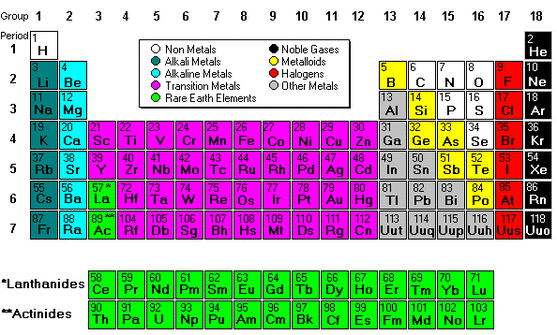
Periodic Table
Groups 1 -2A and groups 13-18 are known as representative elements. The rest (Group 3-12) are called transitional elements.
Alkali metals (including Hydrogen) are the most reactive metals. They all have one valence electrons so they like to form ions with plus 1 charges.
(H+, Li+, K+)
Alkaline Earth metals are reactive but not as violently as Alkali. They have 2 valence electrons so they love to form ions with plus 2 charges. (Be^+2).
Metals like to give away electrons (ionic bonds), as they do that they will form a positively charged ion (a cation).
Transition Metals have variable charges .
Examples:
Iron (Fe) has +2/+3 in oxidation state.
Zinc (ZN) has a common of +2.
Silver (AG) is +1
Gold (AU) could be +1/+2
Mercury (HG) +1/+2
Cobalt (CO) has +2/+3
Magnesium (Mn) +2/+7
In the inner transition metal they are called Lanthanides and Actinides.
Group 3A has 3 valence electrons and most of them likes to form +3 charges.
Group 4A elements have 4 valence electrons so they like to form +4 charges.
Group 5A elements have 5 valence electrons but they like to form -3 charges.
- When Phosphorus forms -3 charges its called phosphate.
- Same goes with Nitrogen it would be called Nitrate after the formation.
In Group 6A they have 6 valence electrons so they like to form -2 charges.
- They are also known as the chalcogens.
Group 7a elements have 7 valence electrons and they like to form -1 charges.
- They are called halogens.
------------------------------------------------------------------------------------------------------------------------------------------------------------------------------------------------------------------
Metals likes to give up electrons, while nonmetals like accepting elections.
Florine is electronegative because it really wants electrons.
- As you go up and right on the table electronegativity increases.
- Non metals are most likely electronegative
- Metals are most likely electropositive
Once electronegative elements acquire theirs electrons they form negative charges.
Electropositive elements like to give away electron they form a positive charge.
The noble gases (8A) have a complete set of valence electrons (Helium only has 2 in all so the innermost is complete).
They are stable and don't participate much in chemical reactions(non-reactive).
Elements in the same column have similar chemical properties. For example, Oxygen and Sulfur.
Metals- conducts electricity and heat. They are malleable and ductile.
Nonmetals- cannot conduct electricity
Metaloids
Información
- Descripción
- Apunte sobre Intro, creado por Red Robin el 04/08/2020.
- Creado por
- Red Robin
- Visitas
- 3
- Valoración