
Flashcards
Pyschodynamic Approach
Cards in this deck (42)
- 1Who is Freud?-He explores the human mind
-He influenced many people
-He was the founder of pyscho-analysis (talking therapy - got people to talk about their feelings) - 2What are the 3 assumptions of the psychodynamic approach?1. Childhood experiences
2. The Unconscious mind
3. Tripartite personality - 3Explain the influence of childhood experiences?Freud believes that experiences during childhood shape our adult personalities.
Psychological development in childhood takes place in a series of key development stages. These are called the psychosexual stages and each stage represents the fixation of libido (roughly translated as sexual drives or instincts) on different areas of the body. - 4What are the 5 psychosexual stages?1.Oral
2. Anal
3. Phallic
4. Latency
5. Genital - 5What happen when problems occur in any of the stages?Problems with any stage of the development can result in the child getting fixated (stuck), which will have a long lasting effect on the personality.
- 6Fixation at any of these stages can occur through:Frustration = when the stage has not been resolved and the needs have not been met, for example, the child is unsatisfied
Overindulgence = the child needs have been more than satisfied, and the child feels too comfortable to move on to the next stage - 7When and what happens during the Oral stage?It is between 0-18months. The source of pleasure come from the mouth (chewing, biting, swallowing and sucking)
- 8What happens on either fixation on the oral stage?Frustration - pessimism, envy and sarcasm
Overindulgence - optimism, gullibility and neediness - 9When and what happens during the Anal stage?It is between 18months - 3 years. The source of pleasure come from the anus (withholding, expelling and playing with faeces)
- 10What happens on either fixation at the Anal stage?Frustration - stubborn, possessive and overly tidy
Overindulgence - messy, disorganised and reckless - 11When and what happens during the anal stage?It is between 3 to 5 years. The pleasure comes from the genitals (masturbation)
- 12What personality traits come from the phallic stage?They may be self-assured, vain and may have problems maintaining relationships in the future.
- 13When and what happens during the Genital stage?It is during puberty. The source of pleasure comes from the genitals (masturbation, intercourse)
- 14What personality traits come from the genital stage?Well developed adults personality, well adjusted (if complexes during phallic stage are resolved)
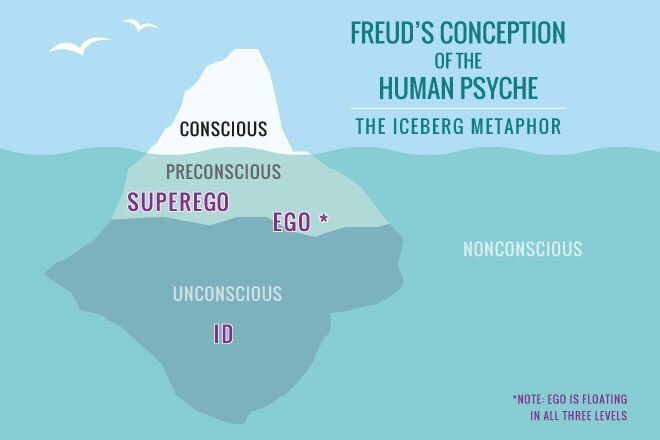
- 15Explain the unconscious mind?Freud proposed that the mind is like an iceburg - much of what goes on inside the mind lies under the surface.
- 16Explain the conscious and unconscious mind?The conscious mind is logical, where as the unconscious mind is not ruled by pleasure seeking. The unconscious mind cannot be directly accessed, but rather expresses itself indirectly through dreams.
- 17Explain more about what Freud says about the unconscious mindFreud believes that the unconscious mind contains unresolved conflicts that have a powerful effect on our behaviours and experiences. He argues that our conflicts show up in our dreams. He also claims that the unconscious mind is also related to ego defence mechanisms.
- 18The conflicting drives on Eros and Thanatos in the unconscious mind, what are these?Eros is the love and affection part of the unconscious mind, it is also the life drive so it has needs for health and safety. Thanatos is the death drive and usually controls the destructive behaviour.
- 19What are the three parts of the tripartite personality?Id, Ego and Superego
- 20What is id?It is the impulsive (and unconscious) part of our personality.
-Survival
-Pleasure seeking
-Does not mature
-Driven by desire - 21What is Ego?It is the conscious, rational part of the mind.
-Fits in with the social norm
-Realistic and sensible
-Reality principle
-Compromising
-Decision making
-Postponing satisfaction - 22What is Superego?It embodies the sense of right and wrong.
-Strives for perfection
-Morality
-Considered conditions
-Causes guilt - 23What is Dream Analysis?Dream analysis is the process of assigning meanings to dreams.
Freud proposed that the unconscious mind expresses itself through dreams, and the content of the dreams can therefore reveal what it is in their unconscious. - 24What does Freud say about dreams?According to Freud, although dreams represent unfulfilled wishes, their contents are expressed symbolically. The meaning of the dream (latent content) is transformed into a more innocuous form (manifest content, the content you actually experience)
- 25What happens with the latent and manifest content?The latent content of the dream is transformed into the manifest content through the process of dreamwork.
- 26What does dreamwork consist of?Dreamwork consists of the various processes such as, condensation, displacement and secondary elaboration. All these are done by undoing the process of dreamwork.
- 27Dreamwork - What is meant by condensation?Condensation is the joining of two or more ideas/image into one.
- 28Dreamwork - What is meant by displacement?Displacement is the emotional significance of a dream object is separated from its real object or content into an entirely different one
- 29Dreamwork - What is meant by secondary elaboration?Secondary elaboration occurs when the unconscious mind strings together wish-fulfilling images in a logical order of events, further obscuring the latent content
- 30Dreamwork - What is meant by free association?Free association is a practice in psychoanalytical therapy in which a client is asked to freely to share thoughts, random words and meaning of the dreams.
- 31Undoing dreamwork - What is meant by condensation?This is the idea of separating objects in the dream into two or more images to revel their true meaning
- 32Undoing dreamwork - What is meant by displacement?This is working out which dream objects are symbolic of those that actually cause anxiety.
- 33Undoing dreamwork - What is meant by presentation?This is where the usual images are translated back into thoughts.
- 34Undoing dreamwork - What is meant by symbolism?Recording the wish-fulling images to uncover the obscured latent content.
- 35How might the therapist undo the steps of dreamwork?The therapist must undo the steps of dreamwork by discussing anything else that comes to mind. The ideas is that free association revels association and connections that might otherwise go uncovered and that clients may uncover repressed memories and emotions.
- 36Undoing Dreamwork - What is 'catharsis'?Catharsis is a concept in psychoanalytical theory where the emotions associated with traumatic experiences come to the surface. It is associated with elimination of negative emotions, affect, or behaviours associated with the unacknowledged trauma. Freud used this to treat hysteria.
- 37What does dream analysis involve?1. Asking the clients to describe their dreams (manifest content) in detail
2. The should discuss each element of the dream and express any thoughts that come to them whilst doing so (free association)
3. It is the therapists role to work out the underlying the dream relation to the clients background and childhood.
4. This will help the client see how the conflicts in the unconscious mind are related to the context of the person's life.
5. The should then finally, experience catharis (emotional release) - 38Evaluation of dream analysis Effectiveness - positives:) - 70.4% of patients benefit from working on their dreams as part of their psychoanalysis (Schredl, 2000)
:) - Dream analysis can aid a client's insight and level of involvement/commitment to the therapy including likeliness of efficacy (Peasant and Zadra, 2004) - 39Evaluation of dream analysis Effectiveness - Negatives:( - Many of Freud's own cases (WolfMan) were unsuccessful in curing patients, suggesting dream analysis is ineffective.
:( - Difficult to measure levels of success as it is used to a wider therapeutic process (psychoanalysis) that takes years. - 40Evaluation of dream analysis Ethical issues:( - Patient therapist relationship can become blurred - e.g. when Dora transferred her feeling for Herr K to Freud.
:( - Revealing traumatic/repressed experiences could cause psychological harm - 41Positive evaluation of the psychodynamic approach:) - Individual differences are accounted for, allows personalised outcomes and treatment
:) - Practical applications - Can be used when other approaches/therapies have been unsuccessful in resolving disorders like post traumatic stress disorder (PTSD) - 42Negative evaluation of the psychodynamic approach?:( - Unscientific - based on case study methods, have limited reliability
:( - Deterministic - suggests you have no freewill over your childhood experiences or unconscious mind.
:( - Generalisability - cases to support Freud have only been completed on abnormal behaviours
Information
- Description
- A-level Psychology Flashcards on Pyschodynamic Approach, created by Catherine Rayner on 12/11/2017.
- Created by
- Catherine Rayner
- Views
- 0
- Rating