
Flashcards
5. Operations Process Analysis
Cards in this deck (14)
- 1Steps of analysing a process• How many customers can the process handle per hour?
• How long will it take to serve a customer?
• How much does the process cost?
• What change is need in the process to expand capacity? - 2Define: Cycle timeAverage time of process (raw materials to finished product) - average time between completion of units
- 3Process terminology in multi-stage processes: BufferingBuffering
– storage between stages
– allows stages to operate independently - 4Process terminology in multi-stage processes: Blocking– activities must stop because nowhere to store item just completed
– if there is no room for an employee to place a unit of work down, the employee will hold on to it not able to continue working on the next unit - 5Process terminology in multi-stage processes: Starving– activities must stop because there is no work
– If an employee is waiting at a work station and no work is coming to the employee to process, the employee will remain idle until the next unit of work comes - 6Process terminology in multi-stage processes: Bottleneck- the process stage with the smallest throughput rate (longest cycle
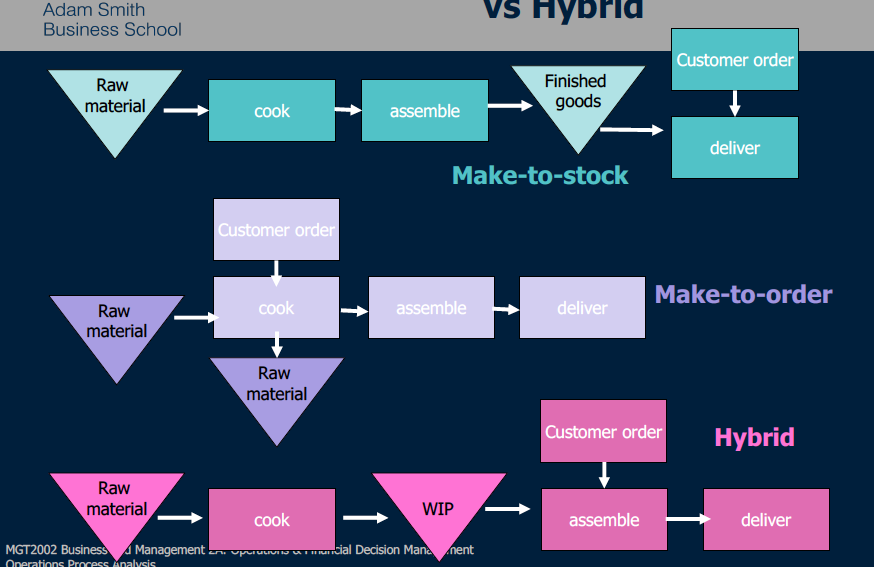
time) - 7Visualization: Make-to-stock vs make-to-order vs hybrid
- 8Define: Operation timesetup time + run time
- Set up time: the time required to prepare a machine to make a particular item
– Run time: the time required to produce a batch of parts - 9Define: Throughput timeaverage time for a unit to move through
the system - 10Define: UtilizationProportion of available time that resources are performing useful work
- 11Explain: Little's LawProcess performance in simple systems can be analysed quickly using a
formula known as Little’s Law
- Throughput time = average time for a unit to move through the system
- Work in progress (WIP) = number of items within the process at any
point in time
Throughput time = WIP x cycle time - 12Define: Throughput efficiencyThe work content of whatever is being processed as a percentage of its throughput time.
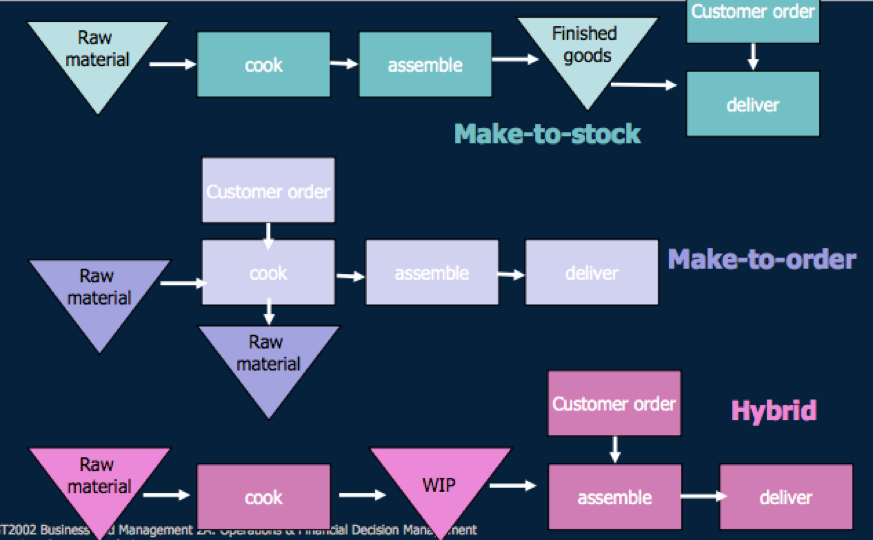
- 13Examples of make-to-stock and make-to-order and when each is appropriate (image)
- 14Measuring process performance• Operation time = setup time + run time, where set up time refers to the tie required to prepare a machine to make a particular item, and run time refers to the time required to produce a batch of parts
• Throughput time: The average time for a unit to move through the system
• Process velocity (throughput ratio) = throughput time / value – added time (time in which useful work is actually being done)
• Cycle time = average time between completion of units
• Throughput rate = 1 / cycle time
Efficiency = actual output / standard output
• Productivity = output / input
• Utilisation = time activated / time available
Utilisation: Proportion of available time that resources are performing useful work
Information
- Description
- Business and Management 2A (Operations Management) Flashcards on 5. Operations Process Analysis, created by Nina Olsson on 03/12/2017.
- Created by
- Nina Olsson
- Views
- 1
- Rating