
Flashcards
PSY 209
Cards in this deck (71)
- 1biological psychology (behavioral neuroscience)study of biological cases of psychological processes & behavior
- 25 major perspectives to study brain & behavior1. describing behavior
2. studying evolution of behavior
3. observing the development of behavior over the life span
4. studying biological mechanisms of behavior
5. studying applications of biological psychology, as in behavioral dysfunction - 3somatic interventionmanipulating the body to affect behavior EX. administer a hormone (somatic) -> strength of mating behavior (behavior)
- 4behavioral interventionhow experience affects the body EX. put male in presence of female (behavior) -> changes in hormone levels
- 5correlationhow body and behavioral measures covary. no manipulation of any factors EX brain size correlation to learning scores
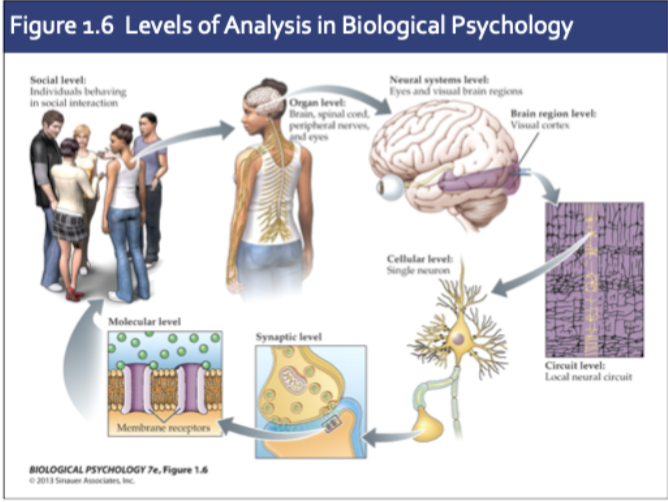
- 6levels of analysis in biological psychology
- 7reductionismscientific strategy of breaking a system down into increasingly smaller parts
- 8Camillo Golgi; reticular theoryneural network, one big tube through which information flows
- 9Cajal's 4 principals for neural organization (neural doctrine)1. neuron is the fundamental structural and functional unit of the brain
2. info is transmitted from cell to cell across synapses
3. connection specificity
4. dynamic polarization - 10cell nucleuscontains genetic instructions
- 11ribosomestranslate genetic instructions into proteins
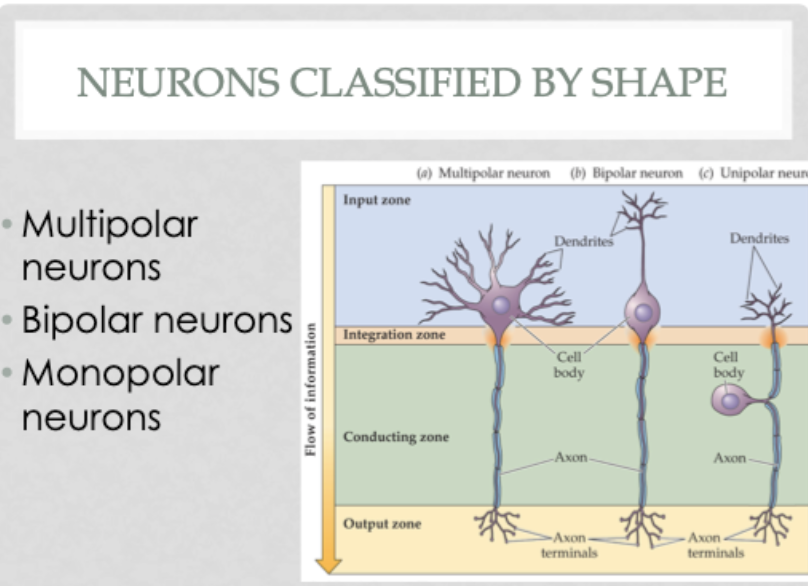
- 12dendritesinput zone-receives info form other cells
- 13cell body, axon hillockintegration zone
- 14axonconduction zone-output information, electrical impulses, axon collaterals
- 15axon terminalsoutput zone- end of the axon, communicates activity to other cells
- 16synaptic vesiclesstore neurotransmitters that are released into the synaptic cleft. these neurotransmitters bind to receptors on the postsynaptic membrane
- 17neurons classified by shape
- 18motoneuronsinnervate muscles or glands
- 19sensory neuronsrespond to environmental stimuli such as light odor or touch
- 20interneuronsreceive input from and send input to other neurons
- 21glial cellssupport neuron function, communicate w/ each other & w/ neurons, alter neuron structure/excitability, 4 types
- 22astrocytestar-shaped cells with many processes, regulate blood flow, receive neuronal input and monitor synaptic activity, modulate neuron activity & synapse formation
- 23microgliasmall continuously extended & withdraw processes, migrate to sites of injury or disease, remove debris, cleaning crew, remain inactive until cell death/injury occurs, remove harmful substance from brain to protect NS
- 24oligodendrocytesin CNS, smaller than astrocytes, few extensions, sheath a few adjacent axons
- 25schwann cellsoutside CNS sheath a single axon
- 26cFosprotein created by a cell that has been recently activated
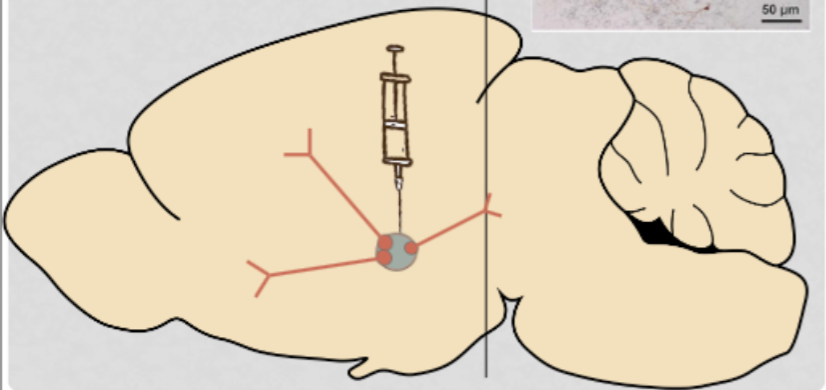
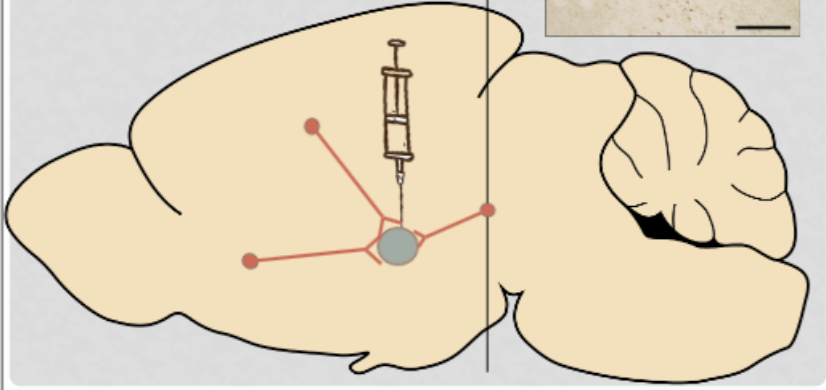
- 27tracingused to identify the routed and interconnection of neuronal projections
- 28anterogradeinjected into the brain, taken up by cell bodies to visualize projection sites (=where do these cell bodies project)
- 29retrogradeinjected into brain, taken up by axons to visualize where the axons originate (=where do these axons come from)
- 30CNS: TerminologyNucleus: collection of neurons
Tract: bundle of axon - 31PNS: TerminologyGanglion: collection of neurons
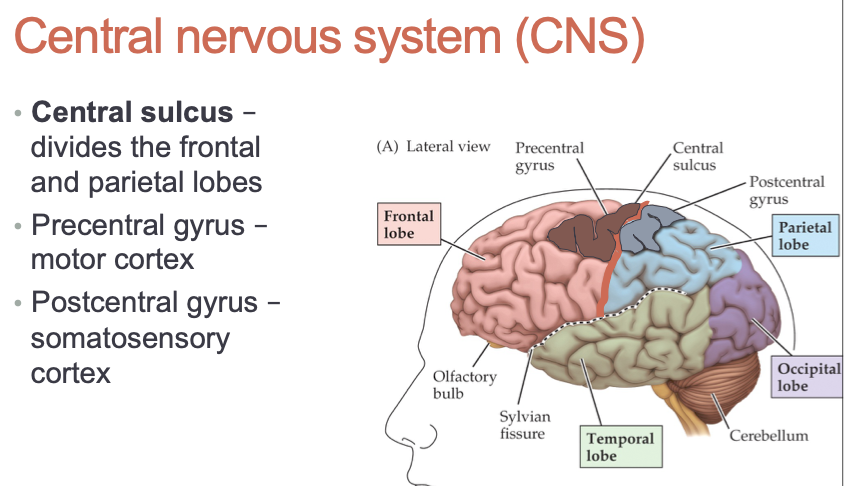
Nerve: bundle of axons - 32Frontal lobecognitive skills and emotional expression
- 33temporal lobeauditory information; learning, memory, emotion
- 34parietal lobesensory information across modalities linguistic capacity sense of touch
- 35occipital lobevisual processing
- 36gyrusridged portion of the brian surface
- 37sulcusgroove or furrow in the brain surface
- 38central sulcus-divides frontal lobe and parietal lobe. Precentral gyrus- motor cortex Postcentral gyrus- somatosensory cortex sylvian fissure- divides temporal lobe from frontal and parietal
- 39white matterconsists mostly of axons with white myelin sheaths
- 40gray mattercontains more cell bodies and dendrites which lack myelin
- 41cortex2000cm^2 2mm thick
functional compartmentation (visual, auditory, somatosensory, motor) higher cognitive function (language math memory) - 42basal gangliaimportant in motor control, include for nuclei (caudate nucleus, putamen, globus pallidus, substantia nigra)
- 43limbic systemamygdala- emotional regulation
hippocampus-memory/learning
cingulate gyrus- attention
olfactory bulb- sense of smell - 44diencephalonthalamus: cluster of nuclei that relay sensory information
Hypothalamus- contains nuclei w/ many functions controls pituitary - 45midbrain sensory systemssuperior colliculi- processes visual information
inferior colliculi- process auditory info
(form the tectum) - 46midbrain motor systemssubstantia nigra- part of basal ganglia
red nucleus- communicates w. motoneurons in the spinal cord
reticular formation- involved w/ sleep & temp./motor control - 47raphe nuclei (midbrain)Neurotransmitter serotonin produced here & released through brain (depression, anxiety, arousal, sexual behavior)
- 48ventral tegmental areaneurotransmitter dopamine produced here (motivation)
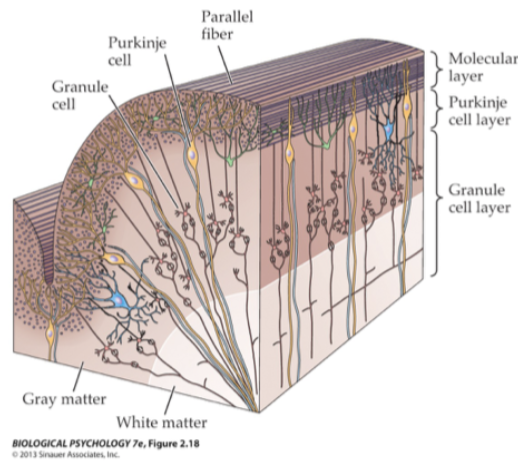
- 49cerebelluminvolved with motor coordination and learning 3 layers
- 50ponsattached to the cerebellum & contain motor and sensory nuclei gives rise to cranial nerves. relays signals from the forebrain to cerebellum, important for regulatory functions i.e. sleep, respiration, facial sensation
- 51medullacontains cranial nerve nuclei & marks transition from brain to spinal cord
responsible for autonomic functions including breathing/sneezing - 52CNS: meningesprotective membranes surrounding brain and spinal cord.
A.M filled with cerebrospinal fluid (CSF)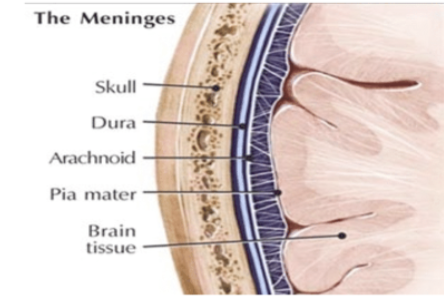
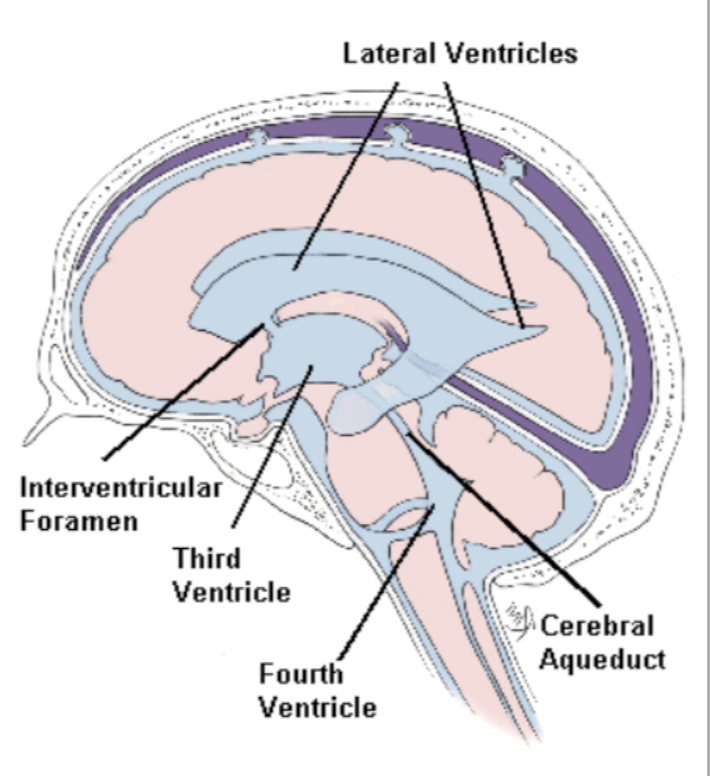
- 53ventricular systemseries of chamber filled with CSF
CSF acts as a shock absorber and provides an exchange medium between blood and brain - 54lateral ventricleextends into all four lobes and line w/ choroid plexus (membrane that produces CSF)
- 55flow of CSFinto the third ventricle at midline then into fourth ventricle where it exists to circulate over the brain and spinal cord
- 56bulk flow transmissiona way for neurons to communicate with other neurons w/o synaptic connections
-> axons release neural chemicals into ventricular system, dendrites of far away neurons line the ventricular walls - 57cranial nervesrelay information between areas of body and brain 12 pairs, carry sensory/motor info , pass through small opening in skull & directly enter or leave the brain w/o joining the spinal cord
- 58Cranial nerve mnemonic (names) oh oh oh to take a family vacation. go vegas after hours Type Function: some say marry money but my brother says big brains matter more
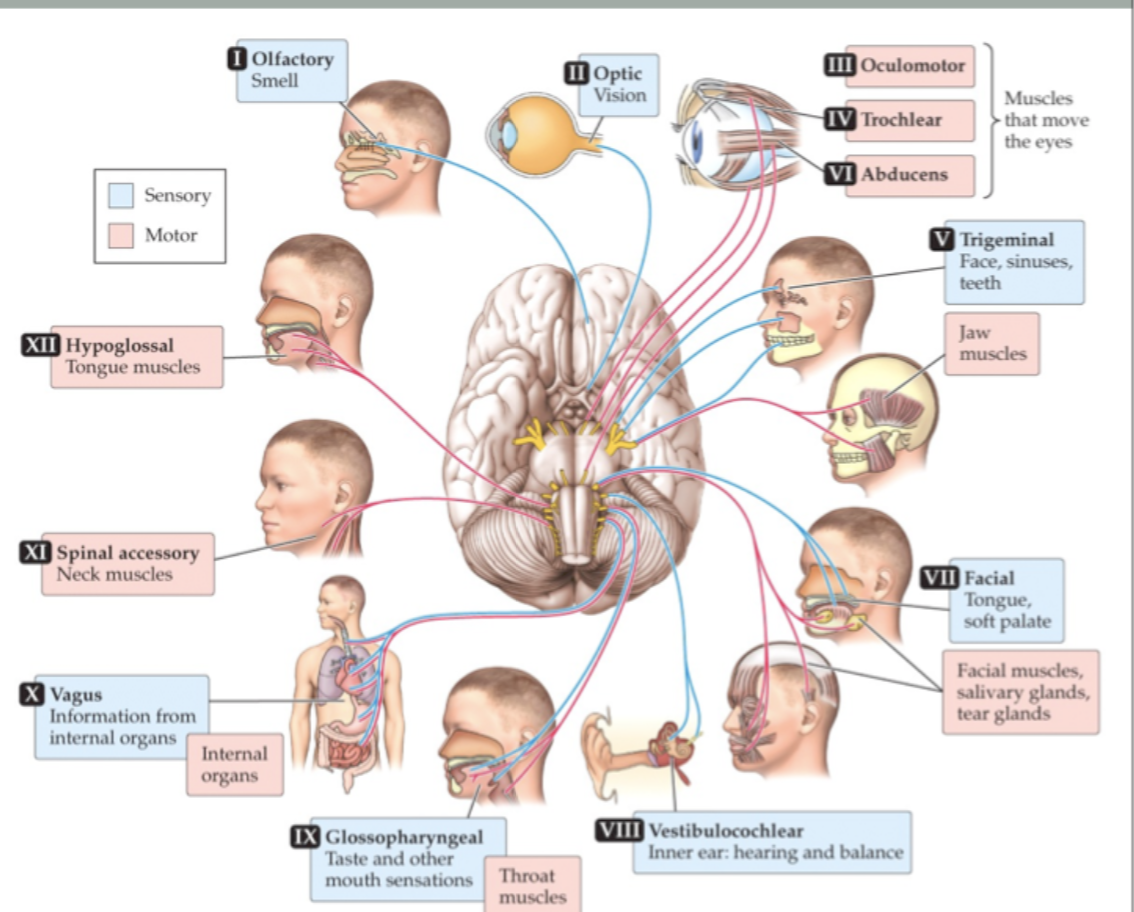
- 59Peripheral nervous systemSomatic NS-Cranial nerves: connected to brain
Somatic NS-Spinal nerves: connected to spinal cord
Autonomic nervous system: control glands and internal organs - 60dorsal (back) root spinal nervesensory
- 61ventral (front) root spinal nervemotor
- 62spinal nervescervical (neck)- 8
Thoracic (trunk)- 12
Lumbar (lower back)- 5
Scaral (pelvic)- 5
Coccygeal (bottom)-1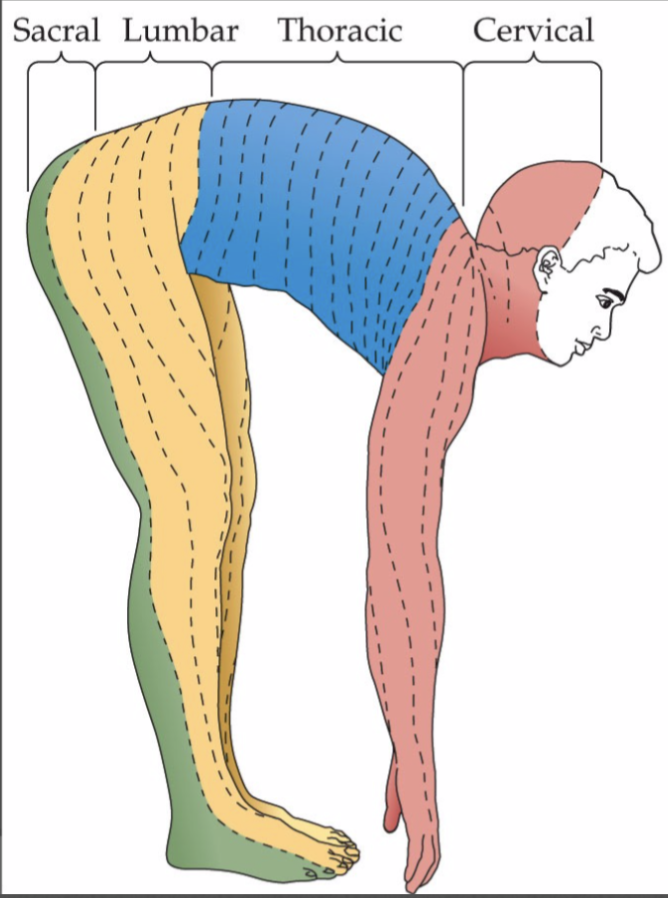
- 63Autonomic nervous systemspans CNS and PNS not subject to conscious, voluntary control
- 64ANSpreganglionic neurons (run form CNS to autonomic ganglia) -> autonomic ganglia (located outside CNS)-> postganglionic neurons (run form autonomic ganglia to targets in the body
- 65Division of ANS: sympathetic nervous systemhas preganglionic neurons only in the spinal cord- they innervate the sympathetic chain )runs along each side of spinal column) prepares body for FIGHT OR FLIGHT
produces norepinephrine to accelerate activity - 66Divisions of ANS: parasympathetic nervous systempreganglionic neurons that arise in cranial nerves & sacral spinal cord
rest and digestion
produces acetylcholine - 67Divisions of ANS: enteric nervous systemlocal network of neurons that governs function in the gut (fluids/nutrients) innervated by sympa/ parasymp dividions
- 68fMRIdetects small changes in brain metabolism
in active areas measured by blood-oxygen-level-dependent signal
good spatial - 69Electroencephalogrammeasures electrical brain activity by placing sensors around scalp. good temporal res.
- 70neurophysiologystudy of the life processes within neurons that use electrical and chemical signals
- 71action potentialrapid electrical signal that travels along the axon of a neuron