
Flashcards
Memory
Cards in this deck (100)
- 1What was the first cognitive explanation of memory?The Multi-Store Model of Memory (MSM).
- 2Who devised the MSM?Atkinson and Shriffin (1968).
- 3How did psychologists attempt to study and explain memory prior to the MSM?Through biological means.
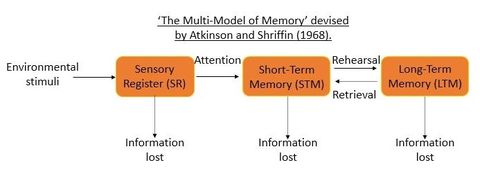
- 4What does the MSM explain?How information flows through a series of storage systems, with three permanent structures:
• Sensory register (SR).
• Short-term memory (STM).
• Long-term memory (LTM). - 5Describe the Multi-Store Model of Memory, including the visual 'flow-chart' design.
- 6What three factors depict how each of the MSM's 3 stages differ from one another?• Coding - the form in which the information is stored.
• Capacity - how much information can be stored.
• Duration - how long information can be stored for. - 7List 4 general facts about the Sensory Register (SR).• Not under cognitive control.
• Automatic response to reception of sensory information, by sense organs.
• First storage system within MSM.
• All information within STM and LTM will have passed through SR. - 8What are the 5 types of coding stores within the Sensory Register?• Iconic (vision).
• Echoic (sound).
• Haptic (touch).
• Gustatory (taste).
• Olfactory (smell). - 9What did Crowder (1993) discover about the coding of the Sensory Register (SR).• Only retains information in iconic store, few milliseconds.
• 2 to 3 seconds within echoic store.
• Supports theory that sensory memory is coded into different sensory stores with different durations. - 10What 2 facts can be said about capacity within the Sensory Register (SR)?• Large.
• Contains unprocessed, highly-detailed, ever-changing information. - 11What did Sperling (1960) discover about the capacity of the Sensory Register?• Used 3x4 grid to flash letters onto screen for one-twentieth second.
• Asked participants to recall letters of one row.
• Information faded quickly, so sounded different pitch tones (high, medium, low) to indicate which row to recall (1st, 2nd, 3rd).
• Recall was high suggesting information was originally there.
• Therefore, capacity is quite large. - 12List 3 facts about duration of the sensory register.• All have limited duration.
• Different people have different duration.
• Decreases with age. - 13What did Treisman (1964) discover about duration within the sensory register?• Presented identical auditory in both ears of participants, slight delay between presentations.
• Participants noticed messages were identical if delay 2 seconds or less.
• Suggests echoic store limited duration of 2 seconds, illustrates difference of duration in iconic store (average 500 milliseconds - Walsh and Thompson). - 14Describe Short Term Memory (STM) (3 points).• Temporarily stores information from SR.
• Active (ever-changing) memory system.
• Contains information currently being thought about. - 15List 3 facts about coding in Short Term Memory.• Information arrives from SR in raw form.
• Then encoded in form STM can more easily process.
• Research suggests main coding form in STM is acoustic. - 16What did Baddeley (1966) discover about coding of Short Term Memory?• 75 participants presented 1 of 4 word lists: A- acoustically similar, B- acoustically dissimilar, C- semantically similar or D- semantically dissimilar.
• Repeated 4 times.
• Later given list original words in wrong order, task to rearrange.
• List A performance worst (10% recall), recall for others relatively good (between 60% and 80%).
• List A recalled least efficiently- acoustic confusion, suggesting STM coded on acoustic basis. - 17What is known of capacity in Short Term Memory?• Capacity is limited.
• Can be increased through chunking. - 18What did Jacobs (1887) discover about capacity in Short Term Memory?• Serial digit span technique (long list of numbers to recall in right order).
• When participants fail 50% of tasks - reached their capacity.
• Number capacity found 9 items and letters 7 items.
• Capacity is very limited (numbers may be easier to recall as only 9 single-digits, compared to 26 letters). - 19What two facts are there are about duration in Short Term Memory?• Maximum 30 seconds.
• Increased through rehearsal. - 20What did Peterson & Peterson (1959) discover about duration in Short Term Memory?• Nonsense trigrams (words 3 letters, not recognisable words e.g. ZFB) read to participants.
• Participants counted backwards in 3's from 300 (to prevent repetition/rehearsal) varying periods of time.
• 90% trigrams recalled correctly after 3 seconds but only 5% after 18 seconds.
• STM duration between 20-30 seconds. - 21List 2 facts about Long Term Memory (LTM).• Storage of information over long periods of time (over 30 seconds to potentially a lifetime).
• Suggested that there are different types of LTM (episodic, semantic, procedural). - 22What can be said about coding within LTM?• Said to be semantic.
• The deeper the level of processing of a stimulus, the more likely it will be recalled. - 23What did Baddeley (1966) discover about coding in LTM?• Tested whether coding was mainly semantic.
• 75 participant, 1/4 lists repeated 4 times. List A (acoustically similar), B (acoustically dissimilar), C (semantically similar) or D (semantically dissimilar).
• 20 minute interval before recall, during which participants performed task to prevent rehearsal.
• List C worst only 55% recall. Others comparatively good at 70%-85%.
• List C suggests semantic confusion, due to coding on semantic basis. - 24What can be said capacity in Long Term Memory (LTM)?• Potential capacity is unlimited.
• May be lost due to decay and interference but not because of limited capacity. - 25What did Wagenaar (1986) discover about capacity in LTM?• Diary of 2400 events over 6 years, tested himself on recall of events (not dates).
• Excellent recall - 75% after one recall, 45% after 5.
• Suggests capacity is limitless. - 26What can be said about duration in Long Term Memory?• Depends on lifespan.
• Longer duration if originally coded well. - 27What did Bahrick (1975) discover about duration of LTM.• Investigated duration of Very Long Term Memory (VLTM).
• 400 participants between ages 17 and 74.
• Shown set of photos and list of names, some ex-school friends.
• Those left high school in last 15 years, identified 90% faces and names, those left in 48 years previously, identified 80% of names and 70% of faces.
• Suggests memory for faces is long lasting (VLTM). - 28Of all the studies focusing on different sections of memory, the negative and positive evaluations are the same, what are they?+ High degree of and experimental validity due to control in lab experiment and procedures are adhered to.
+ High reliability.
- Demand characteristics
- Investigator effects.
- Lack of ecological validity due to lab not replicating real life. - 29What are the overall strengths of the Multi-Store Model (MSM)?+ 1st explanation of memory - very influential, formed basis for other investigations. Had positive impact of research area of cognitive psychology.
+ Considerable research evidence for existence of memory stores. Significant scientific backing.
+ Model supported by amnesia cases - tend to lose either STM or LTM abilities, suggesting separate memory stores. - 30What are 2 criticisms of the Multi-Store Model?- Over-simplified, assumes only single STM and LTM stores. Research like Working Memory Model suggest several types of STM e.g. 1 for visual and 1 for verbal. Disagrees with theory that MSM only has 3 simple storage compartment.
- Cohen (1990), memory capacity cannot be measured purely on amount of information but rather nature of information recalled. Some things easier to recall. Reduces validity of model. - 31Complete the sentence: Research indicates the existence of _______ types of memory, each with a ________ function and associated with different _____ areas.Research indicates the existence of several types of memory, each with a separate function and associated with different brain areas.
- 32Long-term memory can be split into two main types, what are these types and what do they mean?• Explicit (also known as declarative, easy to put into words), recalled only if consciously thought about.
• Implicit (also known as non-declarative, not easy to put into words), don't require conscious thought to be recalled. - 33What are two types of explicit Long Term Memory?• Episodic memory.
• Semantic memory. - 34What is one type of implicit Long Term Memory?• Procedural memory.
- 35What are six facts about episodic memory?• Are specific personal events and their context.
• Gives individuals autobiographical record of personal experiences e.g. birthday.
• Strength of episodic memory influenced by emotions present and degree of processing (thought highly processed memories recalled more easily and helps distinguish real events from delusions) when memory is coded.
• Initial coding liked with prefrontal cortex.
• Memories of different parts of event located in different areas of brain (e.g. olfactory stores) and connected in hippocampus. - 36What is a study that investigates differences in the processing of episodic and semantic memory and what was the method?• Tulving (1989).
• Assessed effectiveness of neuro-imaging when investigating mental processes.
• 6 volunteers injected, small amount of radioactive gold, scanned to detect location with gamma ray detector.
• Participants included Tulving, wife and colleague.
• Each performed 8 successive trials of 80 seconds (4 semantic, 4 episodic topics, randomised order).
• Trials separated by 2 minutes rest each. Participant lay face up, on couch, eyes closed, indulge in episodic or semantic LTM retrieval, involving in silent mental thought.
• Selected topics like to think about - episodic events like a holiday or semantic like general knowledge acquired from a book.
• Gold injected 60 seconds after thinking about topic, scanning occurs about 8 seconds later after gold tracer arrives at brain. Scanning rook 2.4 seconds. - 37What were the findings of this experiment investigating the differences in processing episodic and semantic memory (Tulving 1989)?• Only 3 participants continued experiment. Data from 3 remaining show consistent differences in cortical blood flow patterns between semantic and episodic thinking.
• Greater activation in the frontal lobes of the cortex during thinking of episodic memories and greater activation in the posterior region of the cortex when retrieving semantic information.
• This information depicting separate forms of LTM suggesting a biological basis. - 38What are 3 facts of semantic memory?• Contains all knowledge (facts, concepts, meanings etc.) an individual has learned.
• Are stronger if processed deeply, but seem better sustained over time than episodic memories. Over time, will be a gradual move from episodic to semantic with knowledge becoming increasingly divorced from the event/experience that it was learned from.
• Disagreement over which brain areas involved in semantic LTM, some evidence suggests hippocampus and related areas, while others believe there's usage of several brain areas. - 39Who investigated the locations used for semantic and episodic memories, and whether they differ? What did they find?• Vicari (2007).
• Case study of eight-year-old girl ("CL") suffered brain damage due to removal of tumour.
• Demonstrated deficiencies in episodic LTM, especially creating new episodic memories. but still created and recalled semantic memories.
• Suggests separate systems using different brain areas - hippocampus associated with episodic and the perirhinal cortex with semantic LTM. - 40Give four facts of procedural memory.• Type of implicit memory, permits individuals perform learned tasks little conscious thought e.g. riding bike.
• Difficult to explain in words, classed as non-declarative. Many occur early in life involving learning of motor skills.
• Involved in language, helping speaking automatically. Shows how procedural and semantic memories work together.
• Mainly associated with neocortex brain areas of primary motor cortex, cerebellum and prefrontal cortex. - 41Who investigated the existence of procedural memory and it's separation from episodic and semantic memory? What did they discover?• Finke (2012).
• Case study of 68 year old professional cellist (called "PM"). Brain damage to various brain areas and amnesia after contracting encephalitis.
• Episodic and semantic LTM very affected, couldn't remember facts but ability to read and play music unaffected.
• Evidence suggesting procedural LTM separate to episodic and semantic LTM. - 42Who first theorised the Working Memory Model, when and what was their first question?• Baddeley and Hitch (1974).
• Questioned existence of a single STM, arguing it is more complex than just as a temporary store for information to transfer to LTM.
• STM seen as active store, holding several pieces of information at a time. - 43What was the Working Memory Model?• Proposed multi-component 'working memory' of initially three components.
• Central Executive(CE) at head of model, overseas two 'slave' systems: visuo-spatial sketchpad(VSS) and phonological loop(PL) (temporary stores, process specific types of information.
• 4th component, episodic buffer(EB) added in 2000 to address shortcomings of model. - 44Visually, what does the Working Memory Model look like? Describe the structure.
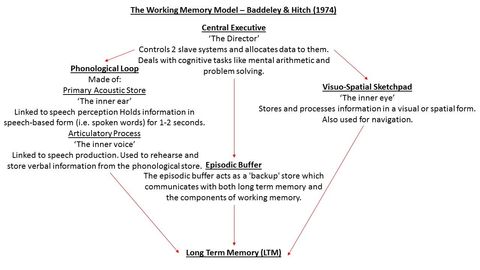
- 45In detail, what is the Central Executive?• Acts as filter to determine information received by sense organs.
• Processes information in all sensory forms, directs information to model's slave systems, collects responses.
• Limited in capacity, only effectively with one strand information at a time.
• Selective attention to particular information, attaining balance between tasks when attention needs to be divided between them e.g. driving.
• Permits to switch attention between different inputs of information. - 46What did Baddeley (1996) discover about the capacity and function of the Central Executive (CE).• Asked participants to generate lists of random numbers while simultaneously switching between pressing numbers and letters on keyboard.
• Participants found it difficult to complete both tasks at once.
• Limited in capacity, can only cope with 1 type of information at a time. - 47In detail, what is the Phonological Loop?• PL deals with auditory information and order of it.
• Limited capacity determined by amount of information spoken out loud in about 2 seconds.
• Mainly acoustic store, confusions occur with acoustically similar words.
• Can divide into 2 sub-parts, primary acoustic store(PAS)/'inner ear' - words recently heard, articulatory process(AP)/'inner voice' - keeping information through sub-vocal repetition. - 48What did Baddeley (1975) discover about the Phonological Loop and it's capacity?• Visual presentations five-word lists for brief exposures and asked participants to write them down in same order.
• One condition, lists consisted of single-syllable English words.
• Second condition, polysyllabic words (2 or more syllables).
• Average correct recall over several trials showed significant increase for short words.
• Concludes capacity of PL determined by length of time it takes to say words rather than by number of items ('word length effect'). - 49In detail, what is the Visuo-spatial Sketchpad (sometimes referred to as 'inner eye')?• Limited capacity, temporary memory system for holding visual and/or spatial information.
• Thought to consist of passive visual store called 'visual cache' (stores information about form and colour) linked to active 'inner scribe' (stores information about physical relationships of items) that acts as visual rehearsal mechanism. - 50What did Klauer and Zhao (2004) discover about the existence• 2 groups, one asked to carry out visual task (e.g. memory for Chinese ideographics)., other group to carry out spatial task (e.g. memory locations dots on screen.
• Simultaneously asked to carry out spatial interference task and then visual interference task.
• Also a no interference control condition.
• Spatial memory task more strongly disrupted by spatial than visual and visual memory by visual.
• Suggests that VSS has distinct visual and spatial compartments. - 51In detail, what is the Episodic Buffer?• Relatively new component (devised in 2000, the model was devised 25 years earlier).
• Became apparent the model needed a general store to operate properly- would store, hold and combine information (not only from VSS, PL and CE but also LTM). - 52What did Alkhalifa (2009) discover about the existence of an Episodic Buffer?• 48 University students presented with numbers on screen given either as a sequence (e.g. 1, 2, 3, 4) or in parallel fashion where participants compare information in different parts of the screen simultaneously.
• Sufficient complexity numbers were used to overwhelm capacities of both PL and VSS.
• Participants answer problem-solving questions. Those presented numbers in sequence had most correct answers.
• Capacity of STM up to 25 items, far exceeding capacity of PL and VSS.
• As sequential processing more effective, suggests total capacity of WM larger than determined by capacity of PL and VSS, implying EB holds items in working memory until they are recalled. - 53What are the strengths of the Working Memory Model?+ Great deal of research to support it. Scientifically supports various components.
+ Extremely influential, most cognitive psychologists use term 'working memory' in preference for STM. Shows how influential model is.
+ More plausible than STM in terms of both temporary storage and active processing. Also incorporates rehearsal as one means of transferring information to LTM rather than the only way. Suggests model is detailed and adds to it's validity. - 54What the weaknesses of the Working Memory Model?- Little is known about the CE, how it works or what it does. This vagueness means it can be used to explain almost any experimental results even though not scientifically test.
- Claims that CE can be divided into sub systems but they haven't yet been identified and it is difficult to determine which processes that control slave systems belong to CE or are of other systems. Demonstrating model can't explain how everything works. - 55What are the 3 theories of forgetting?• Interference theory.
• Proactive interference.
• Retroactive interference. - 56In detail, what is interference theory?• Forgetting information as a result of information in LTM becoming confused or disrupted by other information.
• Can happen during coding, leading to inaccurate recall. - 57In detail, what is proactive interference?• Works forwards in time.
• Occurring when information stored previously interferes with an attempt to recall something new.
• E.g. memory of old phone number disrupts attempts to recall new phone number. - 58In detail, what is retroactive interference?• Works backwards in time.
• Occurring when coding new information disrupts information stored previously.
• E.g. New rules for football moves backward and interferes with the retrieval of old information. - 59What did Schmidt (2000) discover about the influence if retroactive interference on memory?• 700 names randomly selected from 1700 former Dutch elementary students in a database. Sent questionnaire.
• 211 participants responded, ages 11-79 and given map of Molenberg neighborhood (where they had gone to school), 48 street names replaced with numbers, participants asked to remember the names.
• Other details collected by questionnaire included how often moved house, where to, for how long and how often they visited Molenberg. Amount of retroactive interference assessed by number of times individuals moved to other neighborhoods/cities.
• Positive association between number of times participants moved house outside Molenberg and number of street names forgotten.
• Retroactive interference seems to explain the difficulty in recalling older pattern of street names. - 60What are the strengths of interference theory?+ Baddeley & Hitch (1977), rugby players recalled as many teams they had played against that they could. Found the more games played=more forgetful. Supports idea of interference causes memory loss.
+ Abel & Bauml (2013) participants given single list word pairs to learn or two lists to cause interference. Participants tested on memory of lists after 12 hours either wakefulness or sleep. Found sleep reduced both types of interference. Suggests sleep helps strengthen memories and reduce interference, supporting key idea of interference theory. - 61What are the weaknesses of interference theory?- Research tends to use laboratory based tasks and can be accused of not relating to real life.
- Only explains forgetting when 2 sets of information are similar, which doesn't happen very often and so cannot explain forgetting in the majority of real-life settings.
- Studies don't clearly identify cognitive processes at work, reducing its clarity, validity and usefulness. - 62What, in detail, is cue-dependent forgetting (CDF)?• When information still in LTM but can't be accessed.
• CDF sees recall as dependent upon retrieval cues (like labels on files).
• Recall dependent on accessing information, remembering retrieval cue which information is stored under.
• Effectiveness depends on how overloaded it is (fewer number of items associated with it, more effective a cue is), how deep processing of cue was and how well cue fits information associated with it.
• Two main types - Context-dependent failure and State-dependent failure. - 63What is context-dependent failure?• Occurs with external retrieval cues, forgetting occurring when external environment different at recall from how it was at coding.
• E.g. getting fewer marks on test when sitting in unfamiliar room compared to sitting test in usual classroom. - 64What did Godden & Baddeley (1975) discover about context-dependent failure as an explanation if forgetting?• Divers learn new material either on dry land or while underwater.
• Recall worse when occurred in different context to coding than the same context, e.g. words learned under water were recalled better under water.
• Being in same context on learning and recall has positive effect on recall. - 65What, in detail, is state-dependent failure?• Occurs with internal retrieval cues, forgetting occurring when an individual's internal environment is dissimilar at recall to when information .
• E.g. trying to recall information learned when sober when you are drunk. - 66What did Overton (1972) discover about state-dependent failure as an explanation to forgetting?• Participants learned material when either drunk or sober, and then tested when either drunk or sober.
• Recall worse when participants were in different internal state at recall than their internal state at coding, recalling information learned when drunk was better if information had been learned when drunk rather than sober.
• Same state on learning and recall has positive effect on recall. - 67What are the strengths of cue dependent forgetting?+ Godden & Baddeley and Overton found state and context have important role in forgetting. Supports idea cues are essential for memory.
+ Darley (1973) found participants who hid money whilst high on marijuana, less able to recall where money was when not high. Supports state-dependent failure as exploitation of forgetting as state of using marijuana appeared to cause memory loss.
• Tulving & Pearlstone (1966), participants given list, 48 words to learn, organised into 12 categories of 4 words each with headings. Given headings act as cues (cued recall condition) and recalled more with an than without (free recall condition). Supports idea that lack of retrieval cue (category headings) leads to forgetting. - 68What are the weaknesses of cue dependent forgetting?- Studies often lab based, not everyday memory tasks, such as ability to perform learned skill like riding a bike which uses procedural memory. Suggests explanation can only explain forgetting in certain parts of memory.
- Smith (1979) said just thinking of cue can work as effectively as actually being in room. Suggests cue can be imaginary and doesn't have to be 'real' as theory suggests. - 69How important is eyewitness testimony and why?• Guilt in courts of law often depends upon the accuracy of memories of eyewitnesses.
• Jurors often find EWT vitally important in decisions. - 70Fill the blanks: In __% of cases where individuals found by DNA evidence to be wrongly convicted, original guilty verdict was based on inaccurate EWT. As seen in the 1985 case of ______ _____.In 75% of cases where individuals found by DNA evidence to be wrongly convicted, original guilty verdict was based on inaccurate EWT. As seen in the 1985 case of Steven Avery.
- 71The way we form memories in influenced by, what?Schemas.
- 72What did Bartlett (1932) comment on memory?• Memories are not accurate 'snapshots' of events, but are 'reconstructions'.
• Influenced by active schemas - ready made expectations based on previous experiences moods, existing knowledge, contexts, attitudes and stereotypes.
• Helps makes sense of world by 'filling gaps' and simplifying processing of info.
• This reconstruction can lead to false memories. - 73What was Bartlett's (1932) research illustrating the influence of cultural schemas?• Western cultural participants told Navajo Indian story 'The War of the Ghosts'.
• Story didn't make sense from their cultural viewpoint.
• Their memory of story became distorted, with details changed to fit Western cultural viewpoint. - 74What are two factors affecting EWT?• Misleading information.
• Anxiety. - 75What is the effect of misleading information of EWT?• EWT often affected by experiences occurring after witnessed event.
• Key factor is use of misleading, suggestive questions and post-event discussion. - 76Loftus and Palmer (1974) conducted two experiments looking at misleading information in EWT. What was the aim of both of these experiments.To assess the extent to which participants estimate speed of cars involved in accidents witnessed on video could be influenced by misleading questions.
- 77What was Loftus and Palmer's method in their first experiment?• 45 students shown clips of traffic accidents.
• Asked series of questions about film including 'about how fast were the cars going when they .... into each other'.
• Missing verb either; smashed; collided; hit; bumped or contacted. - 78What were the results of Loftus and Palmer's first experiment?• As intensity of verb used increased, so did estimation of speed of cars.
• Mean speed in mph: contacted=31.8, hit=34.0, bumped=38.1, collided=39.3 and smashed=40.8.
• Concluded misleading information in form of leading questions can affect memory recall of eyewitnesses. - 79What was the method for Loftus and Palmer's second experiment?• 150 participants shown short film of car accident (that didn't include any broken glass).
• Some participants asked 'how fast were cars going when they smashed into each other?'.
• Other asked same question but with word 'hit'.
• 1 week later, given questionnaire including question 'did you see any broken glass'. - 80What were the results of Loftus and Palmer's second experiment?• Participants twice as likely in 'smashed' condition to recall false memory of broken glass.
• In 'yes' to broken glass, results were: 'smashed'=16, 'hit'=7 and control=6.
• In 'no' to broken glass, results were: 'smashed'=34, 'hit'=43 and control=44.
• Concluded misleading information in form of post-event information can affect memory recall of eyewitnesses. - 81What are 3 strengths in evaluation of leading questions being a factor affecting EWT?+ Loftus and Palmer experiments show clear support that misleading questions and post-event info can lead to distorted memories.
+ Loftus and Pickerill (1995), 24 participants aged 18-53, four stories about childhoods (from relatives), 3/4 were true. False involved being lost in department store aged five and rescued by elderly lady before returned to family. Participants asked what they could remember about these incidents (68% true incidents recalled, 29% false ones). Implies false memories created by suggestion.
+ Tomes and Katz (1997) found individuals identify with others' moods, score highly on measures of imagery vividness and have poor recall are more affected by misleading questions. Implies personality factors influence EWT too rather than just questions. - 82What are 2 weaknesses in the evaluation of leading questions being a factor affecting EWT?- Research often carried out in lab setting. Ecological validity low as cannot be sure participants would behave same way in real-life situation.
- Foster (1994) showed EWT more accurate for real-life crimes as opposed to simulations, suggests low validity to theory as maybe doesn't apply to real-life and therefore legal court situation as previously thought. - 83What is the influence of anxiety on EWT?Real-life events (although often not simulations) such as violent crimes often have a high anxiety context that can greatly affect recall.
- 84What was the aim of Loftus' (1979) study?To investigate the effect of anxiety on EWT.
- 85What was the method for Loftus' (1979) study?• Participants asked to sit outside lab, believing they were overheating genuine exchanges of people inside.
• One condition, overheard amicable discussion about equipment failure. Man with greasy hands and holding a pen, witnessed to leave lab.
• Other condition, heard hostile discussion and man emerged holding knife, covered in blood. Following these events, participants given 50 photos and asked to identify man who had come out of lab. - 86What were the results for Loftus' (1979) study?• Participants in pen condition more accurate in recognising man (49%).
• Knife condition was only 33% accuracy.
• Concluded that anxiety was caused by knife which was said to take away attention from face (weapon focus). - 87What are 3 strengths for evaluating anxiety as a factor affecting EWT?+ Loftus study shows clear support for idea that anxiety influences EWT as when anxiety (knife) was present, accuracy of recall reduced.
+ Loftus and Burns (1982) found participants shown violent version of crime in which boy was shot in face, significantly impaired recall for events compared to those seen non-violent version. Negative impact on memory.
+ Deffenbacher (2004), meta-analysis found high levels of anxiety had negative impact on accuracy of crime-related details, including details of perpetrator. Showing violence with variety of violent behaviours decreases EWT in more ways than one. - 88What are 2 weaknesses for evaluating anxiety as a factor affecting EWT?- Research is lab based. Yuille and Cutshall (1986) interviewed with leading questions, 13 witnesses to actual violent crime, four months after event and found recall very accurate. Suggests anxiety might not have same impact on real-life witnesses. Decreasing ecological validity.
- Christianson and Hubinette (1993) carried out survey of 110 witnesses of bank robberies. Threatened victims showed more detailed and accurate recall than onlookers. Suggests real life incidents involving stress can give accurate, detailed and long-lasting memories. - 89A suggestion of how to improve EWT is to eliminate leading questions from police investigation. What did Fisher et al (1987) look for and then find when investigating this?• Whether interview techniques need to be improved.
• Over 4 months, studied real interviews (aka Standard Interviews) conducted by Floridian, experienced detectives.
• Found witnesses bombarded with series of brief, direct and closed questions aimed to elicit facts.
• Also found sequence of questions seemed 'out of sync' with witness' own mental representation of event.
• Witness often interrupted and not allowed to talk freely. - 90Why did Fisher find the techniques of Standard Interview unhelpful?• Broke concentration of witness.
• Encouraged shorter, less detailed answers. - 91In 1992, Fisher and Geidelman devised a technique to improve eyewitness recall during police investigation. What was this technique called?The Cognitive Interview.
- 92Fisher and Geiselman (1992) devised four components to enhance accurate recall with the cognitive interview. What were these?• Context reinstatement(CR), mentally reinstate context of event, recall scene, weather, thoughts and feelings at time.
• Report everything(RE), report every detail possible even if seems trivial/irrelevant.
• Recall from changed perspective(CP), describe episode if seen from different points of view.
Recall in reverse order(RO), change order of recall so event reported in different orders moving backwards and forwards in time. - 93What was the intended purpose of the cognitive interview, how was it supposed to improve EWT?• Designed to enhance retrieval of original memory.
• Done by providing extra cues that may prompt witness' memory for more details. - 94What was the aim of Geiselman and Fisher's (1997) study?Investigate the effectiveness of the Cognitive Interview by comparing it to other means to acquire eyewitness testimony.
- 95What was the method of Geiselman and Fisher's (1997) study?• 89 participants shown police training films simulating violent crimes.
• 48 hours later, interviewed about films by experienced, LA police officer.
• Used either cognitive interview, standard police interview or interview using hypnosis.
• Interviews recorded and eyewitness reports assessed for correct and incorrect responses. - 96What were the findings of Geiselman and Fisher's (1997) study?• Found cognitive interview elicited most accurate recall, followed by hypnosis and then standard interview.
• No significant difference in number of errors made.
• Concluded similarity of results for CI and hypnosis due to two techniques having similar components such as report everything.
• Standard interview worse because of repeated focus encouraging recall of key info without aids to memory retrieval. - 97What is the Enhanced Cognitive Interview?• Subsequent research had led to this version of cognitive interview.
• After studying current police practice through detailed analysis of taped interviews, Fisher added several extra features. - 98What were the added features of the Enhanced Cognitive Interview?• Interviewer not to distract witness with unnecessary interruptions/questions.
• Witness controls flow of info.
• Open-ended questions.
• Get witness to speak slowly.
• Participants reminded not to guess or to use 'don't know' when necessary, in order to reduce confabulations(false memories).
• Reduce anxiety in witnesses. - 99In evaluating cognitive interview, what are 3 strengths?+ Geiselman and Fisher's (1997) research found CI greatly improves EWT accuracy. Suggests higher validity than standard interview.
+ Fisher et al(1999) trained detectives to use enhanced CI techniques with genuine crime witnesses and found significant increase in volume of info recorded, suggesting high validity and usefulness in this method.
+ CI was modified (MCI), meaning people such as children and those with learning difficulties can be interviewed effectively making positive practical applications. - 100In evaluating cognitive interview, what are 2 weaknesses.- Practical problem, time-consuming. Often requires more time than officers have operational time for. May be useful but unlikely to be used a great deal.
- Practical problem, generally not effective as form of memory- enhancement in regards to recognition of suspects in identity parades and photographs. Reduces validity and usefulness as identity parades still often used with police.
Information
- Description
- AS - Level Psychology Flashcards on Memory, created by Emma Chell on 09/12/2016.
- Created by
- Emma Chell
- Views
- 4
- Tags
- Rating