
Flashcards
Memory Studies and Terms
Cards in this deck (56)
- 1Episodic MemoryA long term memory store for personal events. It includes memories of when the events occurred and of the people, objects, places and behaviours involved. Memories from this store have to be retrieved consciously and with effort.
- 2Semantic MemoryA long- term memory store for our knowledge of the world. This includes facts and out knowledge of what words and concepts mean. These memories usually also need to be recalled deliberately.
- 3Procedural MemoryA long- term memory store for our knowledge of how to do things. This includes our memories of learned skills. We usually recall these memories without making a conscious or deliberate effort.
- 4Who proposed the three types of long term memoryTulving in 1972 he criticised the MSM because he felt there wasn't just one LTM
- 5Tulving 1989 Study- Injected radioactive gold into his own bloodstream, then recalled semantic or episodic memory, while scanners monitored his blood flow.
- Results: Two distinct memory stores - Episodic(front of brain) Semantic (Back of Brain)
- Can't generalise findings - 6Corkin (1968)- Case Study HM - investigated ability of people to acquire new motor skills in a person with amnesia.
-Method: HM's memory so bad he couldn't remember new information. Trained to carry out a task which involved tracking or following a curvy line on rotating disk over several days. - 7Corkin - 1968- ResultsHe found that HM's ability was poor at first but improved with practice. After several days he had no conscious memory of his first lesson, but his performance was just as good. So he retained procedural but not episodic memory.
- 8Corkin- 1968 - ConclusionHM unable to acquire any new declarative knowledge, but able to learn and retain new motor skills. Supporting the idea that declarative and non- declarative are different memory stores.
- 9Clive Wearing (Case Study)Suffer from severe amnesia (infection)
Was a world class musician and can still play piano now but doesn't remember his musical education.
Remembers he has a wife but forgets he has seen her overtime.
Procedural/semantic memory unharmed. - 10Evaluation of case studiesCant be generalised
Lack of Control over variable- bad internal validity - 11CodingThe format in which information is stored in the various memory stores
- 12CapacityThe amount of information that can be held in a memory store
- 13DurationThe length of time information can be held in the memory
- 14Study into coding-Baddeley- 4 groups of words to learn
Acoustically similar worse recall immediately
Semantically similar worse after 20 minutes.
Info is coded semantically in LTM - 15Studies into capacity- Jacobs (digit span) : asked people to recall numbers and digits until they couldn't anymore (list got bigger)
- Found that mean digit span :9.3
Mean letter span : 7.3
Miller: Suggested that capacity for STM to remember is 7+/- 2 (can remember 5 numbers as well as 5 letters- by chunking) - 16chunkinggrouping sets of digits or letters into units or chunks
- 17Research on duration of STMPeterson and Peterson- 24 undergrad students - asked PPS to remember consonant syllable and also 3 digit number that they were asked to count backwards till asked to stop (stop maintenance rehearsal)
- PPS were asked to stop at different amounts of time ( found the longer time the worse recall) - 18Research on duration of LTMBahrick - yearbooks- 392 pps-
17-74 year
free recall/ photo recognition
after15 years- photo recognition 90% 48 years- photo recognition 70%
free recall 15 years- 60%
Free recall 48 years- 30% - 19Who thought of the MSMAtkinson and Shiffrin
- 20What are the three parts of the MSMSensory registor (unlimited cap/short duration/attention)
STM- Limited capacity/7+/- 2 / chunking/ maintenance rehearsal to LTM
LTM- potentially unlimited/permanent/ coded semantically - 21Who proposed the WMMBaddeley and Hitch
1974 - 22What is the episodic buffer- Type of slave system - added later in 2000
Seen as a temporary store for information- integrating visual/spatial/verbal
Info processed by other stores basically recording events - 23What is the central executiveMonitors incoming data, makes decisions and allocates slaves systems to tasks- limited storage capacity
- 24What is the phonological loopSlave System - Two parts
Phono store- stores the words you hear
Articulatory process- Allows maintenance rehearsal (2 second capacity worth of what you say) - 25What is the visuo spatial sketchpadSlave System- stores visual and spatial information. Logie divided VSS into :
visual cache- stores visual data
Inner scribe- records the arrangement of objects in the visual field. - 26Interference TheoryMemory can be disrupted not only be previous learning but also by what is learned in the future
- 27Proactive InterferenceOlder memories interfere with new ones
- 28Retroactive interferenceNew memories interfere with older one
- 29Study on Effects of similarityMcGeoch and McDonald
- Studied retroactive interference - 2 sets of materials.
PPS had to learn list of words 100% accuracy- Then learn a new list. - 30What were the 6 lists in the Mcgeoch and McDonald study1. Synonyms
2.Antonyms
3.Unrelated words to original
4. Nonsense syllables
5. 3 digit numbers
6. No new list- pps just rested. - 31Findings from Mcgeoch and McDonald StudyWhen the first list was recalled- PPS performance was worse when synonyms - showing interference is stronger when words are similar.
- 32What is retrieval FailureType of forgetting that occurs when we don't have necessary cues to access memory.
- 33State Dependent forgetting studyCarter and Cassaday :
- Antihistamine Drugs- different psychological state.
- PPS had to learn list of words while on or off drugs + recall on / off.
When recall was different to coding recall was worse. - 34Context Dependent Forgetting StudyGodden and Baddeley
- Sea Divers: List of words learnt - then recalled underwater or on land.
Recall was 40% lower in non matching conditions. - 35What is the encoding specificity principleTulving discovered that for a cue to help us to remember it has to be present at coding and retrieval.
- 36Evaluate Retrieval Failure- Many studies support it.
- However, Baddeley argues context dependent not as strong / bc land and water so different other environments may not have as large an effect.
- Recall/ context dependent / when recall was used no difference between land/water on recall.
- Real Life application
ESP cannot be tested / we can't test if a cue has been encoded. - 37Evaluate Interference TheoryEvidence from lab studies
Low ecological validity
Real life studies: Rugby player study (time not different / amount of matches changed recall)
Interference effect is overcome using cues
( Tulving and Pstoka) - 38What are leading questionsA question which because of the way it is phrased, suggests a certain answer
- 39Study on leading questionsLoftus and Palmer:
- Students watched films of car accidents: asked them Q's about it
' About how fast was the car going when they HIT each other?'
- 5 different groups and 5 different verbs: Hit, contacted, bumped, collided, smashed.
Found when contacted used - mean speed (31.8mph) when smashed (40.5mph) - 40Evaluate leading questionsreal life application - police interviews
- Artificial tasks: film clips of car accidents - lack of stress these emotions may influence memory.
- Individual differences- evidence to show older people worse at recall than younger people. - 41Why do leading questions effect EWT?Response bias explanation : Doesn't effect memories but influences how people decide.
Substiution explanation: Loftus and Palmer did experiment proving that leading Q changes memory, because when pps heard 'smashed' more likely to report seeing broken glass - 42What is post event discussionWhen witnesses discuss event influencing accuracy of recall.
- 43Study into post event discussionGabbert et al:
Studied PPS in pairs - They watched clips of a crime from different points.
Then PPS discussed.
71% inaccurately recalled aspects of event they had picked up from other PPS.
- control group- no discussion- 0%.
Gabbert thought people go along with each other to win social approval or because they believe them to be right - memory conformity. - 44Evaluate Post event discussionZaragosa and McCloskey argue that answers in lab studies could be due to demand characteristic.
Foster et al- said that when you actually remember things for EWT it has serious consequences in the world/ this is not the case for lab studies - 45What is anxietyA state of emotional and physical arousal/ including having worried thoughts or feelings
- 46Study: Anxiety has a negative effect on recallJohnson and Scott:
Two rooms: pps thought taking place in lab study
- argument through door in each condition:
low anxiety condition: argument/ man walks out with greasy pen
High anxiety condition: argument/ glass smashed/ man walks out with bloody plastic knife. - 47findings : Johnson and ScottPPS had to pick a man from 50 photos
- 49% could idenitfy in low anxiety
- 33%- high anxiety - 48Anxiety : positive effect on recall - studyYuille and Cutshall
- Real shooting in Vancouver :
13 witnesses took part in study- had interviews 4-5 months later after police interviews carried out.
witnesses also asked how stressed they felt at the time using a 7- point scale. - 49FindingsWitnesses accurate in accounts and little difference from before.- Those recoded highest levels of stress were more accurate.
85% - more stressed
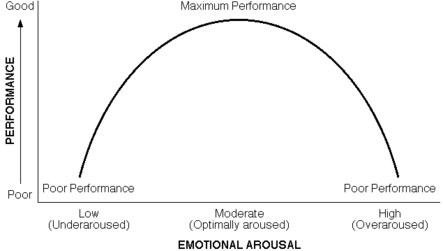
75% recall accuracy - less stressed - 50Explain the contradictory findingsYerkes and Dodson argued that the findings are different because anxiety and recall is an inverted U
- 51Evaluate anxiety in EWT- Inverted U is reductionist- other aspects may affect anxiety.
- Ethical issues- Johnson and Scotts study could have caused PPS with psychological harm.
- Weapon focus may not be relevant- The study may have been testing surprise not anxiety ( chicken in hairdressers)
-Field studies lack control- interviews carried out later so had no control over pps in that time. - 52Who proposed the cognitive interviewFisher and Geiselman
- 53What is the cognitive interviewIt is a method of interviewing eyewitnesses to help them retrieve more accurate memories.
- 54What are the 4 techniques in the cognitive interview1- Report Everything
2- Reinstate the context
3- Reverse the order
4- Changed perspective - 55What is enhanced cognitive interviewCognitive interview with some additional elements added by Fisher: focuses on the social dynamics of interaction. e.g. interviewer knowing when to make eye contact/ reducing witnesses anxiety and minimising distractions.
- 56Evaluate the cognitive interview- Time consuming/ not enough time for proper training
- Kohnken et al: Meta analysis of 50 studies- found that ECI provided more correct info than standard interviews.
- CI creates an increase of inaccurate info (Kohnken) - 81% accurate / 61% inaccurate
- Milne and Bull- combination of report everything and reinstate context produced better recall than other conditions/ good because police don't have to use all aspects/ less time consuming.
Information
- Description
- A2 Psychology Flashcards on Memory Studies and Terms, created by Emily Cons on 04/04/2017.
- Created by
- Emily Cons
- Views
- 3
- Rating