
Mind map
Memory - Key research
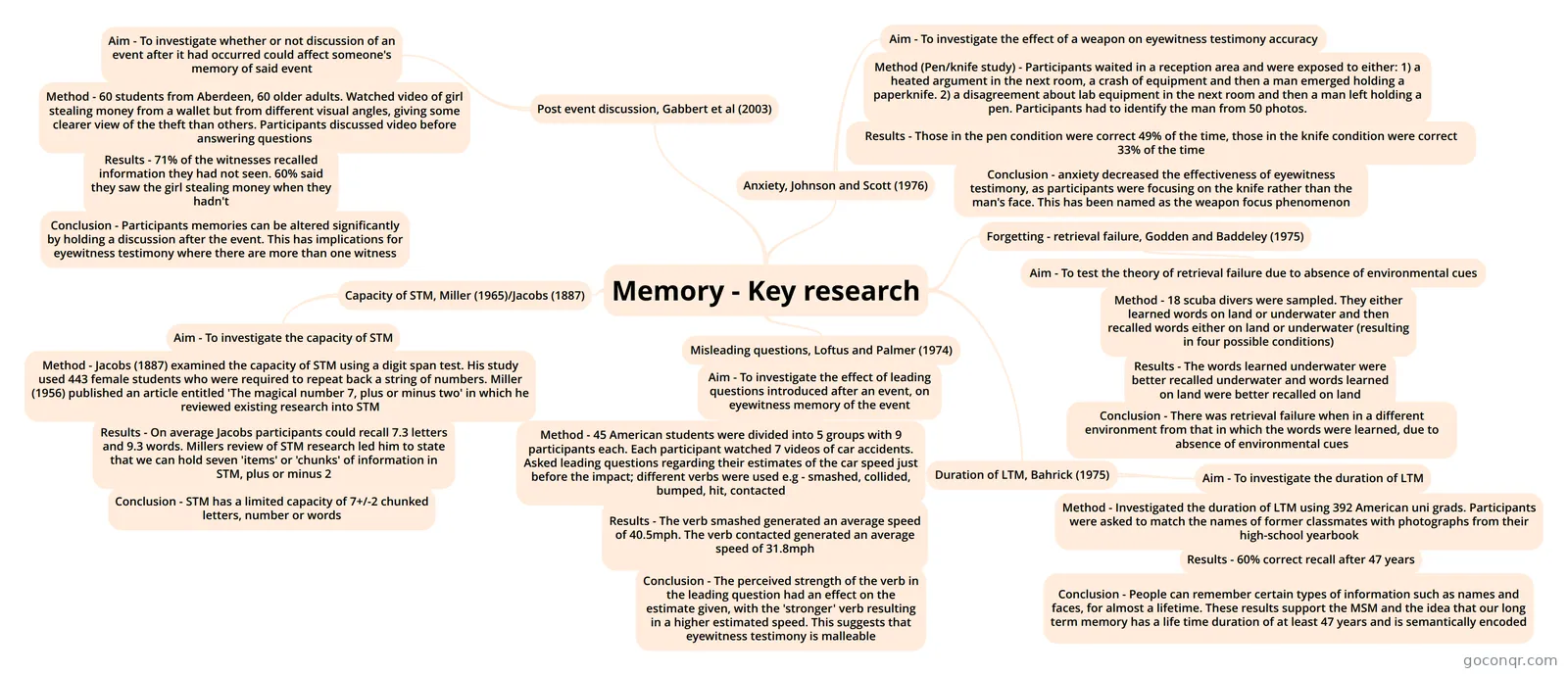
Mind map: Memory key research
Map content
Memory - Key research
Anxiety, Johnson and Scott (1976)
- Aim - To investigate the effect of a weapon on eyewitness testimony accuracy
- Method (Pen/knife study) - Participants waited in a reception area and were exposed to either: 1) a heated argument in the next room, a crash of equipment and then a man emerged holding a paperknife. 2) a disagreement about lab equipment in the next room and then a man left holding a pen. Participants had to identify the man from 50 photos.
- Results - Those in the pen condition were correct 49% of the time, those in the knife condition were correct 33% of the time
- Conclusion - anxiety decreased the effectiveness of eyewitness testimony, as participants were focusing on the knife rather than the man's face. This has been named as the weapon focus phenomenon
- Results - Those in the pen condition were correct 49% of the time, those in the knife condition were correct 33% of the time
- Method (Pen/knife study) - Participants waited in a reception area and were exposed to either: 1) a heated argument in the next room, a crash of equipment and then a man emerged holding a paperknife. 2) a disagreement about lab equipment in the next room and then a man left holding a pen. Participants had to identify the man from 50 photos.
- Aim - To investigate the effect of a weapon on eyewitness testimony accuracy
Forgetting - retrieval failure, Godden and Baddeley (1975)
- Aim - To test the theory of retrieval failure due to absence of environmental cues
- Method - 18 scuba divers were sampled. They either learned words on land or underwater and then recalled words either on land or underwater (resulting in four possible conditions)
- Results - The words learned underwater were better recalled underwater and words learned on land were better recalled on land
- Conclusion - There was retrieval failure when in a different environment from that in which the words were learned, due to absence of environmental cues
- Results - The words learned underwater were better recalled underwater and words learned on land were better recalled on land
- Method - 18 scuba divers were sampled. They either learned words on land or underwater and then recalled words either on land or underwater (resulting in four possible conditions)
- Aim - To test the theory of retrieval failure due to absence of environmental cues
Duration of LTM, Bahrick (1975)
- Aim - To investigate the duration of LTM
- Method - Investigated the duration of LTM using 392 American uni grads. Participants were asked to match the names of former classmates with photographs from their high-school yearbook
- Results - 60% correct recall after 47 years
- Conclusion - People can remember certain types of information such as names and faces, for almost a lifetime. These results support the MSM and the idea that our long term memory has a life time duration of at least 47 years and is semantically encoded
- Results - 60% correct recall after 47 years
- Method - Investigated the duration of LTM using 392 American uni grads. Participants were asked to match the names of former classmates with photographs from their high-school yearbook
- Aim - To investigate the duration of LTM
Misleading questions, Loftus and Palmer (1974)
- Aim - To investigate the effect of leading questions introduced after an event, on eyewitness memory of the event
- Method - 45 American students were divided into 5 groups with 9 participants each. Each participant watched 7 videos of car accidents. Asked leading questions regarding their estimates of the car speed just before the impact; different verbs were used e.g - smashed, collided, bumped, hit, contacted
- Results - The verb smashed generated an average speed of 40.5mph. The verb contacted generated an average speed of 31.8mph
- Conclusion - The perceived strength of the verb in the leading question had an effect on the estimate given, with the 'stronger' verb resulting in a higher estimated speed. This suggests that eyewitness testimony is malleable
- Results - The verb smashed generated an average speed of 40.5mph. The verb contacted generated an average speed of 31.8mph
- Method - 45 American students were divided into 5 groups with 9 participants each. Each participant watched 7 videos of car accidents. Asked leading questions regarding their estimates of the car speed just before the impact; different verbs were used e.g - smashed, collided, bumped, hit, contacted
- Aim - To investigate the effect of leading questions introduced after an event, on eyewitness memory of the event
Post event discussion, Gabbert et al (2003)
- Aim - To investigate whether or not discussion of an event after it had occurred could affect someone's memory of said event
- Method - 60 students from Aberdeen, 60 older adults. Watched video of girl stealing money from a wallet but from different visual angles, giving some clearer view of the theft than others. Participants discussed video before answering questions
- Results - 71% of the witnesses recalled information they had not seen. 60% said they saw the girl stealing money when they hadn't
- Conclusion - Participants memories can be altered significantly by holding a discussion after the event. This has implications for eyewitness testimony where there are more than one witness
- Results - 71% of the witnesses recalled information they had not seen. 60% said they saw the girl stealing money when they hadn't
- Method - 60 students from Aberdeen, 60 older adults. Watched video of girl stealing money from a wallet but from different visual angles, giving some clearer view of the theft than others. Participants discussed video before answering questions
- Aim - To investigate whether or not discussion of an event after it had occurred could affect someone's memory of said event
Capacity of STM, Miller (1965)/Jacobs (1887)
- Aim - To investigate the capacity of STM
- Method - Jacobs (1887) examined the capacity of STM using a digit span test. His study used 443 female students who were required to repeat back a string of numbers. Miller (1956) published an article entitled 'The magical number 7, plus or minus two' in which he reviewed existing research into STM
- Results - On average Jacobs participants could recall 7.3 letters and 9.3 words. Millers review of STM research led him to state that we can hold seven 'items' or 'chunks' of information in STM, plus or minus 2
- Conclusion - STM has a limited capacity of 7+/-2 chunked letters, number or words
- Results - On average Jacobs participants could recall 7.3 letters and 9.3 words. Millers review of STM research led him to state that we can hold seven 'items' or 'chunks' of information in STM, plus or minus 2
- Method - Jacobs (1887) examined the capacity of STM using a digit span test. His study used 443 female students who were required to repeat back a string of numbers. Miller (1956) published an article entitled 'The magical number 7, plus or minus two' in which he reviewed existing research into STM
- Aim - To investigate the capacity of STM
Information
- Description
- A level Psychology Mind Map on Memory - Key research, created by gee nash on 07/11/2017.
- Created by
- gee nash
- Views
- 0
- Rating