
Mind map
2.6.1 Data storage and recovery systems
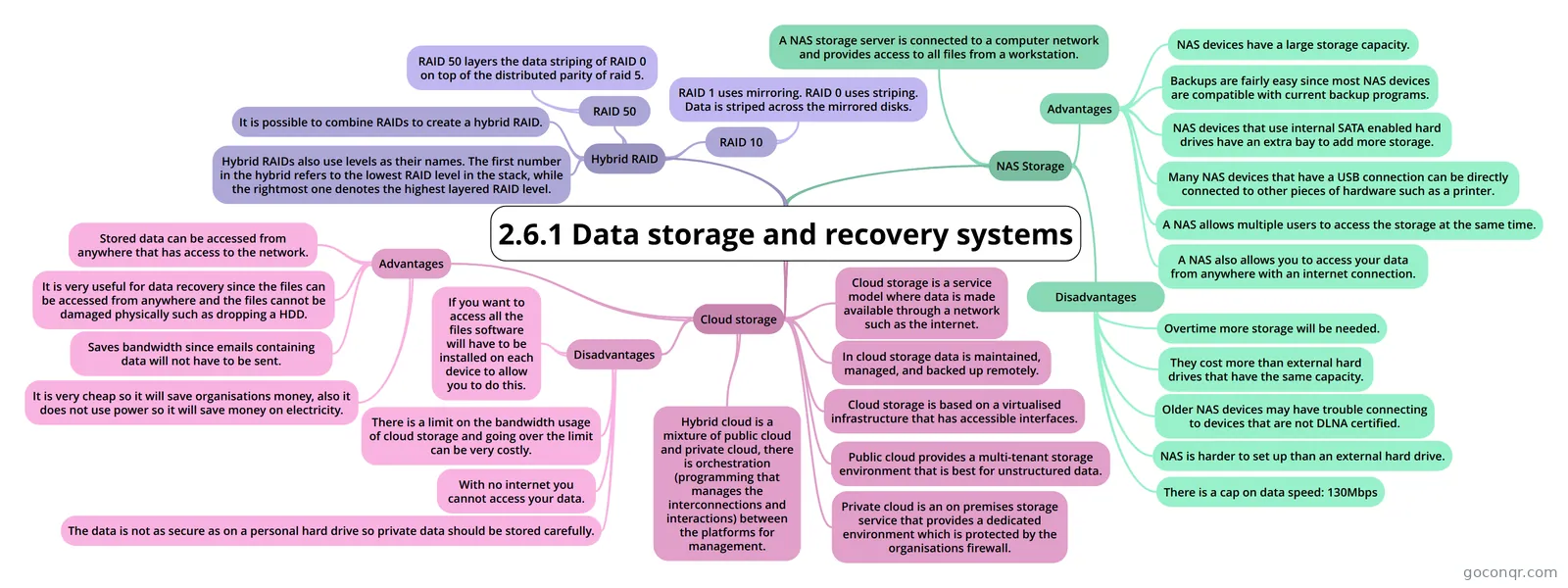
Mind map: Data storage and recovery systems
Map content
2.6.1 Data storage and recovery systems
Hybrid RAID
- It is possible to combine RAIDs to create a hybrid RAID.
- Hybrid RAIDs also use levels as their names. The first number in the hybrid refers to the lowest RAID level in the stack, while the rightmost one denotes the highest layered RAID level.
- RAID 50
- RAID 50 layers the data striping of RAID 0 on top of the distributed parity of raid 5.
- RAID 10
- RAID 1 uses mirroring. RAID 0 uses striping. Data is striped across the mirrored disks.
NAS Storage
- A NAS storage server is connected to a computer network and provides access to all files from a workstation.
- Advantages
- Backups are fairly easy since most NAS devices are compatible with current backup programs.
- NAS devices have a large storage capacity.
- NAS devices that use internal SATA enabled hard drives have an extra bay to add more storage.
- Many NAS devices that have a USB connection can be directly connected to other pieces of hardware such as a printer.
- A NAS allows multiple users to access the storage at the same time.
- A NAS also allows you to access your data from anywhere with an internet connection.
- Disadvantages
- Overtime more storage will be needed.
- They cost more than external hard drives that have the same capacity.
- Older NAS devices may have trouble connecting to devices that are not DLNA certified.
- NAS is harder to set up than an external hard drive.
- There is a cap on data speed: 130Mbps
Cloud storage
- Cloud storage is a service model where data is made available through a network such as the internet.
- In cloud storage data is maintained, managed, and backed up remotely.
- Cloud storage is based on a virtualised infrastructure that has accessible interfaces.
- Public cloud provides a multi-tenant storage environment that is best for unstructured data.
- Private cloud is an on premises storage service that provides a dedicated environment which is protected by the organisations firewall.
- Hybrid cloud is a mixture of public cloud and private cloud, there is orchestration (programming that manages the interconnections and interactions) between the platforms for management.
- Advantages
- Stored data can be accessed from anywhere that has access to the network.
- It is very cheap so it will save organisations money, also it does not use power so it will save money on electricity.
- Saves bandwidth since emails containing data will not have to be sent.
- It is very useful for data recovery since the files can be accessed from anywhere and the files cannot be damaged physically such as dropping a HDD.
- Disadvantages
- There is a limit on the bandwidth usage of cloud storage and going over the limit can be very costly.
- With no internet you cannot access your data.
- The data is not as secure as on a personal hard drive so private data should be stored carefully.
- If you want to access all the files software will have to be installed on each device to allow you to do this.
Information
- Description
- BTEC BTEC Computing (Unit 2) Mind Map on 2.6.1 Data storage and recovery systems, created by Destiny Hood on 19/11/2017.
- Created by
- Destiny Hood
- Views
- 1
- Rating