
Mind map
Neural and Hormonal Mechanisms
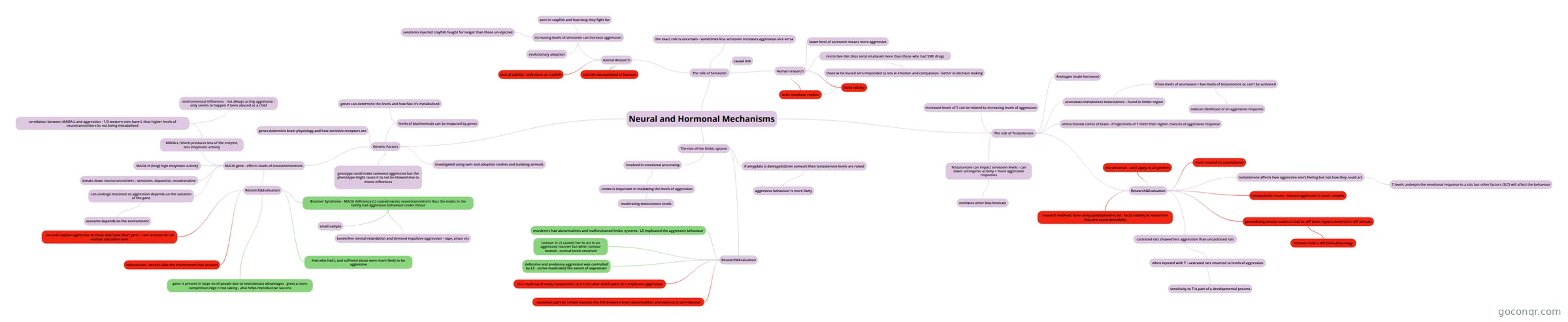
Mind map: Neural and Hormonal Mechanisms
Map content
Neural and Hormonal Mechanisms
The role of the limbic system
- involved in emotional processing
- cortex is important in mediating the levels of aggression
- moderating testosterone levels
- cortex is important in mediating the levels of aggression
- if amygdala is damaged (brain tumour) then testosterone levels are raised
- aggressive behaviour is more likely
- Research&Evaluation
- defensive and predatory aggression was controlled by LS - cortex moderated the extent of expression
- murderers had abnormalities and malfunctioned limbic systems - LS implicated the aggressive behaviour
- tumour in LS caused her to act in an aggressive manner but when tumour treated - normal levels returned
- LS is made up of many components so it's not clear which parts of it implicates aggression
- causation can't be certain because the link between brain abnormalities and violence is correlational
- involved in emotional processing
The role of Serotonin
- the exact role is uncertain - sometimes less serotonin increases aggression vice versa
- Animal Research
- increasing levels of serotonin can increase aggression
- seen in crayfish and how long they fight for
- serotonin injected crayfish fought for longer than those un-injected
- evolutionary adaption
- can't be extrapoliated to humans
- lack of validity - only done on crayfish
- increasing levels of serotonin can increase aggression
- Human research
- lower level of serotonin means more aggressive
- restrictive diet (less sero) retaliated more than those who had SSRI drugs
- those w increased sero responded to situ w emotion and compassion - better in decision making
- lacks mundane realism
- lacks validity
- causal link
The role of Testosterone
- Androgen (male hormone)
- increased levels of T can be related to increasing levels of aggression
- aromatase metabolises testosterone - found in limbic region
- if low levels of aromatase = low levels of testosterone bc can't be activated
- reduces likelihood of an aggressive response
- if low levels of aromatase = low levels of testosterone bc can't be activated
- orbito-frontal cortex of brain - if high levels of T there then higher chances of aggressive response
- Testosterone can impact serotonin levels - can lower serongenic activity = more aggressive responses
- mediates other biochemicals
- Research&Evaluation
- castrated rats showed less aggression than uncastrated rats
- when injected with T - castrated rats returned to levels of aggression
- sensitivity to T is part of a developmental process
- when injected with T - castrated rats returned to levels of aggression
- testosterone affects how aggressive one's feeling but not how they could act
- T levels underpin the emotional response to a situ but other factors (SLT) will affect the behaviour
- extrapolation issues - human aggression is more complex
- generalising animal studies is bad bc diff brain regions involved in diff animals
- humans have a diff brain physiology
- research methods done using questionnaires etc - lacks validity bc researcher bias and social desirabilty
- most research is correlational
- not universal - can't apply to all genders
- castrated rats showed less aggression than uncastrated rats
Genetic Factors
- levels of biochemicals can be impacted by genes
- genes can determine the levels and how fast it's metabolised
- genes determine brain physiology and how sensitive receptors are
- investigated using twin and adoption studies and isolating animals
- genotype could make someone aggressive but the phenotype might cause it to not be showed due to enviro influences
- MAOA gene - effects levels of neurotransmitters
- breaks down neurotransmitters - serotonin, dopamine, noradrenaline
- MAOA-L (short) produces less of the enzyme, less enzymatic activity
- correlation between MAOA-L and aggression - 1/3 western men have L thus higher levels of neurotransmitters bc not being metabolised
- environmental influences - not always acting aggressive - only seems to happen if been abused as a child
- correlation between MAOA-L and aggression - 1/3 western men have L thus higher levels of neurotransmitters bc not being metabolised
- MAOA-H (long) high enzymatic activity
- can undergo mutation so aggression depends on the variation of the gene
- outcome depends on the environment
- Research&Evaluation
- Brunner Syndrome - MAOA deficiency (L) caused excess nuerotransmitters thus the males in the family had aggressive behaviour under threat
- borderline mental retardation and demoed impulsive aggression - rape, arson etc
- small sample
- kiwi who had L and suffered abuse were more likely to be aggressive
- can only explain aggression in those who have short gene - can't account for all women and other men
- gene is present in large no of people due to evolutionary advantages - gives a more competitive edge n risk taking - also helps reproductive success
- reductionist - doesn't take the environment into account
- Brunner Syndrome - MAOA deficiency (L) caused excess nuerotransmitters thus the males in the family had aggressive behaviour under threat
- levels of biochemicals can be impacted by genes
Information
- Description
- A level Psychology (Aggression P3) Mind Map on Neural and Hormonal Mechanisms, created by fatima farhan on 27/11/2017.
- Created by
- fatima farhan
- Views
- 0
- Rating
More on Neural and hormonal mechanisms of aggression