
Mind map
Reconstructive Memory (Bartlett 1932)
Map content
Reconstructive Memory (Bartlett 1932)
Overview
- How we recall is affected by previous experiences.
- Focuses on qualitative changes in what is remembered, stories, pictures, witnessed events in natural conditions.
- Recall is affected by schemas.
Idea
- Memory is not like a 'tape recorder.'
- People do not passively record memories as exact copies of new information they receive but try make sense of it from what they already know.
- Info can be remembered in a distorted way - they are imaginative reconstructions of original info in light of each individual's past experiences and schemas.
The War of the Ghosts.
- Rationalisation - Altering something to make it make sense to you.
- Confabulation - Making up certain parts to fill in your memory to make it make sense.
- Demonstrate how when presented with info people extract the gist or underlying meaning.
Schemas
- Parcels of stored knowledge or a mental representations of info about a specific event or object.
- We draw on our schemas when recalling an event to fill in the gaps,
- Can cause people to distort unfamiliar or unconsciously unacceptable info in order to fit better with our existing knowledge.
- Can lead to inaccurate, stereotypical and prejudiced remembering.
Evaluation
- A: Inform us on the accuracy of EWT. Schemas can distort memory. So events could be confabulated and rationalised - won't be accurate and reliable.
- SS: Bartlett's War Ghosts Story - When testing English ppts with an unfamiliar North American folk story, found that ppts recalled inaccuracies (e.g. ghosts in boats.) Showing that we rationalise and confabulate, so it fits our schemas.
- SS: Brewer & Treyens (1981) - Tested memory for objects in an office that 30 ppts had waited in individually for 35s. Office schema strongly affected their recall (falsely recalled books and pens etc) did not recall unexpected objects (pilers). Research support for rationalisation.
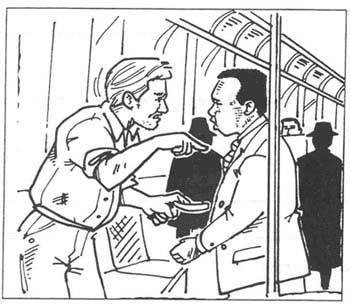
- SS: Allport & Postman (1947) - Asked ppts to recall details of picture beside and they tended to report that it was the black man holding the razor. We alter our memories to fit with our schemas (rationalization) - Conducted at a time with racial tension.
- CC: War Ghosts Story - Use of folk tales, they are written in an unusual style and so many not actually represent everyday memory and were deliberately ambiguous.
- CC: Much research comes evidence comes from lab experiments - Office study lacks validity.
Images and files in the map
Information
- Description
- A level Psychology (Cognitive) Mind Map on Reconstructive Memory (Bartlett 1932), created by Erin Owen on 20/01/2018.
- Created by
- Erin Owen
- Views
- 6
- Rating