
Mind map
Forgetting Explanation: Interference.
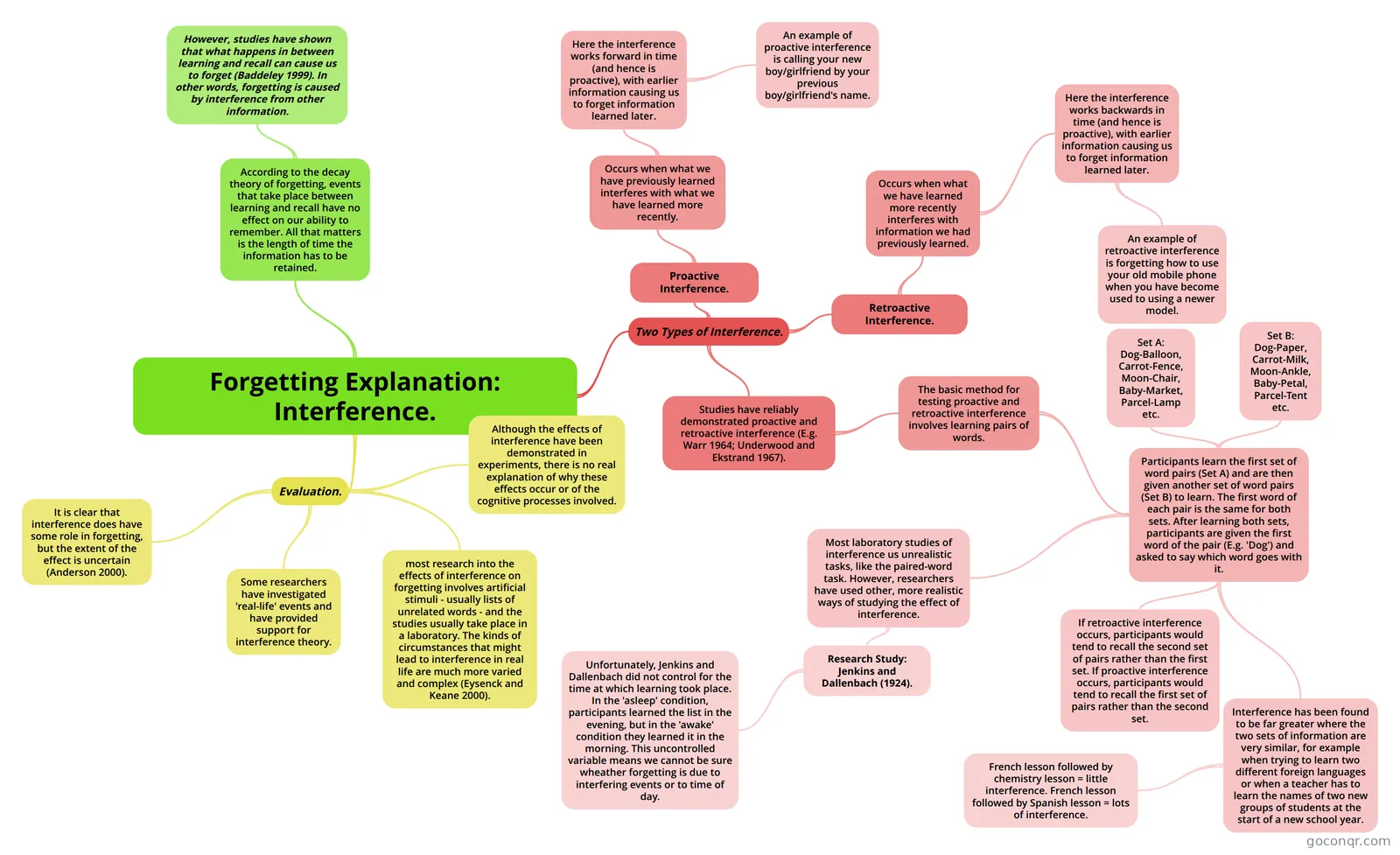
Mind map: Forgetting explanation: interference
Map content
Forgetting Explanation: Interference.
According to the decay theory of forgetting, events that take place between learning and recall have no effect on our ability to remember. All that matters is the length of time the information has to be retained.
- However, studies have shown that what happens in between learning and recall can cause us to forget (Baddeley 1999). In other words, forgetting is caused by interference from other information.
Two Types of Interference.
- Proactive Interference.
- Occurs when what we have previously learned interferes with what we have learned more recently.
- Here the interference works forward in time (and hence is proactive), with earlier information causing us to forget information learned later.
- An example of proactive interference is calling your new boy/girlfriend by your previous boy/girlfriend's name.
- Here the interference works forward in time (and hence is proactive), with earlier information causing us to forget information learned later.
- Occurs when what we have previously learned interferes with what we have learned more recently.
- Retroactive Interference.
- Occurs when what we have learned more recently interferes with information we had previously learned.
- Here the interference works backwards in time (and hence is proactive), with earlier information causing us to forget information learned later.
- An example of retroactive interference is forgetting how to use your old mobile phone when you have become used to using a newer model.
- Here the interference works backwards in time (and hence is proactive), with earlier information causing us to forget information learned later.
- Occurs when what we have learned more recently interferes with information we had previously learned.
- Studies have reliably demonstrated proactive and retroactive interference (E.g. Warr 1964; Underwood and Ekstrand 1967).
- The basic method for testing proactive and retroactive interference involves learning pairs of words.
- Participants learn the first set of word pairs (Set A) and are then given another set of word pairs (Set B) to learn. The first word of each pair is the same for both sets. After learning both sets, participants are given the first word of the pair (E.g. 'Dog') and asked to say which word goes with it.
- Set A: Dog-Balloon, Carrot-Fence, Moon-Chair, Baby-Market, Parcel-Lamp etc.
- Set B: Dog-Paper, Carrot-Milk, Moon-Ankle, Baby-Petal, Parcel-Tent etc.
- If retroactive interference occurs, participants would tend to recall the second set of pairs rather than the first set. If proactive interference occurs, participants would tend to recall the first set of pairs rather than the second set.
- Interference has been found to be far greater where the two sets of information are very similar, for example when trying to learn two different foreign languages or when a teacher has to learn the names of two new groups of students at the start of a new school year.
- French lesson followed by chemistry lesson = little interference. French lesson followed by Spanish lesson = lots of interference.
- Most laboratory studies of interference us unrealistic tasks, like the paired-word task. However, researchers have used other, more realistic ways of studying the effect of interference.
- Research Study: Jenkins and Dallenbach (1924).
- Unfortunately, Jenkins and Dallenbach did not control for the time at which learning took place. In the 'asleep' condition, participants learned the list in the evening, but in the 'awake' condition they learned it in the morning. This uncontrolled variable means we cannot be sure wheather forgetting is due to interfering events or to time of day.
- Research Study: Jenkins and Dallenbach (1924).
- Participants learn the first set of word pairs (Set A) and are then given another set of word pairs (Set B) to learn. The first word of each pair is the same for both sets. After learning both sets, participants are given the first word of the pair (E.g. 'Dog') and asked to say which word goes with it.
- The basic method for testing proactive and retroactive interference involves learning pairs of words.
- Proactive Interference.
Evaluation.
- Although the effects of interference have been demonstrated in experiments, there is no real explanation of why these effects occur or of the cognitive processes involved.
- most research into the effects of interference on forgetting involves artificial stimuli - usually lists of unrelated words - and the studies usually take place in a laboratory. The kinds of circumstances that might lead to interference in real life are much more varied and complex (Eysenck and Keane 2000).
- Some researchers have investigated 'real-life' events and have provided support for interference theory.
- It is clear that interference does have some role in forgetting, but the extent of the effect is uncertain (Anderson 2000).
Information
- Description
- Psychology (Remembering and Forgetting.) Mind Map on Forgetting Explanation: Interference., created by Stephanie Price on 03/06/2013.
- Created by
- Stephanie Price
- Views
- 178
- Tags
- Rating