
Mind map
Evolutionary Psychology
Map content
Evolutionary Psychology
Evolution
- the change in genetic frequency across generations
Theories of Evolution
- Lamarkian Evolution
- evolution occurring on acquired traits
- result of the interaction between the organism needs, actions, and the environment
- no natural genetic variation within the population
- activity of the animal that causes “heritable" changes
- Two Laws of Evolution
- 1st law: Law of Use and Disuse
- changes in the environment could lead to changes in an animal’s behaviour
- leads to an organ being used more or less, causing a change in structure
- changes in the environment could lead to changes in an animal’s behaviour
- 2nd law: Inheritance of Acquired Traits
- structural changes in the organism are heritable
- 1st law: Law of Use and Disuse
- evolution occurring on acquired traits
- Darwinian Evolution
- all living things emerged from a common ancestor
- competition is driving force behind evolution
- Natural Selection
- natural genetic variation within the population
- differences in phenotype
- organisms better adapted to their environment tend to survive and reproduce more than their counterparts
- dfferential survival and reproduction of individuals
- Three components
- 1. Heritable genetic variation
- individuals within a population tend to differ from each other in ways that are passed on to their offsprings
- 2. Differential reproductive success
- as a result of phenotypic differences, some individuals leave more surviving offsprings than others
- 3. Environmental pressures/Selecting Factor
- genetic variations are winnowed out by their suitability to the environment and by their inheritability
- selection causes gradual changes over large tracts of time
- 1. Heritable genetic variation
- natural genetic variation within the population
- Sexual Selection
- Alfred Russell Wallace simultaneously came up with the theory of variation and natural selection as Darwin did
- all living things emerged from a common ancestor
- Mendelian Genetics
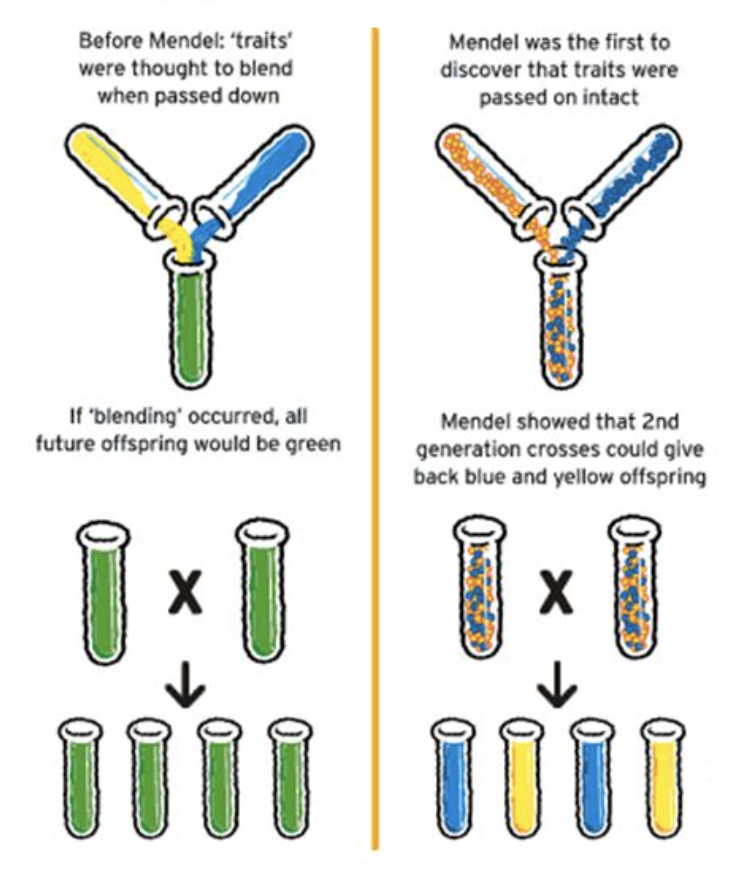
- found that inheritance was particulate
- as opposed to the blended
- parental traits are inherited in “discrete particles”
- discrete particles are what we know now as genes
- genes retain their ability to be expressed, while not always appearing in a descending generation
- as opposed to blended inheritance
- simplest form of genetics; a probabilistic genetic inheritance system
- found that inheritance was particulate
- The Modern Synthesis
- a unified theory of evolution
- fusion of Mendelian genetics with Darwinian evolution
- 1. Traits are inherited through genes
- 2. Variation in traits are due to multiple forms of the same gene — alleles
- 3. Evolution occurs as a change of allele frequency at a gene loci
- 1. Natural selection
- 2. Genetic drift
- descendants of a common genetic pool that have been geographically separated, adapted to their different environment, resulting in species differentiation
- 3. Neutral genetic mutation
- a unified theory of evolution
- Lamarkian Evolution
Differing Perspectives on Evolution
- Evolutionary Psychology
- Psychology explores proximate causations
- cause which is closest to, or immediately responsible for the observed result
- Evolutionary science explores ultimate causations
- the reason the result occurred
- brings a missing component to the cognitive revolution
- what kind of information-processing problems was the brain evolved to solve
- problems of survival and reproduction in our ancestor's past environment
- what kind of information-processing problems was the brain evolved to solve
- Psychology explores proximate causations
- Early Evolutionary Psychology
- Charles Darwin
- believed that natural selection had a role in the evolution of human behaviour too
- human mind as being explainable by the same laws as bodily organs
- mind as a function of body
- human mind as being explainable by the same laws as bodily organs
- believed that natural selection had a role in the evolution of human behaviour too
- Francis Galton
- proposed that traits that may have been useful in ancestral times might be less useful in contemporary society
- minds were adapted to conditions of past generations
- Proposed eugenics to improve society
- the science of improving a population by controlled breeding to increase the occurrence of desirable heritable characteristics
- Positive eugenics
- encouraging people with high fitness to mate together and produce many offsprings
- Negative eugenics
- prohibits reproduction among those who are considered unfit
- an artificial selection of traits
- proposed that traits that may have been useful in ancestral times might be less useful in contemporary society
- William James
- Psychology of Instincts
- human behaviour might be characterised by more instincts than other animals rather than fewer
- Psychology of Instincts
- Charles Darwin
- The Social Sciences
- Standard Social Science Model
- non-evolutionary social science approach
- Culture as a causal force in human behaviour not biology and evolution
- Five assumptions
- 1. Humans are borns as blank slates
- Critiques on SSSM 1. Innate rules are needed to guide sensation and perception — what the mind attends to and produces 2. Lacked a theory on how the mind is designed Evolutionary psychology believes that the mind has an architectural design based on the environmental challenges our ancestors faced. Behaviour then results as a function of this ultimate design interacting with the proximate world.
- nothing is innate
- knowledge, personality traits, and cultural values are acquired from the cultural environment
- 2. Biological constraints on behaviour are unimportant
- Critiques on SSSM 1. SSSM focused on proximate environmental influences and ignores the role of biology 2. Traits cannot be defined as just the result of nature or just the result of nurture -- a behaviour is a product of all its components
- the human behaviour is infinitely malleable
- 3. Difference between individuals arise primarily from differences in experience and culture
- behavioural differences due to learning, socialisation, and indoctrination
- 4. Learning operates on a small number of general-purpose mechanisms
- Critiques on SSSM Minds do not actually behave like a blank slate with no innate features -- biases towards learning certain skills have been observed
- the mind has equal potential to learn anything
- 5. Culture and experience, through general learning mechanisms, produce behaviour
- 1. Humans are borns as blank slates
- non-evolutionary social science approach
- Behaviourism
- the study of observable causes of behaviour
- believe that humans have no nature, few instincts, and a general ability to learn
- Species instincts provide evidence against the general learning theory. Keller and Marie Breland found that animal’s instinctive behaviour kept getting in the way to supposedly species-general processes of association and reinforcement. - Despite using Skinnerian methods to train the animals, the animals kept reverting to instinctive behaviours - Found species typical responses which obstructed learning - Learning is species-specific not general Variation across species in specific learning potential — within a species there may be a predisposition to learn a specific skill- E.g. birds and turtles are predisposed to using star compasses, learning to navigate better- Humans have capacity to learn complex languages and culture- The mind is ready to receive certain types of information
- General Laws of Learning
- All forms of associative learning involve the same underlying mechanisms Learning is defined as a set of processes that allow experience to modify behavior
- Associative learning
- classical conditioning
- Classical conditioning conditions the subject to produce a conditioned response when presented with a conditioned stimulus, by pairing the stimulus with an unconditioned stimlulus that elicits an unconditioned response
- operant conditioning
- Proposed the process of operant conditioning, a learning process where the strength of a behaviour is modified by reward or punishment - A behaviour that is rewarded is more likely to be repeated; a behaviour that is punished is less likely to be repeated
- classical conditioning
- same laws of learning can be applied to all species
- any stimuli can evoke any response
- The Cognitive Revolution
- information-processing approach
- compares the human mind to computers
- As a means of understanding the way information is processed and stored in the human mind - Computers, which process information, include internal states that affect processing
- Hardware
- brain, peripheral physiology, and anatomy
- Softwares
- species-specific capabilities to respond to a particular set of task
- evolutionary psychology postulates domain-specificity in cognition
- certain ways to interpret and respond to information
- without rules of engagement, there would be a combinatorial explosion
- certain ways to interpret and respond to information
- evolutionary psychology postulates domain-specificity in cognition
- species-specific capabilities to respond to a particular set of task
- compares the human mind to computers
- information-processing approach
- Standard Social Science Model
- The Natural Sciences
- Ethology
- study of animal behaviour under natural conditions
- behaviour as an evolutionarily adaptive trait
- First discipline specifically looking at functional explanations of behaviour
- behaviour as an evolutionarily adaptive trait
- study of animal behaviour under natural conditions
- Sociobiology
- biological basis of social behaviour
- approaching social behaviour from an evolutionary perspective
- current behavioural responses occur because of the usefulness they had to ancestors
- 1. Kin Selection
- 2. Reciprocal Altruism
- 3. Parental Investment Theory
- 4. Parent-Offspring Conflict
- approaching social behaviour from an evolutionary perspective
- seen by the common people as propagating dangerous forms of thinking such as eugenics
- Seen by the common people as propagating dangerous forms of thinking such as eugenics
- a fear biological interpretations of behaviour developed
- Seen by the common people as propagating dangerous forms of thinking such as eugenics
- biological basis of social behaviour
- Ethology
- Evolutionary Psychology
Images and files in the map
Information
- Description
- Psychology (Evolutionary Psychology) Mind Map on Evolutionary Psychology, created by Pamela Goh on 10/02/2018.
- Created by
- Pamela Goh
- Views
- 1
- Rating