
Mind map
sexual selection and human reproductive behaviour.
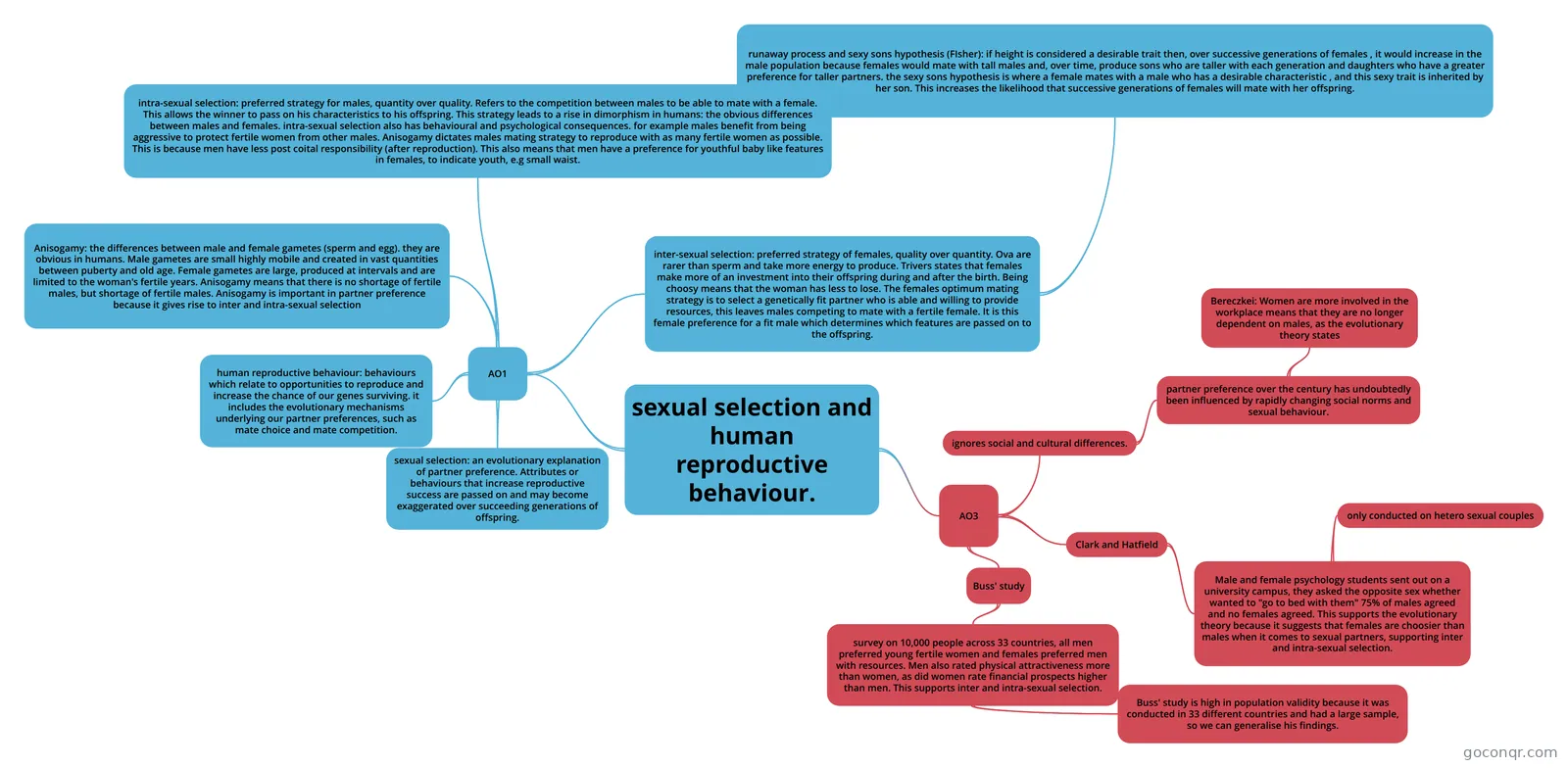
Mind map: sexual selection and human reproductive behaviour
Map content
sexual selection and human reproductive behaviour.
AO1
- sexual selection: an evolutionary explanation of partner preference. Attributes or behaviours that increase reproductive success are passed on and may become exaggerated over succeeding generations of offspring.
- human reproductive behaviour: behaviours which relate to opportunities to reproduce and increase the chance of our genes surviving. it includes the evolutionary mechanisms underlying our partner preferences, such as mate choice and mate competition.
- Anisogamy: the differences between male and female gametes (sperm and egg). they are obvious in humans. Male gametes are small highly mobile and created in vast quantities between puberty and old age. Female gametes are large, produced at intervals and are limited to the woman's fertile years. Anisogamy means that there is no shortage of fertile males, but shortage of fertile males. Anisogamy is important in partner preference because it gives rise to inter and intra-sexual selection
- inter-sexual selection: preferred strategy of females, quality over quantity. Ova are rarer than sperm and take more energy to produce. Trivers states that females make more of an investment into their offspring during and after the birth. Being choosy means that the woman has less to lose. The females optimum mating strategy is to select a genetically fit partner who is able and willing to provide resources, this leaves males competing to mate with a fertile female. It is this female preference for a fit male which determines which features are passed on to the offspring.
- runaway process and sexy sons hypothesis (FIsher): if height is considered a desirable trait then, over successive generations of females , it would increase in the male population because females would mate with tall males and, over time, produce sons who are taller with each generation and daughters who have a greater preference for taller partners. the sexy sons hypothesis is where a female mates with a male who has a desirable characteristic , and this sexy trait is inherited by her son. This increases the likelihood that successive generations of females will mate with her offspring.
- intra-sexual selection: preferred strategy for males, quantity over quality. Refers to the competition between males to be able to mate with a female. This allows the winner to pass on his characteristics to his offspring. This strategy leads to a rise in dimorphism in humans: the obvious differences between males and females. intra-sexual selection also has behavioural and psychological consequences. for example males benefit from being aggressive to protect fertile women from other males. Anisogamy dictates males mating strategy to reproduce with as many fertile women as possible. This is because men have less post coital responsibility (after reproduction). This also means that men have a preference for youthful baby like features in females, to indicate youth, e.g small waist.
AO3
- Buss' study
- survey on 10,000 people across 33 countries, all men preferred young fertile women and females preferred men with resources. Men also rated physical attractiveness more than women, as did women rate financial prospects higher than men. This supports inter and intra-sexual selection.
- Buss' study is high in population validity because it was conducted in 33 different countries and had a large sample, so we can generalise his findings.
- survey on 10,000 people across 33 countries, all men preferred young fertile women and females preferred men with resources. Men also rated physical attractiveness more than women, as did women rate financial prospects higher than men. This supports inter and intra-sexual selection.
- Clark and Hatfield
- Male and female psychology students sent out on a university campus, they asked the opposite sex whether wanted to "go to bed with them" 75% of males agreed and no females agreed. This supports the evolutionary theory because it suggests that females are choosier than males when it comes to sexual partners, supporting inter and intra-sexual selection.
- only conducted on hetero sexual couples
- Male and female psychology students sent out on a university campus, they asked the opposite sex whether wanted to "go to bed with them" 75% of males agreed and no females agreed. This supports the evolutionary theory because it suggests that females are choosier than males when it comes to sexual partners, supporting inter and intra-sexual selection.
- ignores social and cultural differences.
- partner preference over the century has undoubtedly been influenced by rapidly changing social norms and sexual behaviour.
- Bereczkei: Women are more involved in the workplace means that they are no longer dependent on males, as the evolutionary theory states
- partner preference over the century has undoubtedly been influenced by rapidly changing social norms and sexual behaviour.
- Buss' study
Information
- Description
- Psychology Mind Map on sexual selection and human reproductive behaviour., created by Khadija Waqar on 28/02/2018.
- Created by
- Khadija Waqar
- Views
- 0
- History
-
- Created by Khadija Waqar · Feb 28, 2018
- Copied by Khadija Waqar · Feb 28, 2018
- Rating
More on Sexual selection and partner preferences