
Mind map
Chapter 2
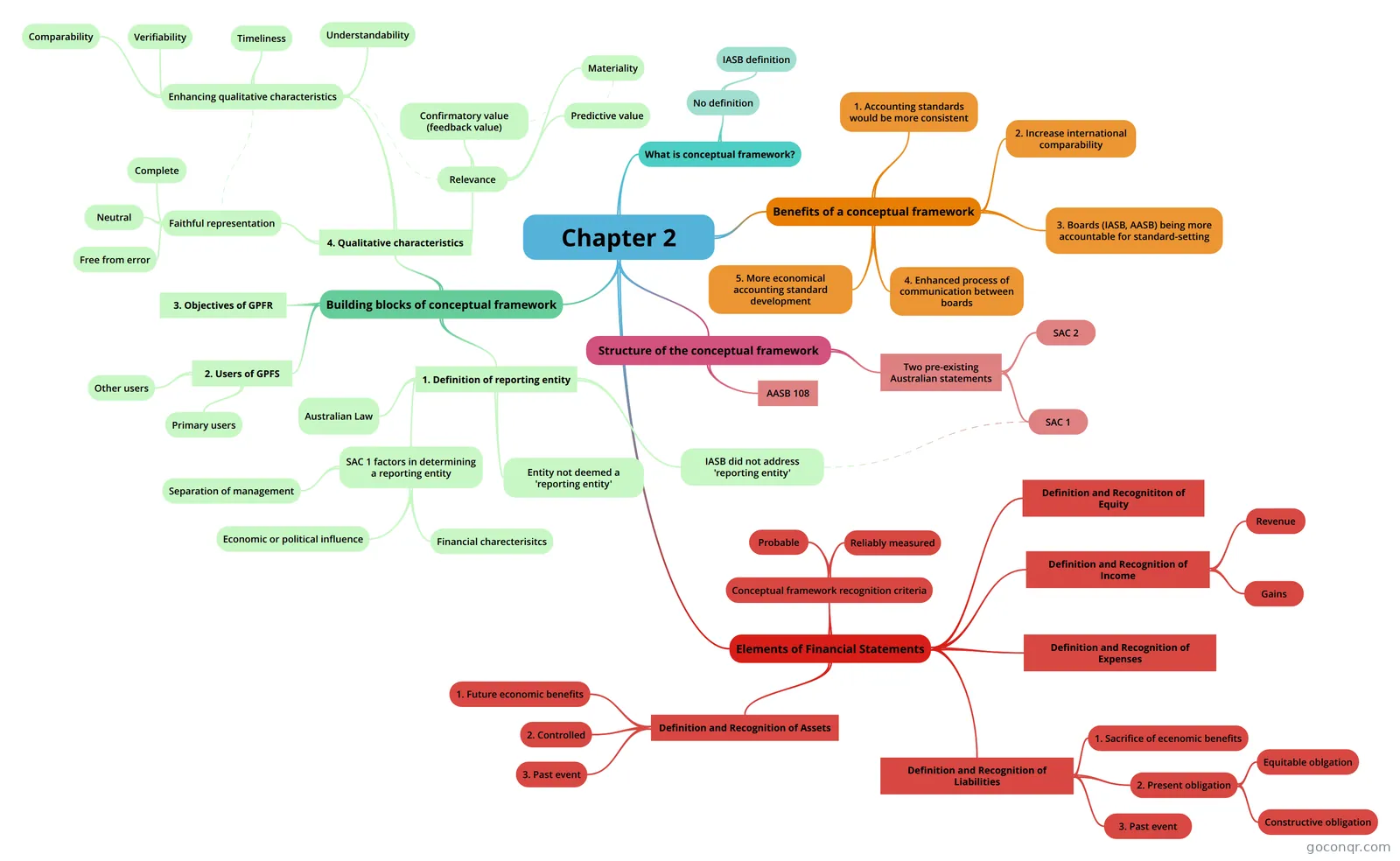
Mind map: Conceptual framework and financial statements
Map content
Chapter 2
What is conceptual framework?
- No definition
- There is no definition of a conceptual framework.
- IASB definition
- IASB note that a conceptual framework "describes the objectives of, and the concepts for, general purpose finanacial reporting". A central goal of establishing a conceptual framework of accounting will be general agreement on: - the scope and objectives of financial reporting - qualitative characterisitcs that financial information should posses (relevance, faithful represenation) - what the elements of financial reporting are, including agreement on the characterisitcs and recognition criteria for assets, liabilities, income, expenses and equity.
- No definition
Benefits of a conceptual framework
- 1. Accounting standards would be more consistent
- Accounting standards would be more consistent (by accepting IFRS) and logical because they are developed from a clearly developed set of concepts
- 2. Increase international comparability
- Increased international compatibility of accounting standards because the conceptual framework is similar to other jurisdictions.
- 3. Boards (IASB, AASB) being more accountable for standard-setting
- Should result in the Boards (e.g. IASB, AASB) being more accountable for their standard-setting decisions, because the thinking behind specific requirements should be more explicit, as should any departures from the concept that might be included in particular accounting standards.
- 4. Enhanced process of communication between boards
- Enhanced process of communication between the Boards and constituent. The conceptual framework also acts as a defense against political attack for some political pressures.
- 5. More economical accounting standard development
- More economical accounting standard development because the concepts developed by the conceptual framework will guide the AASB and the IASB in their decision making.
- 1. Accounting standards would be more consistent
Structure of the conceptual framework
- Two pre-existing Australian statements
- SAC 1
- SAC 1: Definition of the Reporting Entity. SAC 1 is still applicable because IASB did not address 'reporting entity'. However, Once the IASB Conceptual Framework addresses the ‘reporting entity’ concept ,SAC 1 will be withdrawn, and the AASB website updated
- SAC 1 - Definition of the Reporting Entity, defines general purpose financial statements as: Financial statements intended to meet the information needs common to users who are unable to command the preparation of reports tailored to their specific needs
- SAC 2
- SAC 2: Objective of General Purpose Financial Reporting. Contents of SAC 2 is no longer applicable because IASB incorporated their own definition in 2010.
- SAC 1
- AASB 108
- AASB 108: Accounting Policies, Changes in Accounting Estimates, and Errors. Previously, the conceptual framework was a useful source for guidance, but was not mandatory. Now, it is mandatory because of AASB 108 paragraph 10 and 11.
- AASB 108 para 10: In the absence of Australian Accounting Standards (old concept) that specifically applies to transactions, management shall use its judgement in developing and applying an accounting policy that results in information that is: - relevant - reliable (faithfully represented, material, neutral, prudent, and complete).
- AASB 108 para 11: In making judgement prescribed in paragraph 10, management shall consider the following sources: - the requirements in accounting standards; and - the definition, recognition criteria and measurement concepts for assets, liabilities, income and expenses in the conceptual framework.
- Two pre-existing Australian statements
Building blocks of conceptual framework
- 1. Definition of reporting entity
- IASB did not address 'reporting entity'
- The IASB conceptual framework (released in 2010) did not address the notion of a 'reporting entity' therefore, Australia has retained the use of SAC 1.
- SAC 1 definition of reporting entity: Reporting entities are all entities (including economic entities) in respect of which is reasonable to expect the existence of users dependent on general purpose financial reports for information which will be useful to them for making and evaluating decisions about the allocation of scarce resources.
- Entity not deemed a 'reporting entity'
- Entities not deemed a 'reporting entity' are required to not produce GPFS. Small proprietary companies are frequently not considered to be reporting entities—it is assumed that most people who require financial information about the entity will be in a position to specifically demand it.
- SAC 1 factors in determining a reporting entity
- Separation of management
- As the separation of management and ownership increase, so does the likelihood of an entity being considered to be a reporting entity.
- Economic or political influence
- as the entity's dominance in the market and/or its potential influence on the welfare of external parties increase, so does the likelihood of an entity being considered to be a reporting entity.
- Financial charecterisitcs
- amount of sales, value of assets, extent of indebtness, number of customers and employees increase, so does the likelihood of an entity being considered a reporting entity.
- Separation of management
- Australian Law
- Australian Law developed an objective criteria for determining when a company is required to provide financial statements that comply with accounting standards including: - Gross revenue of $25 million or more; - Gross asset of $12.5 million or more; and - Full-time employees of 50 or more.
- IASB did not address 'reporting entity'
- 2. Users of GPFS
- Primary users
- Primary users are: - Lenders; - Potential investors; - Existing inventors; and - Other creditors
- Other users
- The Conceptual Framework has also embraced the belief that users are assumed to have a reasonable knowledge of business and economic activities and accounting and a willingness to study the information with reasonable diligence.
- Primary users
- 3. Objectives of GPFR
- According to the Conceptual Framework: –The objective of general purpose financial reporting is to provide financial information about the reporting entity that is useful to existing and potential investors, lenders and other creditors in making decisions about providing resources to the entity. Those decisions involve buying, selling or holding equity and debt instruments, and providing or settling loans and other forms of credit. - The rest of the framework is developed around this objective - Do we believe this is a good objective? If we dismiss this objective then we might be inclined to dismiss the balance of the framework
- 4. Qualitative characteristics
- The 2 fundamental characteristics identified in the conceptual framework (2010) are 'relevance' and 'faithful representation'
- Ideally, financial information should be both relevant and representationally faithful. However, it is possible for information to be representationally faithful, but not very relevant, or the other way around. If the data or information severely lacks one of the characteristics of relevance or faithful representation, then the information should not be provided to financial statement readers. Because it wont help users make good decisions.
- The most efficient process for applying the fundamental qualitative characteristics (relevance and faithful representation) would usually be as follows: 1. identify the economic phenomenon that has the potential (material effect) to be useful to users. 2. identify the type of information about the phenomenon that would mostly be relevant and faithfully represented. 3. determine whether the information is available and can be faithfully represented. If all these points are plausible, then it satisfies the fundamental qualitative characteristics. If not, then it is repeated for the next relevant type of information.
- Relevance
- Paragraph QC6 of the CF states: Relevant financial information is capable of making a difference in the decisions made by users. Information may be capable of making a difference in a decision even if some users choose not to take advantage of it or are already aware of it from other sources.
- For information to be relevant it should have both predictive value and confirmatory value (or feedback value), the latter referring to information’s utility in confirming or correcting earlier expectations
- Predictive value
- Confirmatory value (feedback value)
- Materiality
- General purpose financial statements are to include all financial information that satisfies the concepts of ‘relevance’ and ‘faithfully represent’ to the extent that such information is material
- If the item is not deemed material, the general principle is that you do not have to use a particular accounting standard to account for it.
- Faithful representation
- According to paragraph QC12 of the conceptual framework: To be a perfectly faithful representation, a depiction would have three characteristics. - Complete; - Neutral; and - Free from error. Of course, perfection is seldom, if ever, achievable. The IASB’s objective is to maximise those qualities to the extent possible.
- Free from error
- Free from error means there are no errors or omissions in the description of the phenomenon (amount is described clearly and accurately as being an estimate), and the process used to produce the reported information has been selected and applied with no errors in the process.
- Neutral
- A neutral depiction is without bias in the selection of presentation of financial information. This is information that has not been manipulated in order to be favourable or unfavouable by users.
- Complete
- A complete depiction includes all information necessary for a user to understand the phenomenon being depicted, including all necessary descriptions and explanations.
- Enhancing qualitative characteristics
- Apart from the two fundamental qualitative characteristics of relevance and faithful representation, there are also four ‘enhancing qualitative characteristics’. These enhancing qualitative characteristics are: –comparability –verifiability –timeliness, and –understandability Each of these qualitative characteristics is assumed to likely enhance the usefulness of information that is both relevant and faithfully represented.
- Comparability
- Comparability is to facilitate the comparisons of the financial statements of different entities, methods of measurement and disclosure must be consistent, but should be changed if no longer relevant to an entity's circumstances.
- Verifiability
- Verifiability refers to the ability to ensure that information represents what it purports to represent, or that the chosen method of measurement has been used without error or bias.
- Timeliness
- The more timely (up to-date) the financial information is, the more useful it will be. The older the information the less useful however, it can be useful if users need to to identify asset trends.
- Understandability
- Information is useful only if it is understood. Financial reports are prepared for users who have a reasonable knowledge of business and economic activitiees and who review and analyse the information diligently.
- 1. Definition of reporting entity
Elements of Financial Statements
- There are 5 elements of financial statements are defined in the conceptual framework: - Assets - Liabilities - Expenses - Income - Equity
- Recognition (defined by conceptual framework): "Recognition is the process of incorporating in the balance sheet or income statement an item that meets the definition of an element and satisfies the criteria (e.g. present obligation past transaction, economic benefit etc.) for recognition." If the element fails to meet the recognition criteria in one period but satisfies them in another period, the element can be reinstated.
- Definition and Recognition of Assets
- Definition of asset: Resource controlled by the entity as a result of past events and from which future economic benefits are expected to flow to the entity. Definition identifies 3 characteristics: 1. Must be future economic benefits 2. The reporting entity must control the future economic benefits 3. Past event giving rise to control must have occurred
- - It is probable that any future economic benefit associated with the asset will flow to or from the entity; and - The item has a cost or value that can be measured with reliability.
- 1. Future economic benefits
- The scarce capacity to provide benefits to the entities that use them - common to all assets irrespective of their physical or other form.
- 2. Controlled
- If an asset is to be recognized, control rather than legal ownership must be established: - Right of ownership is not essential (e.g. property held on a lease is an asset if the entity controls the benefits which are expected to flow from the entity). Control is the capacity of an entity to benefit from an asset in the pursuit of the entity's objectives (generate profit) and to deny or regulate the access of others to that benefit.
- 3. Past event
- Definition and Recognition of Liabilities
- Liabilities defined as: A present obligation of the entity arising from past events, the settlement of which is expected to result in an outflow from the entity of resources embodying economic benefits. There are 3 main characteristics: 1.There must be a future disposition or sacrifice of economic benefits to other entities 2.It must be a present obligation 3.A past transaction or other event must have created the obligation
- Contingent liability: A contingent liability is a liability that cannot be reliably measured but is potentially material, the liability should be disclosed within the notes to the financial statements - defined as 'contingent liability'.
- - A liability is recognised in the balance sheet when it is probable that an outflow of resources embodying economic benefits will result from the settlement of a present obligation and the amount at which the settlement will take place can be measured reliably. - Where a liability cannot be reliably measured but is potentially material, the liability should be disclosed within the notes to the financial statements.
- 1. Sacrifice of ecenomic benefits
- 2. Present obligation
- Present obligation is a duty or responsibility to or perform in a certain way. Obligation may be legally enforceable as a consequence of a binding contract or requirement (amounts payable for G&S - GST). Obligations also arise in normal business practices, custom and a desire to maintain good business relations or act in an equitable manner (obliged to rectify faults in products or return of G&S).
- Equitable oblgation
- An equitable obligation is governed by social or moral sanctions or custom rather than legal sanctions.
- Constructive obligation
- A constructive obligation is created, inferred or construed from the facts in a particular situation rather than contracted by agreement with another entity or imposed by government.
- 3. Past event
- Definition and Recognition of Expenses
- Definition of expenses: Expense decreases in economic benefits during the accounting period in the form of outflows or depletions of assets or incurrences of liabilities that result in decreases in equity, other than those relating to equity participants.
- If a resource is used up or damaged by an entity but that entity does not control the resource (not an asset of the entity), to the extent that no liabilities or fines are imposed, no expenses will be recorded by the entity. E.g. entity pollutes the environment but incurs no related fines because the environment is not controlled by the entity.
- Probable and measurably reliable: – A decrease in future economic benefits related to a decrease in an asset or an increase in a liability has arisen that can be measured reliably.
- Definition and Recognition of Income
- Definition of Income: Increases in economic benefits during the accounting period in the form of inflows or enhancements of assets or decreases of liabilities that result in increases in equity, other than those relating to contributions from equity participants.
- Income can be recognised in the financial statements when: –it is probable that the inflow or other enhancement or saving in outflows has occurred; and –the inflow or other enhancement or saving in outflows of economic benefits can be measured reliably
- Income consists of both 'Revenue' and 'Gains'. Some professional judgement is required to determine whether a component of income should be classified as revenue or a gain.
- Gains
- Gains represent other items that meet the definition of income and might or might not arise in the ordinary activities of an entity. E.g. disposal of non-current assets
- Revenue
- Revenue arises in the course of the ordinary activities of an entity and includes: sales, fees, interest, dividends, royalties and rent.
- Definition and Recognititon of Equity
- Definition of Equity; It is the residual interest in the assets of the entity after deducting all liabilities.
- Conceptual framework recognition criteria
- Conceptual framework also provide a general recognition criteria for the five elements of financial statements being: An item that meets the definition of an element should be recognised if: a. It is 'Probable' that any future economic benefit associated with the item will flow to or from the entity; and b. The item has a cost or value that can be 'Measured with reliability'.
- Probable
- Probable (defined by SAC 4): "More likely rather than less likely".
- Reliably measured
Information
- Description
- Contemporary issues in accounting (Week 2) Mind Map on Chapter 2, created by Micky Marshall on 02/03/2018.
- Created by
- Micky Marshall
- Views
- 2
- Rating