
Mind map
Cognitive classic study- Baddeley (1966b)
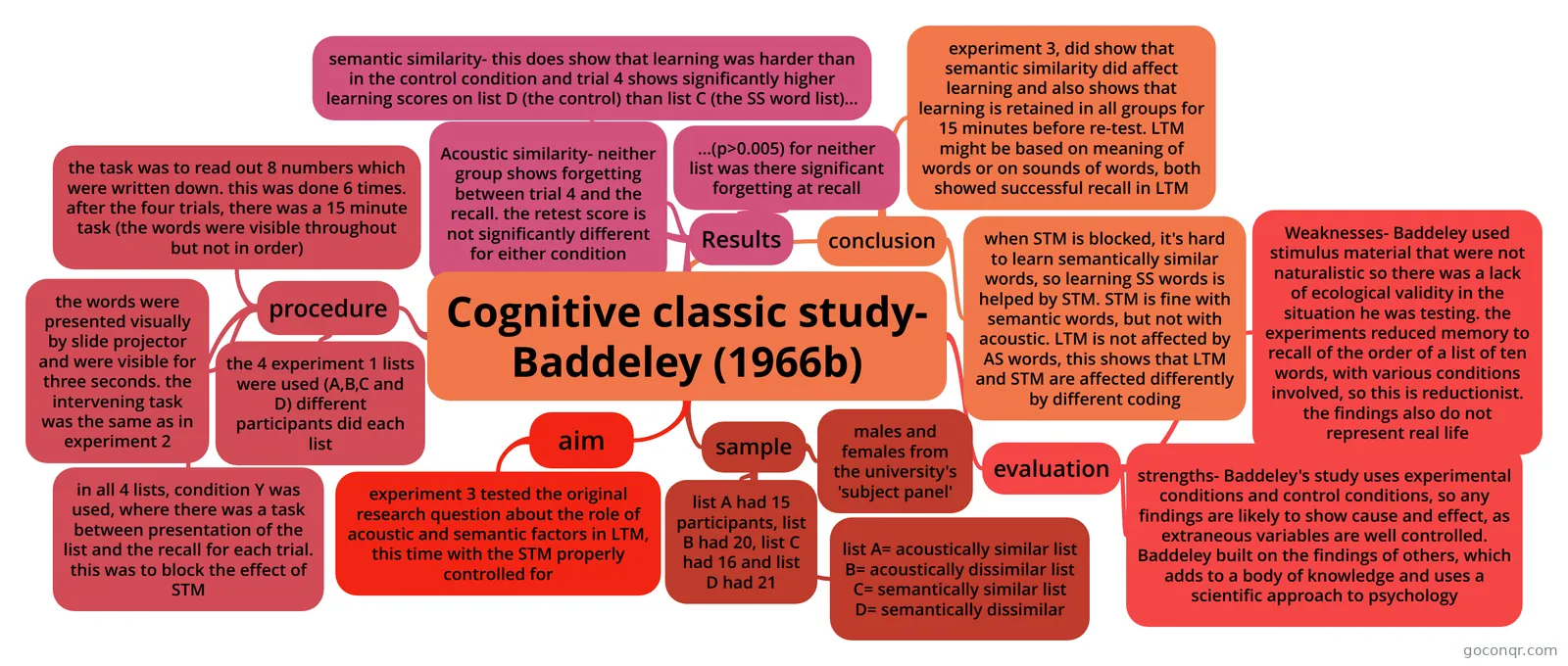
Mind map: Baddeley (1966b) cognitive classic study
Map content
Cognitive classic study- Baddeley (1966b)
aim
- experiment 3 tested the original research question about the role of acoustic and semantic factors in LTM, this time with the STM properly controlled for
sample
- males and females from the university's 'subject panel'
- list A had 15 participants, list B had 20, list C had 16 and list D had 21
- list A= acoustically similar list B= acoustically dissimilar list C= semantically similar list D= semantically dissimilar
procedure
- the 4 experiment 1 lists were used (A,B,C and D) different participants did each list
- in all 4 lists, condition Y was used, where there was a task between presentation of the list and the recall for each trial. this was to block the effect of STM
- the words were presented visually by slide projector and were visible for three seconds. the intervening task was the same as in experiment 2
- the task was to read out 8 numbers which were written down. this was done 6 times. after the four trials, there was a 15 minute task (the words were visible throughout but not in order)
evaluation
- strengths- Baddeley's study uses experimental conditions and control conditions, so any findings are likely to show cause and effect, as extraneous variables are well controlled. Baddeley built on the findings of others, which adds to a body of knowledge and uses a scientific approach to psychology
- Weaknesses- Baddeley used stimulus material that were not naturalistic so there was a lack of ecological validity in the situation he was testing. the experiments reduced memory to recall of the order of a list of ten words, with various conditions involved, so this is reductionist. the findings also do not represent real life
Results
- Acoustic similarity- neither group shows forgetting between trial 4 and the recall. the retest score is not significantly different for either condition
- semantic similarity- this does show that learning was harder than in the control condition and trial 4 shows significantly higher learning scores on list D (the control) than list C (the SS word list)...
- ...(p>0.005) for neither list was there significant forgetting at recall
conclusion
- experiment 3, did show that semantic similarity did affect learning and also shows that learning is retained in all groups for 15 minutes before re-test. LTM might be based on meaning of words or on sounds of words, both showed successful recall in LTM
- when STM is blocked, it's hard to learn semantically similar words, so learning SS words is helped by STM. STM is fine with semantic words, but not with acoustic. LTM is not affected by AS words, this shows that LTM and STM are affected differently by different coding
Information
- Description
- A level Psychology Mind Map on Cognitive classic study- Baddeley (1966b), created by Kerryann Fisher on 06/03/2018.
- Created by
- Kerryann Fisher
- Views
- 4
- History
-
- Created by Dan Peachey · May 10, 2016
- Copied by Kerryann Fisher · Mar 6, 2018
- Rating