
Mind map
theories of intelligence
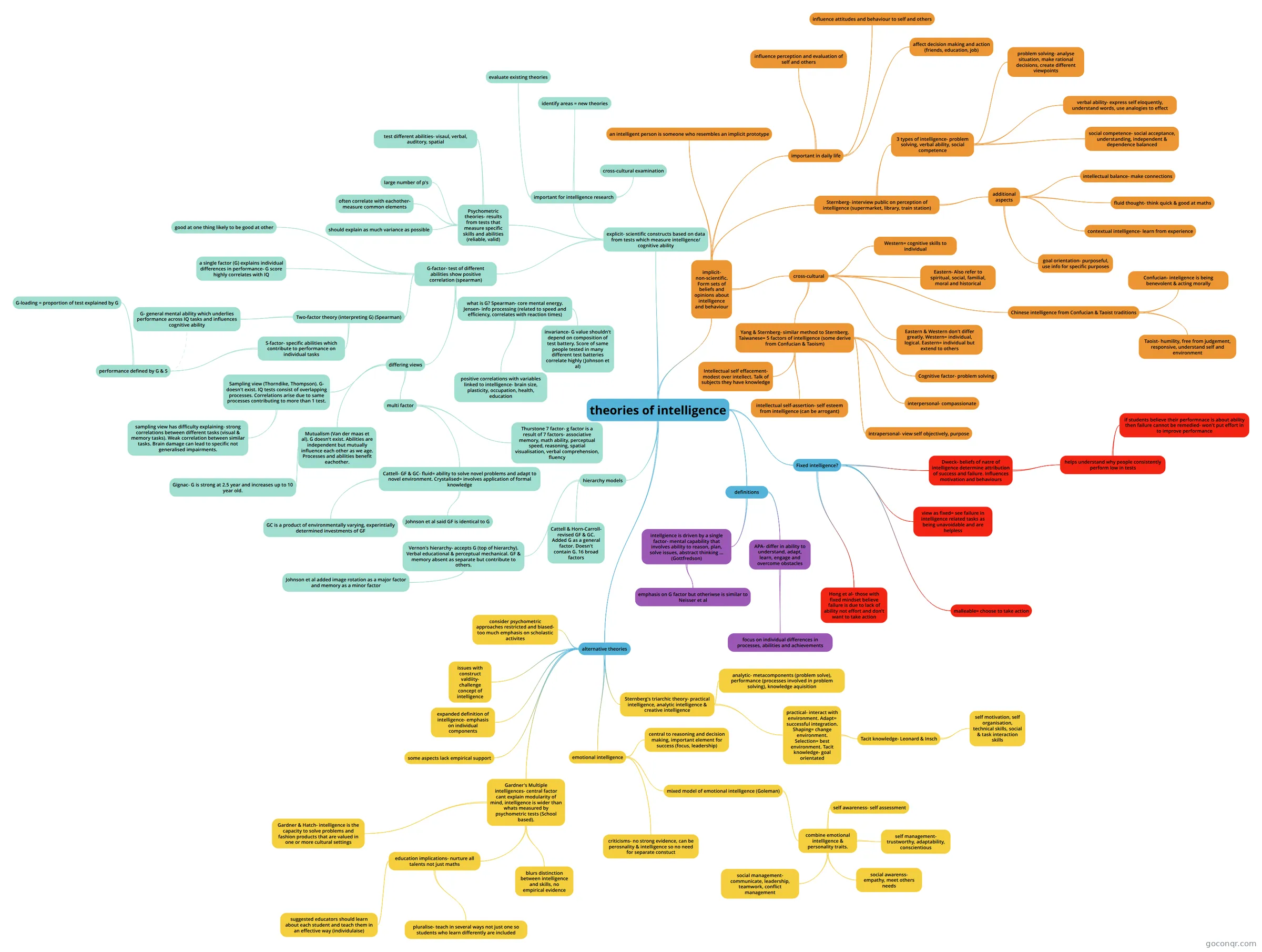
Mind map: theories of intelligence
Map content
theories of intelligence
explicit- scientific constructs based on data from tests which measure intelligence/ cognitive ability
- important for intelligence research
- identify areas = new theories
- evaluate existing theories
- cross-cultural examination
- Psychometric theories- results from tests that measure specific skills and abilities (reliable, valid)
- test different abilities- visaul, verbal, auditory, spatial
- large number of p's
- often correlate with eachother- measure common elements
- should explain as much variance as possible
- G-factor- test of different abilities show positive correlation (spearman)
- good at one thing likely to be good at other
- a single factor (G) explains individual differences in performance- G score highly correlates with IQ
- Two-factor theory (interpreting G) (Spearman)
- G- general mental ability which underlies performance across IQ tasks and influences cognitive ability
- S-factor- specific abilities which contribute to performance on individual tasks
- performance defined by G & S
- G-loading = proportion of test explained by G
- performance defined by G & S
- what is G? Spearman- core mental energy. Jensen- info processing (related to speed and efficiency, correlates with reaction times)
- positive correlations with variables linked to intelligence- brain size, plasticity, occupation, health, education
- invariance- G value shouldn't depend on composition of test battery. Score of same people tested in many different test batteries correlate highly (Johnson et al)
- differing views
- Sampling view (Thorndike, Thompson). G- doesn't exist. IQ tests consist of overlapping processes. Correlations arise due to same processes contributing to more than 1 test.
- sampling view has difficulty explaining- strong correlations between different tasks (visual & memory tasks). Weak correlation between similar tasks. Brain damage can lead to specific not generalised impairments.
- Mutualism (Van der maas et al). G doesn't exist. Abilities are independent but mutually influence each other as we age. Processes and abilities benefit eachother.
- Gignac- G is strong at 2.5 year and increases up to 10 year old.
- multi factor
- Thurstone 7 factor- g factor is a result of 7 factors- associative memory, math ability, perceptual speed, reasoning, spatial visualisation, verbal comprehension, fluency
- Cattell- GF & GC- fluid= ability to solve novel problems and adapt to novel environment. Crystalised= involves application of formal knowledge
- GC is a product of environmentally varying, experintially determined investments of GF
- Johnson et al said GF is identical to G
- Sampling view (Thorndike, Thompson). G- doesn't exist. IQ tests consist of overlapping processes. Correlations arise due to same processes contributing to more than 1 test.
- important for intelligence research
implicit- non-scientific. Form sets of beliefs and opinions about intelligence and behaviour
- an intelligent person is someone who resembles an implicit prototype
- important in daily life
- influence perception and evaluation of self and others
- influence attitudes and behaviour to self and others
- affect decision making and action (friends, education, job)
- Sternberg- interview public on perception of intelligence (supermarket, library, train station)
- 3 types of intelligence- problem solving, verbal ability, social competence
- problem solving- analyse situation, make rational decisions, create different viewpoints
- verbal ability- express self eloquently, understand words, use analogies to effect
- social competence- social acceptance, understanding, independent & dependence balanced
- additional aspects
- intellectual balance- make connections
- fluid thought- think quick & good at maths
- contextual intelligence- learn from experience
- goal orientation- purposeful, use info for specific purposes
- 3 types of intelligence- problem solving, verbal ability, social competence
- cross-cultural
- Western= cognitive skills to individual
- Eastern- Also refer to spiritual, social, familial, moral and historical
- Chinese intelligence from Confucian & Taoist traditions
- Confucian- inteligence is being benevolent & acting morally
- Taoist- humility, free from judgement, responsive, understand self and environment
- Yang & Sternberg- similar method to Sternberg. Taiwanese= 5 factors of intelligence (some derive from Confucian & Taoism)
- Cognitive factor- problem solving
- interpersonal- compassionate
- intrapersonal- view self objectively, purpose
- intellectual self-assertion- self esteem from intelligence (can be arrogant)
- Intellectual self effacement- modest over intellect. Talk of subjects they have knowledge
- Eastern & Western don't differ greatly. Western= individual, logical. Eastern= individual but extend to others
Fixed intelligence?
- Dweck- beliefs of natre of intelligence determine attribution of success and failure. Influences motivation and behaviours
- helps understand why people consistently perform low in tests
- if students believe their performnace is about ability then failure cannot be remedied- won't put effort in to improve performance
- helps understand why people consistently perform low in tests
- view as fixed= see failure in intelligence related tasks as being unavoidable and are helpless
- malleable= choose to take action
- Hong et al- those with fixed mindset believe failure is due to lack of ability not effort and don't want to take action
- Dweck- beliefs of natre of intelligence determine attribution of success and failure. Influences motivation and behaviours
hierarchy models
- Vernon's hierarchy- accepts G (top of hierarchy). Verbal educational & perceptual mechanical. GF & memory absent as separate but contribute to others.
- Johnson et al added image rotation as a major factor and memory as a minor factor
- Cattell & Horn-Carroll- revised GF & GC. Added G as a general factor. Doesn't contain G. 16 broad factors
- Vernon's hierarchy- accepts G (top of hierarchy). Verbal educational & perceptual mechanical. GF & memory absent as separate but contribute to others.
definitions
- APA- differ in ability to understand, adapt, learn, engage and overcome obstacles
- focus on individual differences in processes, abilities and achievements
- intellgience is driven by a single factor- mental capability that involves ability to reason, plan, solve issues, abstract thinking ... (Gottfredson)
- emphasis on G factor but otheriwse is similar to Neisser et al
- APA- differ in ability to understand, adapt, learn, engage and overcome obstacles
alternative theories
- consider psychometric approaches restricted and biased- too much emphasis on scholastic activites
- issues with construct valdiity- challenge concept of intelligence
- expanded definition of intelligence- emphasis on individual components
- some aspects lack empirical support
- Gardner's Multiple intelligences- central factor cant explain modularity of mind, intelligence is wider than whats measured by psychometric tests (School based).
- Gardner & Hatch- intelligence is the capacity to solve problems and fashion products that are valued in one or more cultural settings
- education implications- nurture all talents not just maths
- suggested educators should learn about each student and teach them in an effective way (individulaise)
- pluralise- teach in several ways not just one so students who learn differently are included
- blurs distinction between intelligence and skills, no empirical evidence
- Sternberg's triarchic theory- practical intelligence, analytic intelligence & creative intelligence
- analytic- metacomponents (problem solve), performance (processes involved in problem solving), knowledge aquisition
- practical- interact with environment. Adapt= successful integration. Shaping= change environment. Selection= best environment. Tacit knowledge- goal orientated
- Tacit knowledge- Leonard & Insch
- self motivation, self organisation, technical skills, social & task interaction skills
- Tacit knowledge- Leonard & Insch
- emotional intelligence
- central to reasoning and decision making, important element for success (focus, leadership)
- mixed model of emotional intelligence (Goleman)
- combine emotional intelligence & personality traits.
- self awareness- self assessment
- self management- trustworthy, adaptability, conscientious
- social awarenss- empathy, meet others needs
- social management- communicate, leadership, teamwork, conflict management
- combine emotional intelligence & personality traits.
- criticisms- no strong evidence, can be perosnality & intelligence so no need for separate constuct
Information
- Description
- AS - Level Psychology (intelligence) Mind Map on theories of intelligence, created by Lucy Sheard on 01/05/2018.
- Created by
- Lucy Sheard
- Views
- 3
- Rating
More on Theories of Intelligence