
Mind map
Types of Long-Term Memory Evaluation
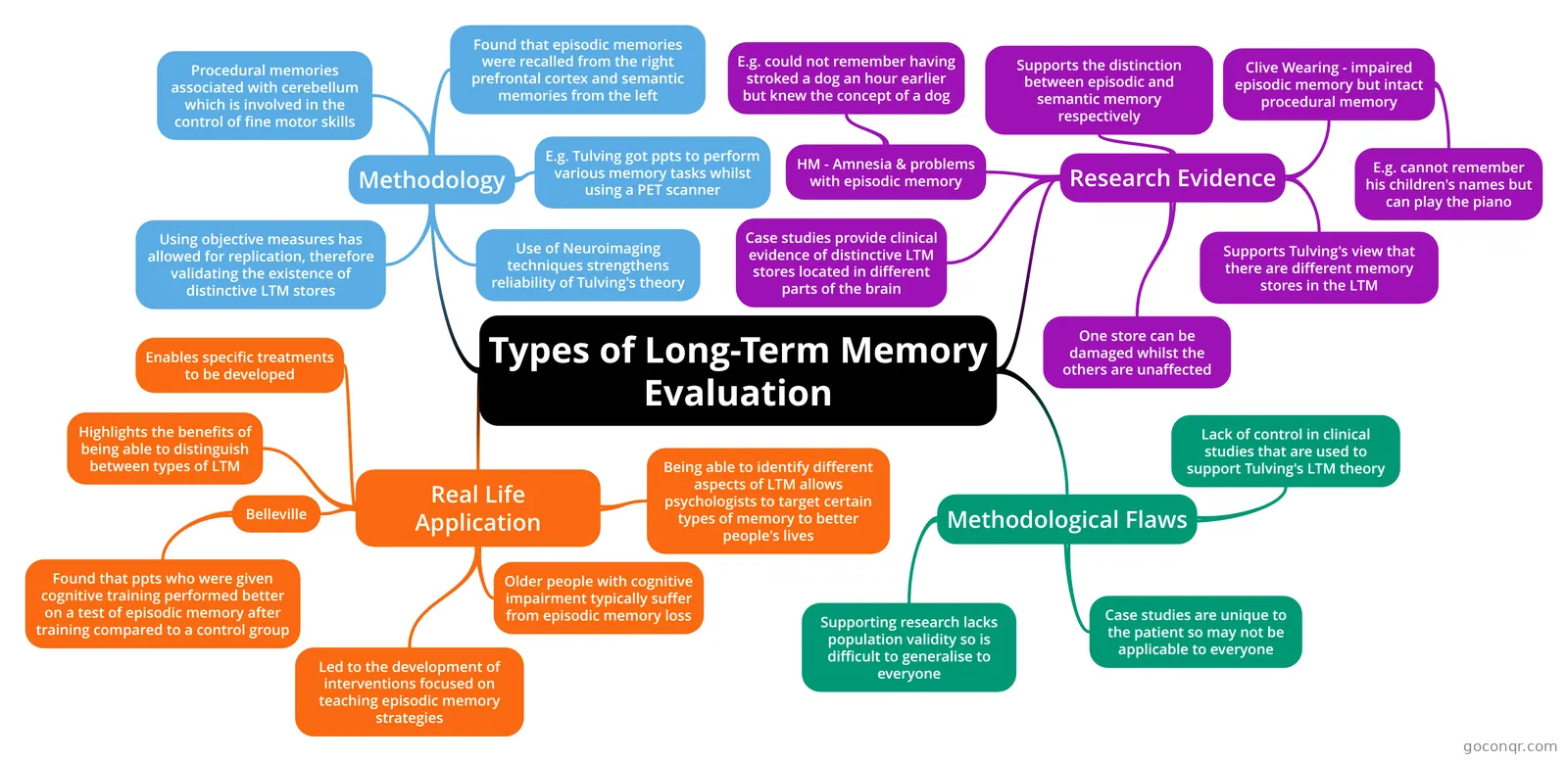
Mind map: Types of long-term memory evaluation
Map content
Types of Long-Term Memory Evaluation
Research Evidence
- Case studies provide clinical evidence of distinctive LTM stores located in different parts of the brain
- HM - Amnesia & problems with episodic memory
- E.g. could not remember having stroked a dog an hour earlier but knew the concept of a dog
- Supports the distinction between episodic and semantic memory respectively
- Clive Wearing - impaired episodic memory but intact procedural memory
- E.g. cannot remember his children's names but can play the piano
- Supports Tulving's view that there are different memory stores in the LTM
- One store can be damaged whilst the others are unaffected
Methodology
- Use of Neuroimaging techniques strengthens reliability of Tulving's theory
- E.g. Tulving got ppts to perform various memory tasks whilst using a PET scanner
- Found that episodic memories were recalled from the right prefrontal cortex and semantic memories from the left
- Procedural memories associated with cerebellum which is involved in the control of fine motor skills
- Using objective measures has allowed for replication, therefore validating the existence of distinctive LTM stores
Real Life Application
- Being able to identify different aspects of LTM allows psychologists to target certain types of memory to better people's lives
- Older people with cognitive impairment typically suffer from episodic memory loss
- Led to the development of interventions focused on teaching episodic memory strategies
- Belleville
- Found that ppts who were given cognitive training performed better on a test of episodic memory after training compared to a control group
- Highlights the benefits of being able to distinguish between types of LTM
- Enables specific treatments to be developed
Methodological Flaws
- Lack of control in clinical studies that are used to support Tulving's LTM theory
- Case studies are unique to the patient so may not be applicable to everyone
- Supporting research lacks population validity so is difficult to generalise to everyone
Information
- Description
- A2 Psychology (P1 Memory) Mind Map on Types of Long-Term Memory Evaluation, created by Abigail Taylor on 14/05/2018.
- Created by
- Abigail Taylor
- Views
- 2
- Rating