
Mind map
Russian economics
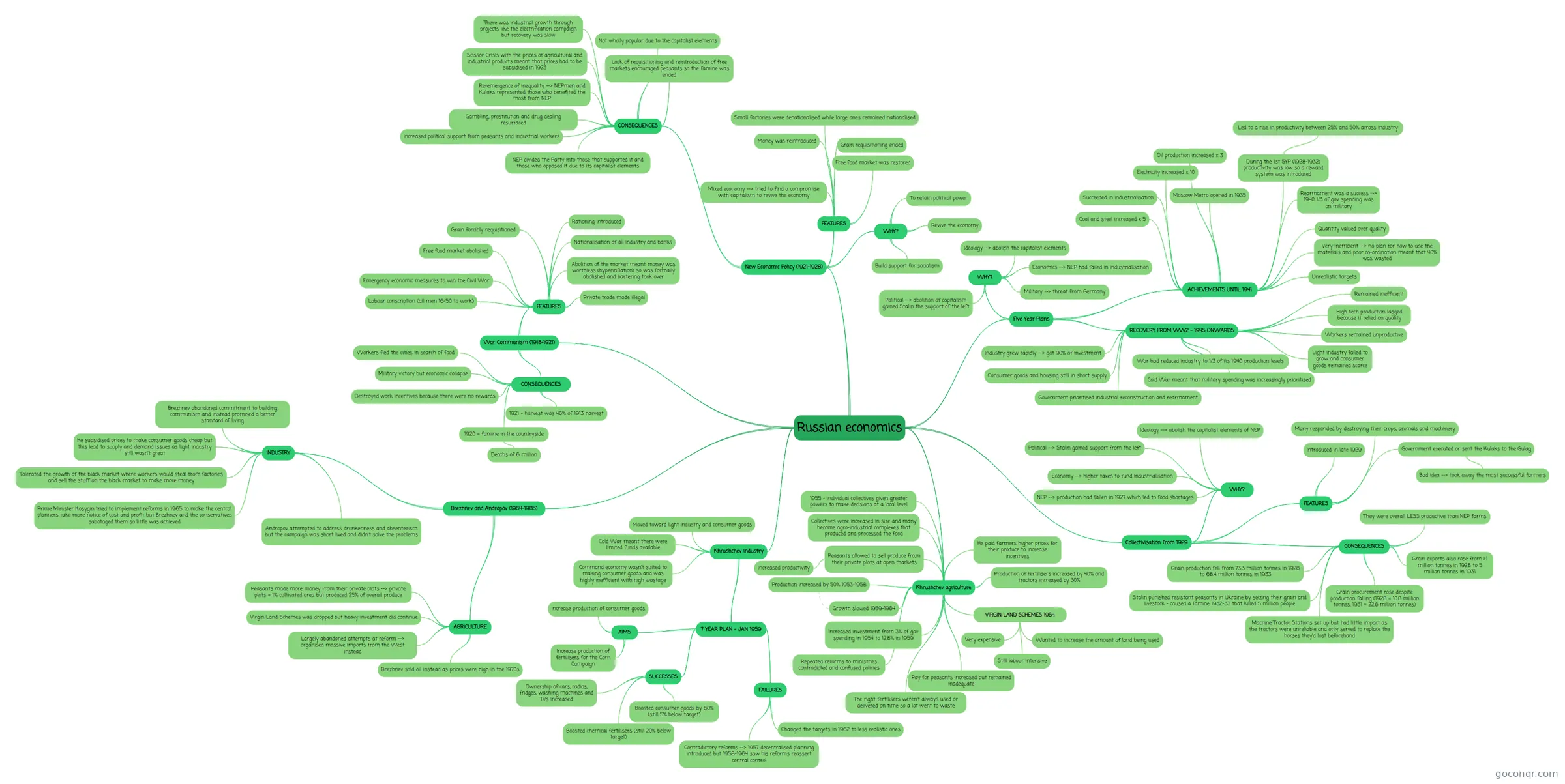
Mind map: Russian economics
Map content
Russian economics
War Communism (1918-1921)
- CONSEQUENCES
- Military victory but economic collapse
- Destroyed work incentives because there were no rewards
- 1920 = famine in the countryside
- Deaths of 6 million
- 1921 - harvest was 46% of 1913 harvest
- Workers fled the cities in search of food
- FEATURES
- Emergency economic measures to win the Civil War
- Nationalisation of all industry and banks
- Free food market abolished
- Grain forcibly requisitioned
- Rationing introduced
- Labour conscription (all men 16-50 to work)
- Abolition of the market meant money was worthless (hyperinflation) so was formally abolished and bartering took over
- Private trade made illegal
- CONSEQUENCES
New Economic Policy (1921-1928)
- WHY?
- To retain political power
- Revive the economy
- Build support for socialism
- FEATURES
- Mixed economy --> tried to find a compromise with capitalism to revive the economy
- Free food market was restored
- Grain requisitioning ended
- Small factories were denationalised while large ones remained nationalised
- Money was reintroduced
- CONSEQUENCES
- Not wholly popular due to the capitalist elements
- Lack of requisitioning and reintroduction of free markets encouraged peasants so the famine was ended
- There was industrial growth through projects like the electrification campaign but recovery was slow
- Scissor Crisis with the prices of agricultural and industrial products meant that prices had to be subsidised in 1923
- Re-emergence of inequality --> NEPmen and Kulaks represented those who benefited the most from NEP
- Gambling, prostitution and drug dealing resurfaced
- Increased political support from peasants and industrial workers
- NEP divided the Party into those that supported it and those who opposed it due to its capitalist elements
- WHY?
Five Year Plans
- WHY?
- Ideology --> abolish the capitalist elements
- Economics --> NEP had failed in industrialisation
- Military --> threat from Germany
- Political --> abolition of capitalism gained Stalin the support of the left
- ACHIEVEMENTS UNTIL 1941
- Succeeded in industrialisation
- Electricity increased x 10
- Coal and steel increased x 5
- Oil production increased x 3
- Moscow Metro opened in 1935
- During the 1st 5YP (1928-1932) productivity was low so a reward system was introduced
- Led to a rise in productivity between 25% and 50% across industry
- Rearmament was a success --> 1940 1/3 of gov spending was on military
- Quantity valued over quality
- Very inefficient --> no plan for how to use the materials and poor co-ordination meant that 40% was wasted
- Unrealistic targets
- RECOVERY FROM WW2 - 1945 ONWARDS
- Industry grew rapidly --> got 90% of investment
- Consumer goods and housing still in short supply
- Government prioritised industrial reconstruction and rearmament
- War had reduced industry to 1/3 of its 1940 production levels
- Cold War meant that military spending was increasingly prioritised
- Remained inefficient
- Workers remained unproductive
- Light industry failed to grow and consumer goods remained scarce
- High tech production lagged because it relied on quality
- WHY?
Collectivisation from 1929
- WHY?
- Ideology --> abolish the capitalist elements of NEP
- Economy --> higher taxes to fund industrialisation
- NEP --> production had fallen in 1927 which led to food shortages
- Political --> Stalin gained support from the left
- FEATURES
- Introduced in late 1929
- Many responded by destroying their crops, animals and machinery
- Government executed or sent the Kulaks to the Gulag
- Bad idea --> took away the most successful farmers
- CONSEQUENCES
- Grain production fell from 73.3 million tonnes in 1928 to 68.4 million tonnes in 1933
- Stalin punished resistant peasants in Ukraine by seizing their grain and livestock - caused a famine 1932-33 that killed 5 million people
- Machine Tractor Stations set up but had little impact as the tractors were unreliable and only served to replace the horses they'd lost beforehand
- Grain procurement rose despite production falling (1928 = 10.8 million tonnes, 1931 = 22.6 million tonnes)
- Grain exports also rose from >1 million tonnes in 1928 to 5 million tonnes in 1931
- They were overall LESS productive than NEP farms
- WHY?
Khrushchev agriculture
- He paid farmers higher prices for their produce to increase incentives
- VIRGIN LAND SCHEMES 1954
- Wanted to increase the amount of land being used
- Very expensive
- Still labour intensive
- Production of fertilisers increased by 40% and tractors increased by 30%
- Increased investment from 3% of gov spending in 1954 to 12.8% in 1959
- Production increased by 50% 1953-1958
- Growth slowed 1959-1964
- The right fertilisers weren't always used or delivered on time so a lot went to waste
- Repeated reforms to ministries contradicted and confused policies
- Pay for peasants increased but remained inadequate
- 1955 - individual collectives given greater powers to make decisions at a local level
- Collectives were increased in size and many become agro-industrial complexes that produced and processed the food
- Peasants allowed to sell produce fro,m their private plots at open markets
- Increased productivity
Khrushchev industry
- Moved toward light industry and consumer goods
- Cold War meant there were limited funds available
- Command economy wasn't suited to making consumer goods and was highly inefficient with high wastage
- 7 YEAR PLAN - JAN 1959
- AIMS
- Increase production of consumer goods
- Increase production of fertilisers for the Corn Campaign
- SUCCESSES
- Boosted consumer goods by 60% (still 5% below target)
- Boosted chemical fertilisers (still 20% below target)
- Ownership of cars, radios, fridges, washing machines and TVs increased
- FAILURES
- Contradictory reforms --> 1957 decentralised planning introduced but 1958-1964 saw his reforms reassert central control
- Changed the targets in 1962 to less realistic ones
- AIMS
Brezhnev and Andropov (1964-1985)
- INDUSTRY
- Brezhnev abandoned commitment to building communism and instead promised a better standard of living
- He subsidised prices to make consumer goods cheap but this lead to supply and demand issues as light industry still wasn't great
- Tolerated the growth of the black market where workers would steal from factories and sell the stuff on the black market to make more money
- Andropov attempted to address drunkenness and absenteeism but the campaign was short lived and didn't solve the problems
- Prime Minister Kosygin tried to implement reforms in 1965 to make the central planners take more notice of cost and profit but Brezhnev and the conservatives sabotaged them so little was achieved
- AGRICULTURE
- Largely abandoned attempts at reform --> organised massive imports from the West instead
- Brezhnev sold oil instead as prices were high in the 1970s
- Virgin Land Schemes was dropped but heavy investment did continue
- Peasants made more money from their private plots --> private plots = 1% cultivated area but produced 25% of overall produce
- INDUSTRY