
Mind map
The Nature of Memory
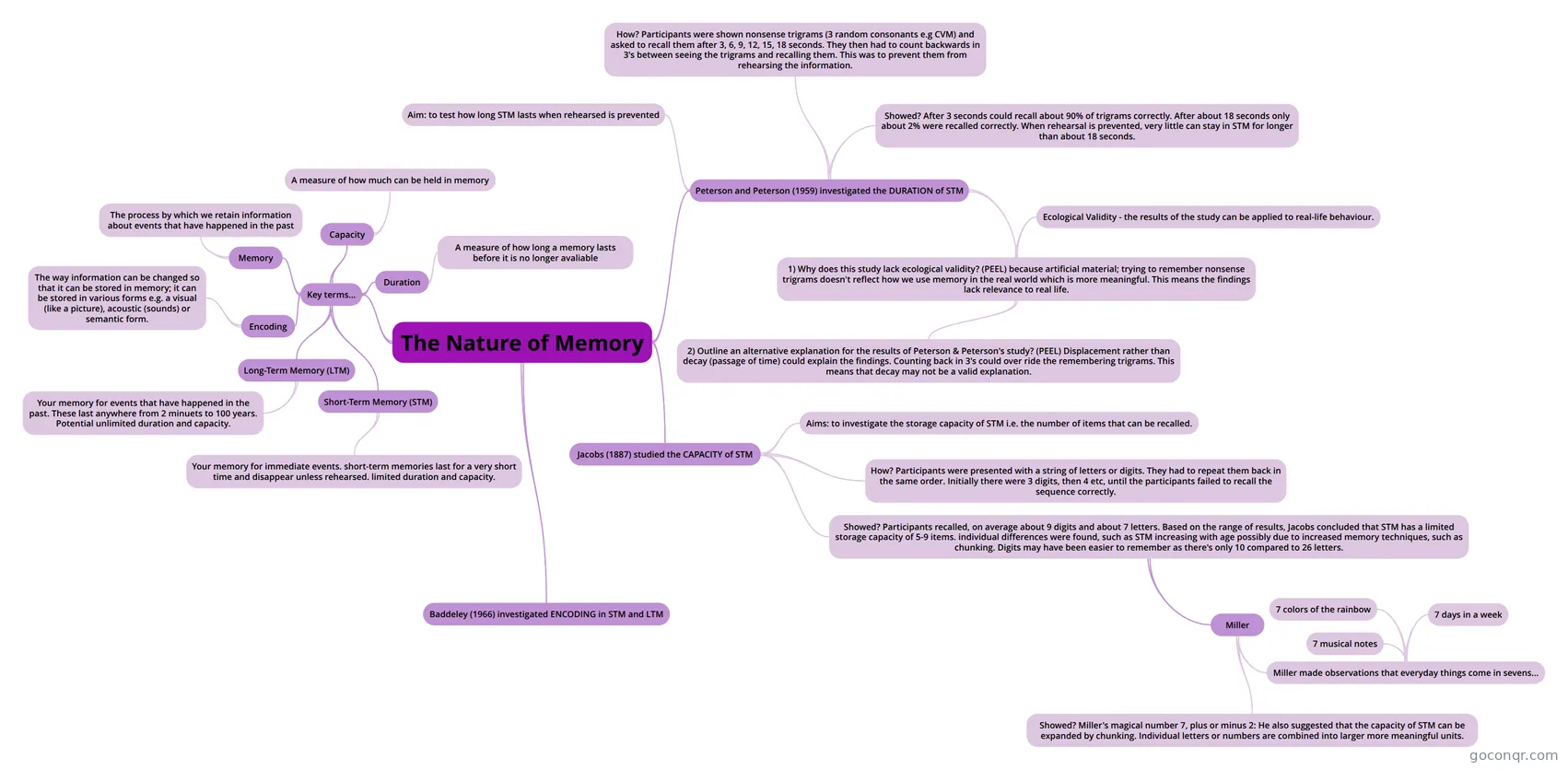
Mind map: The nature of memory
Map content
The Nature of Memory
Key terms...
- Memory
- The process by which we retain information about events that have happened in the past
- Capacity
- A measure of how much can be held in memory
- Duration
- A measure of how long a memory lasts before it is no longer avaliable
- Encoding
- The way information can be changed so that it can be stored in memory; it can be stored in various forms e.g. a visual (like a picture), acoustic (sounds) or semantic form.
- Long-Term Memory (LTM)
- Your memory for events that have happened in the past. These last anywhere from 2 minuets to 100 years. Potential unlimited duration and capacity.
- Short-Term Memory (STM)
- Your memory for immediate events. short-term memories last for a very short time and disappear unless rehearsed. limited duration and capacity.
- Memory
Peterson and Peterson (1959) investigated the DURATION of STM
- Aim: to test how long STM lasts when rehearsed is prevented
- How? Participants were shown nonsense trigrams (3 random consonants e.g CVM) and asked to recall them after 3, 6, 9, 12, 15, 18 seconds. They then had to count backwards in 3's between seeing the trigrams and recalling them. This was to prevent them from rehearsing the information.
- Showed? After 3 seconds could recall about 90% of trigrams correctly. After about 18 seconds only about 2% were recalled correctly. When rehearsal is prevented, very little can stay in STM for longer than about 18 seconds.
- 1) Why does this study lack ecological validity? (PEEL) because artificial material; trying to remember nonsense trigrams doesn't reflect how we use memory in the real world which is more meaningful. This means the findings lack relevance to real life.
- Ecological Validity - the results of the study can be applied to real-life behaviour.
- 2) Outline an alternative explanation for the results of Peterson & Peterson's study? (PEEL) Displacement rather than decay (passage of time) could explain the findings. Counting back in 3's could over ride the remembering trigrams. This means that decay may not be a valid explanation.
Jacobs (1887) studied the CAPACITY of STM
- Aims: to investigate the storage capacity of STM i.e. the number of items that can be recalled.
- How? Participants were presented with a string of letters or digits. They had to repeat them back in the same order. Initially there were 3 digits, then 4 etc, until the participants failed to recall the sequence correctly.
- Showed? Participants recalled, on average about 9 digits and about 7 letters. Based on the range of results, Jacobs concluded that STM has a limited storage capacity of 5-9 items. individual differences were found, such as STM increasing with age possibly due to increased memory techniques, such as chunking. Digits may have been easier to remember as there's only 10 compared to 26 letters.
- Miller
- Miller made observations that everyday things come in sevens...
- 7 colors of the rainbow
- 7 days in a week
- 7 musical notes
- Showed? Miller's magical number 7, plus or minus 2: He also suggested that the capacity of STM can be expanded by chunking. Individual letters or numbers are combined into larger more meaningful units.
- Miller made observations that everyday things come in sevens...
- Miller
Baddeley (1966) investigated ENCODING in STM and LTM
Information
- Description
- A Levels Psychology (Cognitive Psychology - Memory ) Mind Map on The Nature of Memory, created by Ashley Jade on 16/10/2014.
- Created by
- Ashley Jade
- Views
- 6
- Rating