
Mind map
The Working Memory Model, Baddeley and Hitch 1974
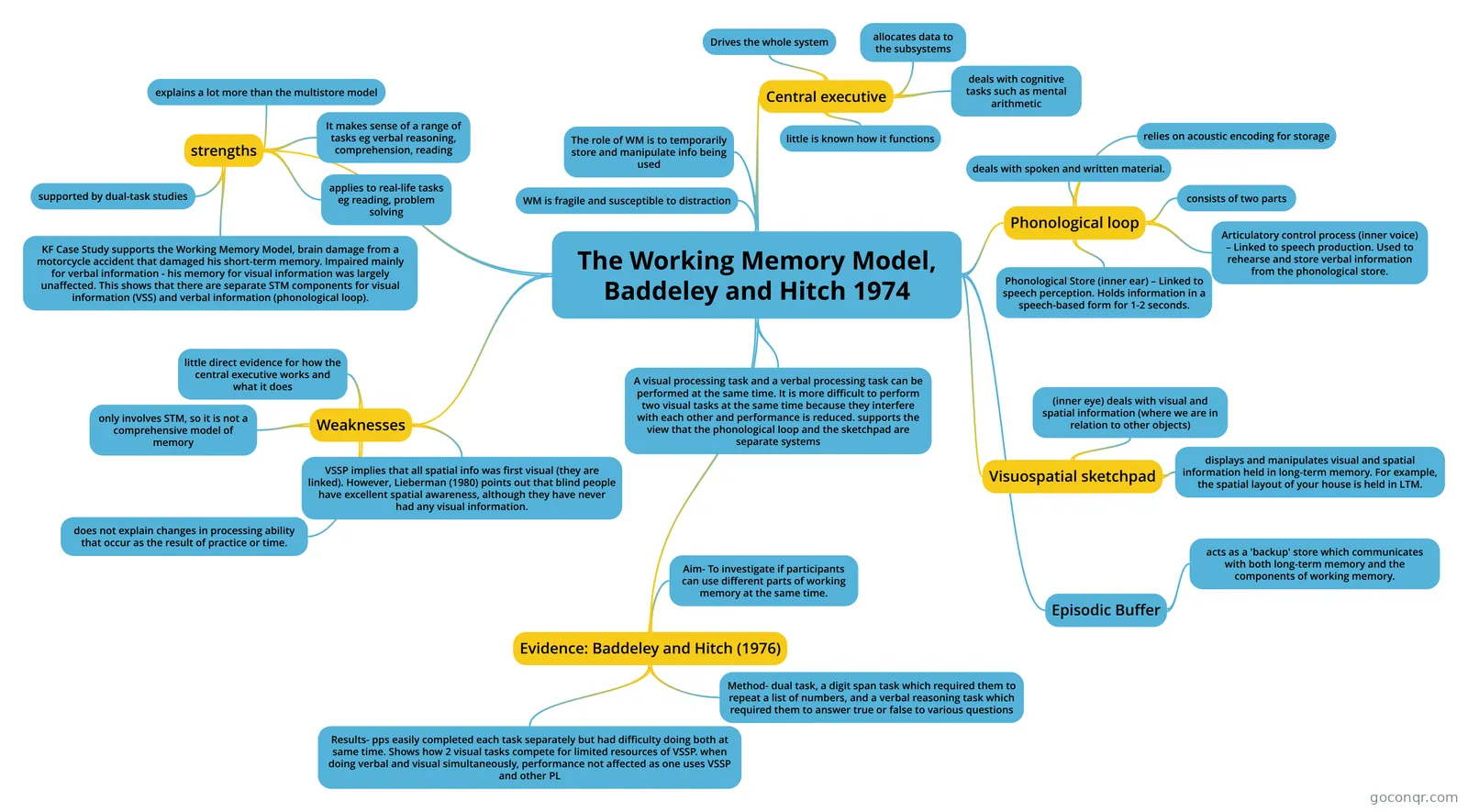
Mind map: Working Memory Model, Baddeley and Hitch 1974
Map content
The Working Memory Model, Baddeley and Hitch 1974
Central executive
- Drives the whole system
- allocates data to the subsystems
- deals with cognitive tasks such as mental arithmetic
- little is known how it functions
The role of WM is to temporarily store and manipulate info being used
WM is fragile and susceptible to distraction
Phonological loop
- deals with spoken and written material.
- Phonological Store (inner ear) – Linked to speech perception. Holds information in a speech-based form for 1-2 seconds.
- consists of two parts
- Articulatory control process (inner voice) – Linked to speech production. Used to rehearse and store verbal information from the phonological store.
- relies on acoustic encoding for storage
strengths
- explains a lot more than the multistore model
- It makes sense of a range of tasks eg verbal reasoning, comprehension, reading
- applies to real-life tasks eg reading, problem solving
- KF Case Study supports the Working Memory Model, brain damage from a motorcycle accident that damaged his short-term memory. Impaired mainly for verbal information - his memory for visual information was largely unaffected. This shows that there are separate STM components for visual information (VSS) and verbal information (phonological loop).
- supported by dual-task studies
Visuospatial sketchpad
- (inner eye) deals with visual and spatial information (where we are in relation to other objects)
- displays and manipulates visual and spatial information held in long-term memory. For example, the spatial layout of your house is held in LTM.
A visual processing task and a verbal processing task can be performed at the same time. It is more difficult to perform two visual tasks at the same time because they interfere with each other and performance is reduced. supports the view that the phonological loop and the sketchpad are separate systems
Evidence: Baddeley and Hitch (1976)
- Aim- To investigate if participants can use different parts of working memory at the same time.
- Method- dual task, a digit span task which required them to repeat a list of numbers, and a verbal reasoning task which required them to answer true or false to various questions
- Results- pps easily completed each task separately but had difficulty doing both at same time. Shows how 2 visual tasks compete for limited resources of VSSP. when doing verbal and visual simultaneously, performance not affected as one uses VSSP and other PL
Episodic Buffer
- acts as a 'backup' store which communicates with both long-term memory and the components of working memory.
Weaknesses
- VSSP implies that all spatial info was first visual (they are linked). However, Lieberman (1980) points out that blind people have excellent spatial awareness, although they have never had any visual information.
- little direct evidence for how the central executive works and what it does
- only involves STM, so it is not a comprehensive model of memory
- does not explain changes in processing ability that occur as the result of practice or time.
Information
- Description
- psychology Psychology Mind Map on The Working Memory Model, Baddeley and Hitch 1974, created by Georgia Rose on 11/10/2018.
- Created by
- Georgia Rose
- Views
- 0
- Rating