
Mind map
Neural and hormonal mechanisms in aggression
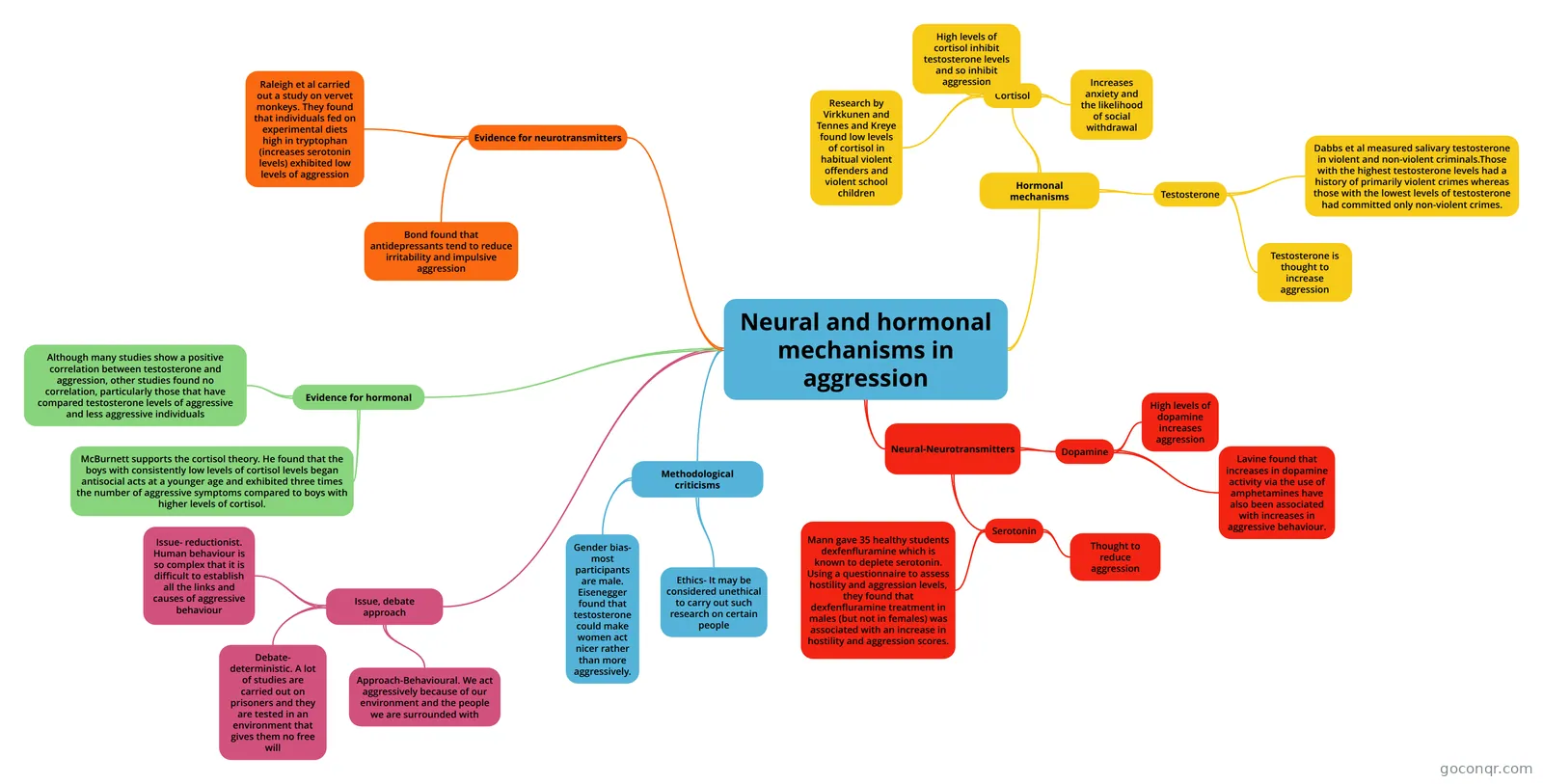
Mind map: Neural and hormonal mechanisms in aggression
Map content
Neural and hormonal mechanisms in aggression
Neural-Neurotransmitters
- Serotonin
- Thought to reduce aggression
- Mann gave 35 healthy students dexfenfluramine which is known to deplete serotonin. Using a questionnaire to assess hostility and aggression levels, they found that dexfenfluramine treatment in males (but not in females) was associated with an increase in hostility and aggression scores.
- Dopamine
- High levels of dopamine increases aggression
- Lavine found that increases in dopamine activity via the use of amphetamines have also been associated with increases in aggressive behaviour.
- Serotonin
Hormonal mechanisms
- Testosterone
- Testosterone is thought to increase aggression
- Dabbs et al measured salivary testosterone in violent and non-violent criminals.Those with the highest testosterone levels had a history of primarily violent crimes whereas those with the lowest levels of testosterone had committed only non-violent crimes.
- Cortisol
- Increases anxiety and the likelihood of social withdrawal
- High levels of cortisol inhibit testosterone levels and so inhibit aggression
- Research by Virkkunen and Tennes and Kreye found low levels of cortisol in habitual violent offenders and violent school children
- Testosterone
Evidence for neurotransmitters
- Raleigh et al carried out a study on vervet monkeys. They found that individuals fed on experimental diets high in tryptophan (increases serotonin levels) exhibited low levels of aggression
- Bond found that antidepressants tend to reduce irritability and impulsive aggression
Evidence for hormonal
- Although many studies show a positive correlation between testosterone and aggression, other studies found no correlation, particularly those that have compared testosterone levels of aggressive and less aggressive individuals
- McBurnett supports the cortisol theory. He found that the boys with consistently low levels of cortisol levels began antisocial acts at a younger age and exhibited three times the number of aggressive symptoms compared to boys with higher levels of cortisol.
Issue, debate approach
- Issue- reductionist. Human behaviour is so complex that it is difficult to establish all the links and causes of aggressive behaviour
- Debate- deterministic. A lot of studies are carried out on prisoners and they are tested in an environment that gives them no free will
- Approach-Behavioural. We act aggressively because of our environment and the people we are surrounded with
Methodological criticisms
- Gender bias- most participants are male. Eisenegger found that testosterone could make women act nicer rather than more aggressively.
- Ethics- It may be considered unethical to carry out such research on certain people
Information
- Description
- A Levels Psychology (Aggression) Mind Map on Neural and hormonal mechanisms in aggression, created by elizabethc2114 on 25/01/2015.
- Created by
- elizabethc2114
- Views
- 3
- Rating
More on Neural and hormonal mechanisms of aggression