
Mind map
Evaluation of Factors Affecting EWT
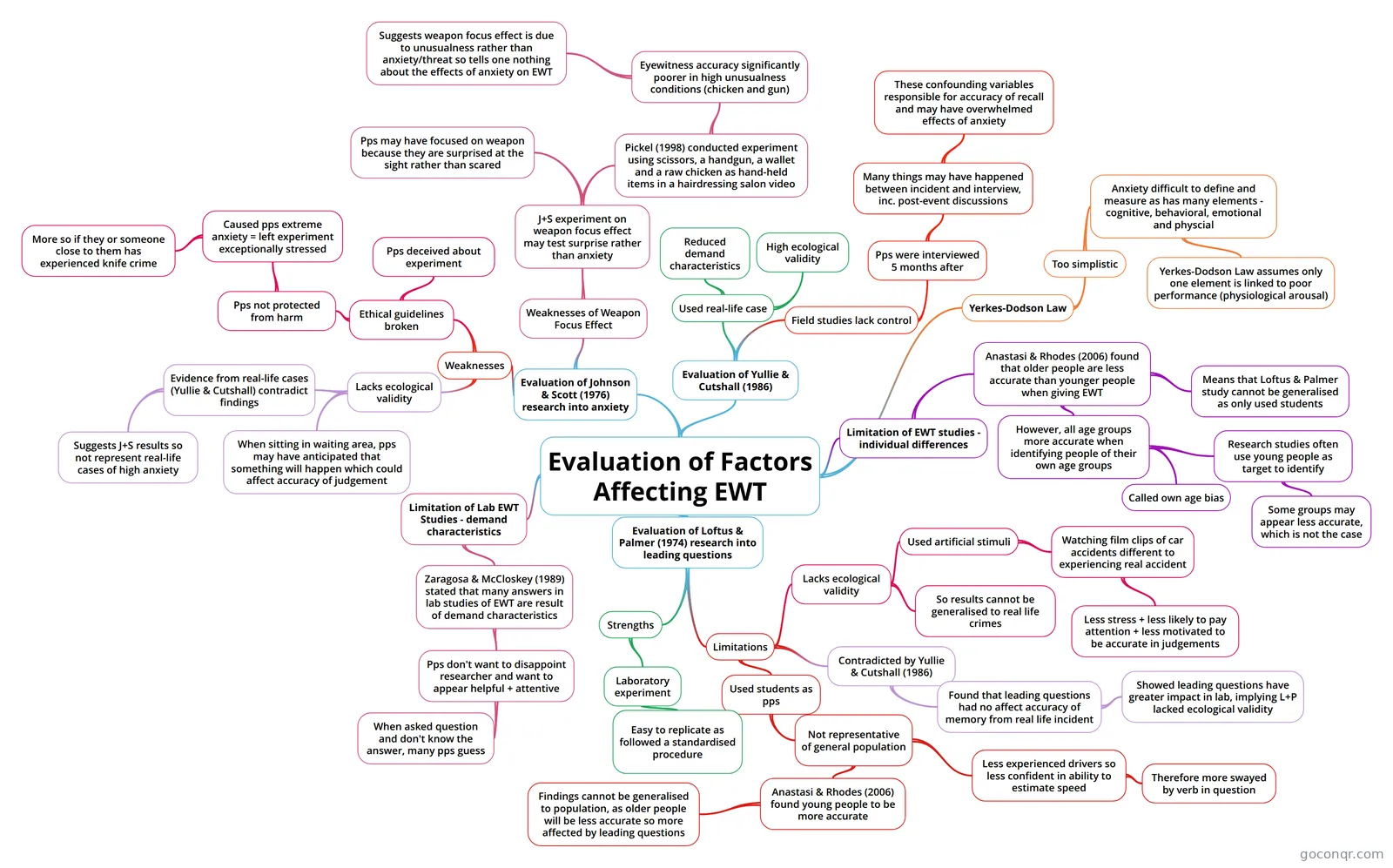
Mind map: Evaluation of Factors Affecting EWT
Map content
Evaluation of Factors Affecting EWT
Evaluation of Loftus & Palmer (1974) research into leading questions
- Limitations
- Lacks ecological validity
- Used artificial stimuli
- Watching film clips of car accidents different to experiencing real accident
- Less stress + less likely to pay attention + less motivated to be accurate in judgements
- Watching film clips of car accidents different to experiencing real accident
- So results cannot be generalised to real life crimes
- Used artificial stimuli
- Contradicted by Yullie & Cutshall (1986)
- Found that leading questions had no affect accuracy of memory from real life incident
- Showed leading questions have greater impact in lab, implying L+P lacked ecological validity
- Found that leading questions had no affect accuracy of memory from real life incident
- Used students as pps
- Not representative of general population
- Less experienced drivers so less confident in ability to estimate speed
- Therefore more swayed by verb in question
- Anastasi & Rhodes (2006) found young people to be more accurate
- Findings cannot be generalised to population, as older people will be less accurate so more affected by leading questions
- Less experienced drivers so less confident in ability to estimate speed
- Not representative of general population
- Lacks ecological validity
- Strengths
- Laboratory experiment
- Easy to replicate as followed a standardised procedure
- Laboratory experiment
- Limitations
Limitation of EWT studies - individual differences
- Anastasi & Rhodes (2006) found that older people are less accurate than younger people when giving EWT
- However, all age groups more accurate when identifying people of their own age groups
- Called own age bias
- Research studies often use young people as target to identify
- Some groups may appear less accurate, which is not the case
- Means that Loftus & Palmer study cannot be generalised as only used students
- However, all age groups more accurate when identifying people of their own age groups
- Anastasi & Rhodes (2006) found that older people are less accurate than younger people when giving EWT
Limitation of Lab EWT Studies - demand characteristics
- Zaragosa & McCloskey (1989) stated that many answers in lab studies of EWT are result of demand characteristics
- Pps don't want to disappoint researcher and want to appear helpful + attentive
- When asked question and don't know the answer, many pps guess
- Pps don't want to disappoint researcher and want to appear helpful + attentive
- Zaragosa & McCloskey (1989) stated that many answers in lab studies of EWT are result of demand characteristics
Evaluation of Johnson & Scott (1976) research into anxiety
- Weaknesses
- Lacks ecological validity
- When sitting in waiting area, pps may have anticipated that something will happen which could affect accuracy of judgement
- Evidence from real-life cases (Yullie & Cutshall) contradict findings
- Suggests J+S results so not represent real-life cases of high anxiety
- Ethical guidelines broken
- Pps deceived about experiment
- Pps not protected from harm
- Caused pps extreme anxiety = left experiment exceptionally stressed
- More so if they or someone close to them has experienced knife crime
- Caused pps extreme anxiety = left experiment exceptionally stressed
- Lacks ecological validity
- Weaknesses of Weapon Focus Effect
- J+S experiment on weapon focus effect may test surprise rather than anxiety
- Pps may have focused on weapon because they are surprised at the sight rather than scared
- Pickel (1998) conducted experiment using scissors, a handgun, a wallet and a raw chicken as hand-held items in a hairdressing salon video
- Eyewitness accuracy significantly poorer in high unusualness conditions (chicken and gun)
- Suggests weapon focus effect is due to unusualness rather than anxiety/threat so tells one nothing about the effects of anxiety on EWT
- Eyewitness accuracy significantly poorer in high unusualness conditions (chicken and gun)
- J+S experiment on weapon focus effect may test surprise rather than anxiety
- Weaknesses
Evaluation of Yullie & Cutshall (1986)
- Used real-life case
- High ecological validity
- Reduced demand characteristics
- Field studies lack control
- Pps were interviewed 5 months after
- Many things may have happened between incident and interview, inc. post-event discussions
- These confounding variables responsible for accuracy of recall and may have overwhelmed effects of anxiety
- Many things may have happened between incident and interview, inc. post-event discussions
- Pps were interviewed 5 months after
- Used real-life case
Yerkes-Dodson Law
- Too simplistic
- Anxiety difficult to define and measure as has many elements - cognitive, behavioral, emotional and physcial
- Yerkes-Dodson Law assumes only one element is linked to poor performance (physiological arousal)
- Anxiety difficult to define and measure as has many elements - cognitive, behavioral, emotional and physcial
- Too simplistic
Information
- Description
- A level Psychology Mind Map on Evaluation of Factors Affecting EWT, created by Alex Nam on 02/11/2019.
- Created by
- Alex Nam
- Views
- 0
- Rating