
Mind map
Caregiver-Infant Interaction in Humans
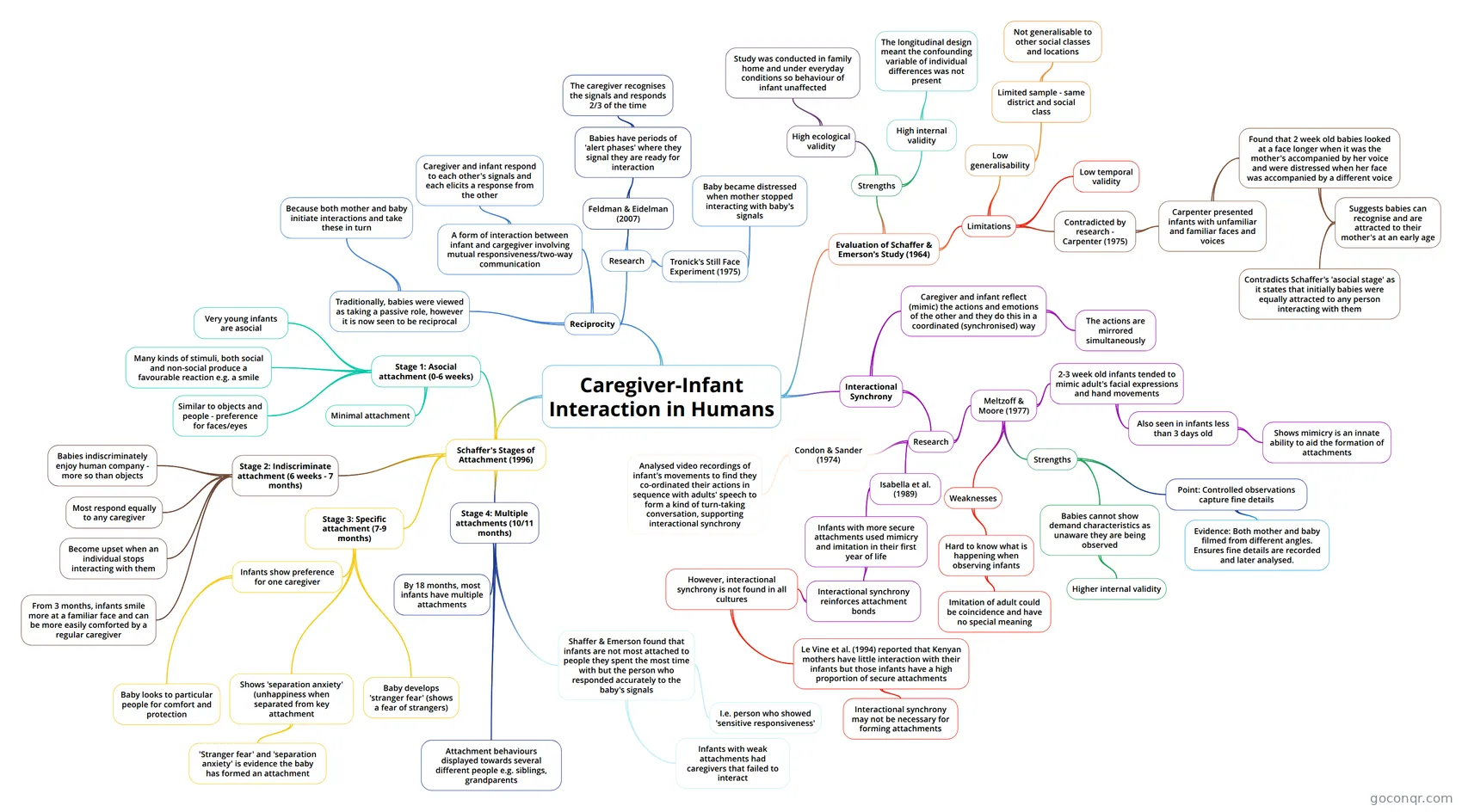
Mind map: caregiver-infant interaction in humans
Map content
Caregiver-Infant Interaction in Humans
Reciprocity
- A form of interaction between infant and cargegiver involving mutual responsiveness/two-way communication
- Caregiver and infant respond to each other's signals and each elicits a response from the other
- Traditionally, babies were viewed as taking a passive role, however it is now seen to be reciprocal
- Because both mother and baby initiate interactions and take these in turn
- Research
- Feldman & Eidelman (2007)
- Babies have periods of 'alert phases' where they signal they are ready for interaction
- The caregiver recognises the signals and responds 2/3 of the time
- Babies have periods of 'alert phases' where they signal they are ready for interaction
- Tronick's Still Face Experiment (1975)
- Baby became distressed when mother stopped interacting with baby's signals
- Feldman & Eidelman (2007)
- A form of interaction between infant and cargegiver involving mutual responsiveness/two-way communication
Interactional Synchrony
- Caregiver and infant reflect (mimic) the actions and emotions of the other and they do this in a coordinated (synchronised) way
- The actions are mirrored simultaneously
- Research
- Meltzoff & Moore (1977)
- 2-3 week old infants tended to mimic adult's facial expressions and hand movements
- Also seen in infants less than 3 days old
- Shows mimicry is an innate ability to aid the formation of attachments
- Also seen in infants less than 3 days old
- Strengths
- Point: Controlled observations capture fine details
- Evidence: Both mother and baby filmed from different angles. Ensures fine details are recorded and later analysed.
- Babies cannot show demand characteristics as unaware they are being observed
- Higher internal validity
- Point: Controlled observations capture fine details
- Weaknesses
- Hard to know what is happening when observing infants
- Imitation of adult could be coincidence and have no special meaning
- Hard to know what is happening when observing infants
- 2-3 week old infants tended to mimic adult's facial expressions and hand movements
- Condon & Sander (1974)
- Analysed video recordings of infant's movements to find they co-ordinated their actions in sequence with adults' speech to form a kind of turn-taking conversation, supporting interactional synchrony
- Isabella et al. (1989)
- Infants with more secure attachments used mimicry and imitation in their first year of life
- Interactional synchrony reinforces attachment bonds
- However, interactional synchrony is not found in all cultures
- Le Vine et al. (1994) reported that Kenyan mothers have little interaction with their infants but those infants have a high proportion of secure attachments
- Interactional synchrony may not be necessary for forming attachments
- Le Vine et al. (1994) reported that Kenyan mothers have little interaction with their infants but those infants have a high proportion of secure attachments
- However, interactional synchrony is not found in all cultures
- Interactional synchrony reinforces attachment bonds
- Infants with more secure attachments used mimicry and imitation in their first year of life
- Meltzoff & Moore (1977)
- Caregiver and infant reflect (mimic) the actions and emotions of the other and they do this in a coordinated (synchronised) way
Schaffer's Stages of Attachment (1996)
- Stage 1: Asocial attachment (0-6 weeks)
- Very young infants are asocial
- Many kinds of stimuli, both social and non-social produce a favourable reaction e.g. a smile
- Similar to objects and people - preference for faces/eyes
- Minimal attachment
- Stage 2: Indiscriminate attachment (6 weeks - 7 months)
- Babies indiscriminately enjoy human company - more so than objects
- Most respond equally to any caregiver
- Become upset when an individual stops interacting with them
- From 3 months, infants smile more at a familiar face and can be more easily comforted by a regular caregiver
- Stage 3: Specific attachment (7-9 months)
- Infants show preference for one caregiver
- Baby looks to particular people for comfort and protection
- Baby develops 'stranger fear' (shows a fear of strangers)
- Shows 'separation anxiety' (unhappiness when separated from key attachment
- 'Stranger fear' and 'separation anxiety' is evidence the baby has formed an attachment
- Infants show preference for one caregiver
- Stage 4: Multiple attachments (10/11 months)
- Attachment behaviours displayed towards several different people e.g. siblings, grandparents
- By 18 months, most infants have multiple attachments
- Shaffer & Emerson found that infants are not most attached to people they spent the most time with but the person who responded accurately to the baby's signals
- I.e. person who showed 'sensitive responsiveness'
- Infants with weak attachments had caregivers that failed to interact
- Stage 1: Asocial attachment (0-6 weeks)
Evaluation of Schaffer & Emerson's Study (1964)
- Strengths
- High ecological validity
- Study was conducted in family home and under everyday conditions so behaviour of infant unaffected
- High internal validity
- The longitudinal design meant the confounding variable of individual differences was not present
- High ecological validity
- Limitations
- Low generalisability
- Limited sample - same district and social class
- Not generalisable to other social classes and locations
- Limited sample - same district and social class
- Low temporal validity
- Contradicted by research - Carpenter (1975)
- Carpenter presented infants with unfamiliar and familiar faces and voices
- Found that 2 week old babies looked at a face longer when it was the mother's accompanied by her voice and were distressed when her face was accompanied by a different voice
- Suggests babies can recognise and are attracted to their mother's at an early age
- Contradicts Schaffer's 'asocial stage' as it states that initially babies were equally attracted to any person interacting with them
- Suggests babies can recognise and are attracted to their mother's at an early age
- Found that 2 week old babies looked at a face longer when it was the mother's accompanied by her voice and were distressed when her face was accompanied by a different voice
- Carpenter presented infants with unfamiliar and familiar faces and voices
- Low generalisability
- Strengths
Information
- Description
- A level Psychology Mind Map on Caregiver-Infant Interaction in Humans, created by Alex Nam on 24/11/2019.
- Created by
- Alex Nam
- Views
- 0
- Rating
More on Caregiver-infant interactions