
Mind map
Immuno 10-15
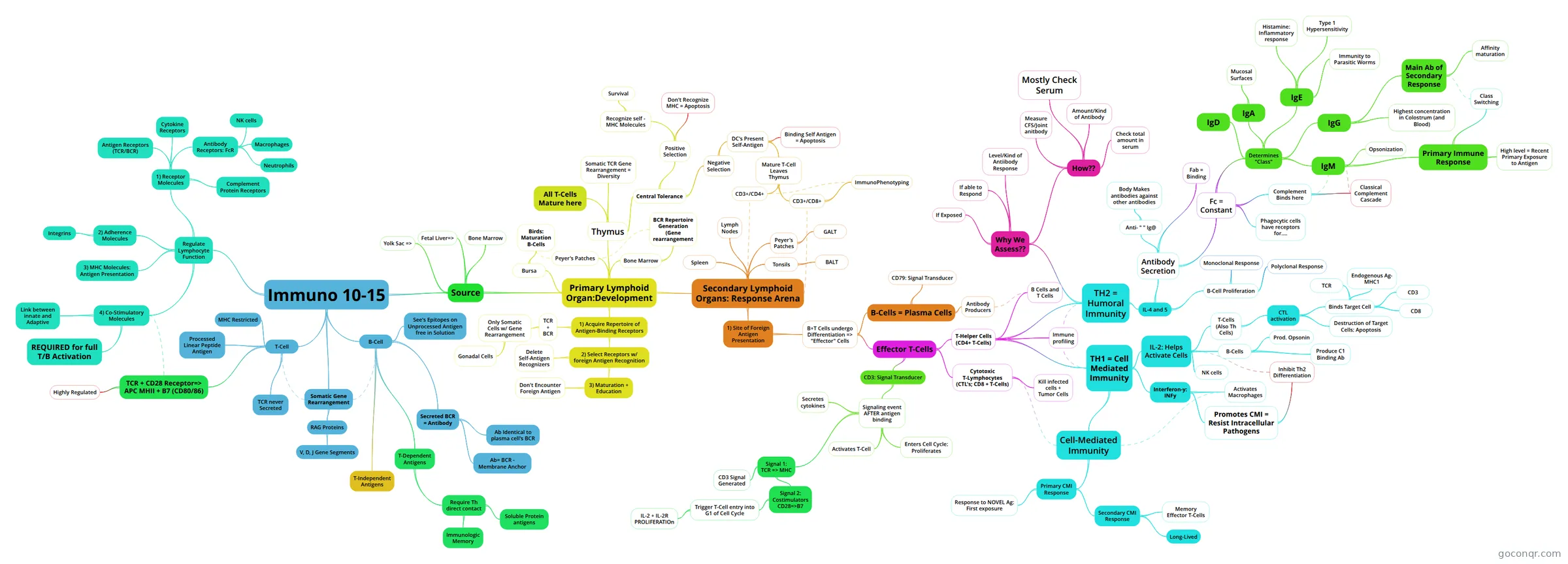
Mind map: T-cell and B-cell immunology
Map content
Immuno 10-15
T-Cell
- MHC Restricted
- Processed Linear Peptide Antigen
- TCR never Secreted
- TCR + CD28 Receptor=> APC MHII + B7 (CD80/86)
- Highly Regulated
B-Cell
- See's Epitopes on Unprocessed Antigen free in Solution
- Secreted BCR = Antibody
- Ab= BCR - Membrane Anchor
- Ab Identical to plasma cell's BCR
- T-Dependent Antigens
- Require Th direct contact
- Immunologic Memory
- Soluble Protein antigens
- Require Th direct contact
- T-Independent Antigens
Source
- Fetal Liver=>
- Bone Marrow
- Yolk Sac =>
- Primary Lymphoid Organ:Development
- Primary Lymphoid Organs= Education/Maturation with self antigen
- Thymus
- All T-Cells Mature here
- Somatic TCR Gene Rearrangement = Diversity
- Central Tolerance
- Positive Selection
- Recognize self - MHC Molecules
- Survival
- Don't Recognize MHC = Apoptosis
- Recognize self - MHC Molecules
- Negative Selection
- DC's Present Self-Antigen
- Binding Self Antigen = Apoptosis
- Mature T-Cell Leaves Thymus
- Remain in thymus 4-5 days.
- CD3+/CD4+
- CD3+/CD8+
- ImmunoPhenotyping
- DC's Present Self-Antigen
- Positive Selection
- Bursa
- Only in Birds
- Birds: Maturation B-Cells
- Peyer's Patches
- Bursa Equivalent in Mammals. Small Intestines
- Bone Marrow
- BCR Repertoire Generation (Gene rearrangement
- Secondary Lymphoid Organs: Response Arena
- Secondary Lymphoid Organs: Differentiation after foreign antigen exposure
- Lymph Nodes
- Peyer's Patches
- GALT
- Gut Associated Lymphoid Tissue
- GALT
- Spleen
- Tonsils
- BALT
- Bronchus Associated Lymphoid Tissue
- BALT
- 1) Site of Foreign Antigen Presentation
- B+T Cells undergo Differentiation => "Effector" Cells
- B-Cells = Plasma Cells
- Antibody Producers
- CD79: Signal Transducer
- Effector T-Cells
- Cytotoxic T-Lymphocytes (CTL's; CD8 + T-Cells)
- Kill infected cells + Tumor Cells
- Infected cells w/ MHC-1 presentation -Tumor w/ Tumor Antigens w/ MHC1 -MHC Incompatible Cells
- Kill infected cells + Tumor Cells
- T-Helper Cells (CD4+ T-Cells)
- B Cells and T Cells
- TH1 = Cell Mediated Immunity
- IL-2: Helps Activate Cells
- T-Cells (Also Th Cells)
- CTL activation
- Binds Target Cell
- TCR
- CD3
- CD8
- Endogenous Ag- MHC1
- Destruction of Target Cells: Apoptosis
- Binds Target Cell
- CTL activation
- B-Cells
- Prod. Opsonin
- Produce C1 Binding Ab
- NK cells
- T-Cells (Also Th Cells)
- Interferon-y: INFy
- Also made by other cells
- Activates Macrophages
- Promotes CMI = Resist Intracellular Pathogens
- Inhibit Th2 Differentiation
- Cell-Mediated Immunity
- 1) Th1 Cells direct the CTL's 2) Delayed-type hypersensitivity (DTH) response: Marophages directed by Th1 cells
- Primary CMI Response
- Response to NOVEL Ag: First exposure
- Secondary CMI Response
- Memory Effector T-Cells
- Long-Lived
- IL-2: Helps Activate Cells
- TH2 = Humoral Immunity
- IL-4 and 5
- B-Cell Proliferation
- Monoclonal Response
- Polyclonal Response
- Antibody Secretion
- Positive Charge Electrophoresis: most Ig migrates to negative cathode: Gamma
- Can: 1) Act as Opsonin 2) Activate Classical Complement Cascade 3) Bind Pathogens, Neutralize 4) Blocking of Attachment 5) Aggregation
- Anti- " " Ig@
- Anti-Human IgM = Human IgM antibody injected into mouse, mouse plasma cells make antibody against human IgM
- Body Makes antibodies against other antibodies
- Fab = Binding
- Fc = Constant
- Complement Binds here
- Classical Complement Cascade
- IgG and IgM allow binding of complement to Fc region
- Classical Complement Cascade
- Determines "Class"
- IgA
- Mucosal Surfaces
- IgG
- Main Ab of Secondary Response
- Affinity maturation
- Highest concentration in Colostrum (and Blood)
- Main Ab of Secondary Response
- IgE
- Histamine: Inflammatory response
- Type 1 Hypersensitivity
- Immunity to Parasitic Worms
- IgM
- Opsonization
- Primary Immune Response
- High level = Recent Primary Exposure to Antigen
- Class Switching
- IgD
- IgA
- Phagocytic cells have receptors for....
- Complement Binds here
- B-Cell Proliferation
- Why We Assess??
- If Exposed
- If able to Respond
- Level/Kind of Antiibody Response
- How??
- Measure CFS/Joint anitbody
- Mostly Check Serum
- Amount/Kind of Antibody
- Check total amount in serum
- IL-4 and 5
- Immune profiling
- CD3: Signal Transducer
- Signaling event AFTER antigen binding
- Activates T-Cell
- Enters Cell Cycle: Proliferates
- Secretes cytokines
- Signal 1: TCR => MHC
- Signal 2: Costimulators CD28=>B7
- Trigger T-Cell entry into G1 of Cell Cycle
- IL-2 + IL-2R PROLIFERATIOn
- Trigger T-Cell entry into G1 of Cell Cycle
- CD3 Signal Generated
- Signal 2: Costimulators CD28=>B7
- Signaling event AFTER antigen binding
- Cytotoxic T-Lymphocytes (CTL's; CD8 + T-Cells)
- B-Cells = Plasma Cells
- B+T Cells undergo Differentiation => "Effector" Cells
- 1) Acquire Repertoire of Antigen-Binding Receptors
- TCR + BCR
- Only Somatic Cells w/ Gene Rearrangement
- Gonadal Cells
- Only Somatic Cells w/ Gene Rearrangement
- 2) Select Receptors w/ foreign Antigen Recognition
- Delete Self-Antigen Recognizers
- 3) Maturation + Education
- Don't Encounter Foreign Antigen
- TCR + BCR
Somatic Gene Rearrangement
- RAG Proteins
- Recombination Activating Gene Protein
- V, D, J Gene Segments
- RAG Proteins
Regulate Lymphocyte Function
- 1) Receptor Molecules
- Antigen Receptors (TCR/BCR)
- Cytokine Receptors
- Antibody Receptors: FcR
- NK cells
- Macrophages
- Neutrophils
- Complement Protein Receptors
- 2) Adherence Molecules
- Integrins
- 3) MHC Molecules: Antigen Presentation
- 4) Co-Stimulatory Molecules
- Stimulated on APC side by exposure to PAMPS or Cytokines -Not antigen specific 1st signal = MHC/Ag - TCR 2nd signal = APC: CD80 (B7) =>Tcell CD28
- Link between innate and Adaptive
- REQUIRED for full T/B Activation
- 1) Receptor Molecules
Information
- Description
- Veterinary Mind Map on Immuno 10-15, created by lance Shen on 01/03/2020.
- Created by
- lance Shen
- Views
- 3
- Rating