
Mind map
GCSE PSYCHOLOGY - PERCEPTION
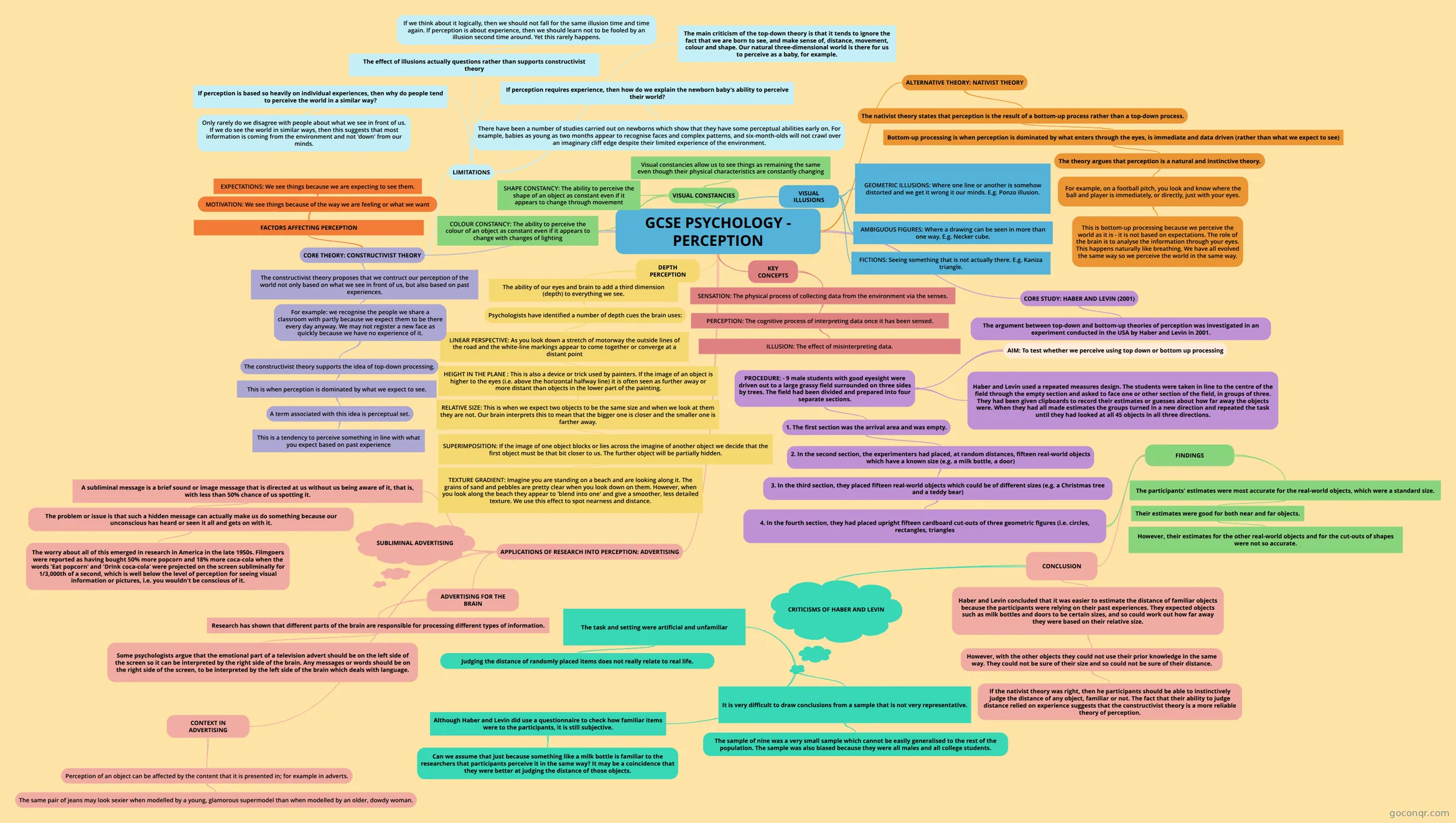
Mind map: GCSE psychology perception
Map content
GCSE PSYCHOLOGY - PERCEPTION
KEY CONCEPTS
- SENSATION: The physical process of collecting data from the environment via the senses.
- PERCEPTION: The cognitive process of interpreting data once it has been sensed.
- ILLUSION: The effect of misinterpreting data.
- PERCEPTION: The cognitive process of interpreting data once it has been sensed.
- SENSATION: The physical process of collecting data from the environment via the senses.
VISUAL ILLUSIONS
- GEOMETRIC ILLUSIONS: Where one line or another is somehow distorted and we get it wrong it our minds. E.g. Ponzo illusion.
- AMBIGUOUS FIGURES: Where a drawing can be seen in more than one way. E.g. Necker cube.
- FICTIONS: Seeing something that is not actually there. E.g. Kaniza triangle.
VISUAL CONSTANCIES
- Visual constancies allow us to see things as remaining the same even though their physical characteristics are constantly changing
- SHAPE CONSTANCY: The ability to perceive the shape of an object as constant even if it appears to change through movement
- COLOUR CONSTANCY: The ability to perceive the colour of an object as constant even if it appears to change with changes of lighting
DEPTH PERCEPTION
- The ability of our eyes and brain to add a third dimension (depth) to everything we see.
- Psychologists have identified a number of depth cues the brain uses:
- LINEAR PERSPECTIVE: As you look down a stretch of motorway the outside lines of the road and the white-line markings appear to come together or converge at a distant point
- HEIGHT IN THE PLANE : This is also a device or trick used by painters. If the image of an object is higher to the eyes (i.e. above the horizontal halfway line) it is often seen as further away or more distant than objects in the lower part of the painting.
- RELATIVE SIZE: This is when we expect two objects to be the same size and when we look at them they are not. Our brain interprets this to mean that the bigger one is closer and the smaller one is farther away.
- SUPERIMPOSITION: If the image of one object blocks or lies across the imagine of another object we decide that the first object must be that bit closer to us. The further object will be partially hidden.
- TEXTURE GRADIENT: Imagine you are standing on a beach and are looking along it. The grains of sand and pebbles are pretty clear when you look down on them. However, when you look along the beach they appear to 'blend into one' and give a smoother, less detailed texture. We use this effect to spot nearness and distance.
- SUPERIMPOSITION: If the image of one object blocks or lies across the imagine of another object we decide that the first object must be that bit closer to us. The further object will be partially hidden.
- RELATIVE SIZE: This is when we expect two objects to be the same size and when we look at them they are not. Our brain interprets this to mean that the bigger one is closer and the smaller one is farther away.
- HEIGHT IN THE PLANE : This is also a device or trick used by painters. If the image of an object is higher to the eyes (i.e. above the horizontal halfway line) it is often seen as further away or more distant than objects in the lower part of the painting.
- LINEAR PERSPECTIVE: As you look down a stretch of motorway the outside lines of the road and the white-line markings appear to come together or converge at a distant point
- Psychologists have identified a number of depth cues the brain uses:
- The ability of our eyes and brain to add a third dimension (depth) to everything we see.
CORE THEORY: CONSTRUCTIVIST THEORY
- The constructivist theory proposes that we contruct our perception of the world not only based on what we see in front of us, but also based on past experiences.
- For example: we recognise the people we share a classroom with partly because we expect them to be there every day anyway. We may not register a new face as quickly because we have no experience of it.
- The constructivist theory supports the idea of top-down processing.
- This is when perception is dominated by what we expect to see.
- A term associated with this idea is perceptual set.
- This is a tendency to perceive something in line with what you expect based on past experience
- A term associated with this idea is perceptual set.
- This is when perception is dominated by what we expect to see.
- The constructivist theory supports the idea of top-down processing.
- For example: we recognise the people we share a classroom with partly because we expect them to be there every day anyway. We may not register a new face as quickly because we have no experience of it.
- FACTORS AFFECTING PERCEPTION
- EXPECTATIONS: We see things because we are expecting to see them.
- MOTIVATION: We see things because of the way we are feeling or what we want
- EXPECTATIONS: We see things because we are expecting to see them.
- LIMITATIONS
- If perception is based so heavily on individual experiences, then why do people tend to perceive the world in a similar way?
- Only rarely do we disagree with people about what we see in front of us. If we do see the world in similar ways, then this suggests that most information is coming from the environment and not 'down' from our minds.
- If perception requires experience, then how do we explain the newborn baby's ability to perceive their world?
- There have been a number of studies carried out on newborns which show that they have some perceptual abilities early on. For example, babies as young as two months appear to recognise faces and complex patterns, and six-month-olds will not crawl over an imaginary cliff edge despite their limited experience of the environment.
- The effect of illusions actually questions rather than supports constructivist theory
- If we think about it logically, then we should not fall for the same illusion time and time again. If perception is about experience, then we should learn not to be fooled by an illusion second time around. Yet this rarely happens.
- The main criticism of the top-down theory is that it tends to ignore the fact that we are born to see, and make sense of, distance, movement, colour and shape. Our natural three-dimensional world is there for us to perceive as a baby, for example.
- If perception is based so heavily on individual experiences, then why do people tend to perceive the world in a similar way?
- The constructivist theory proposes that we contruct our perception of the world not only based on what we see in front of us, but also based on past experiences.
ALTERNATIVE THEORY: NATIVIST THEORY
- The nativist theory states that perception is the result of a bottom-up process rather than a top-down process.
- Bottom-up processing is when perception is dominated by what enters through the eyes, is immediate and data driven (rather than what we expect to see)
- The theory argues that perception is a natural and instinctive theory.
- For example, on a football pitch, you look and know where the ball and player is immediately, or directly, just with your eyes.
- This is bottom-up processing because we perceive the world as it is - it is not based on expectations. The role of the brain is to analyse the information through your eyes. This happens naturally like breathing. We have all evolved the same way so we perceive the world in the same way.
- For example, on a football pitch, you look and know where the ball and player is immediately, or directly, just with your eyes.
- The theory argues that perception is a natural and instinctive theory.
- Bottom-up processing is when perception is dominated by what enters through the eyes, is immediate and data driven (rather than what we expect to see)
- The nativist theory states that perception is the result of a bottom-up process rather than a top-down process.
CORE STUDY: HABER AND LEVIN (2001)
- The argument between top-down and bottom-up theories of perception was investigated in an experiment conducted in the USA by Haber and Levin in 2001.
- AIM: To test whether we perceive using top down or bottom up processing
- PROCEDURE: - 9 male students with good eyesight were driven out to a large grassy field surrounded on three sides by trees. The field had been divided and prepared into four separate sections.
- 1. The first section was the arrival area and was empty.
- 2. In the second section, the experimenters had placed, at random distances, fifteen real-world objects which have a known size (e.g. a milk bottle, a door)
- 3. In the third section, they placed fifteen real-world objects which could be of different sizes (e.g. a Christmas tree and a teddy bear)
- 4. In the fourth section, they had placed upright fifteen cardboard cut-outs of three geometric figures (i.e. circles, rectangles, triangles
- FINDINGS
- The participants' estimates were most accurate for the real-world objects, which were a standard size.
- Their estimates were good for both near and far objects.
- However, their estimates for the other real-world objects and for the cut-outs of shapes were not so accurate.
- Their estimates were good for both near and far objects.
- CONCLUSION
- Haber and Levin concluded that it was easier to estimate the distance of familiar objects because the participants were relying on their past experiences. They expected objects such as milk bottles and doors to be certain sizes, and so could work out how far away they were based on their relative size.
- However, with the other objects they could not use their prior knowledge in the same way. They could not be sure of their size and so could not be sure of their distance.
- If the nativist theory was right, then he participants should be able to instinctively judge the distance of any object, familiar or not. The fact that their ability to judge distance relied on experience suggests that the constructivist theory is a more reliable theory of perception.
- However, with the other objects they could not use their prior knowledge in the same way. They could not be sure of their size and so could not be sure of their distance.
- CRITICISMS OF HABER AND LEVIN
- It is very difficult to draw conclusions from a sample that is not very representative.
- The sample of nine was a very small sample which cannot be easily generalised to the rest of the population. The sample was also biased because they were all males and all college students.
- The task and setting were artificial and unfamiliar
- Judging the distance of randomly placed items does not really relate to real life.
- Although Haber and Levin did use a questionnaire to check how familiar items were to the participants, it is still subjective.
- Can we assume that just because something like a milk bottle is familiar to the researchers that participants perceive it in the same way? It may be a coincidence that they were better at judging the distance of those objects.
- It is very difficult to draw conclusions from a sample that is not very representative.
- Haber and Levin concluded that it was easier to estimate the distance of familiar objects because the participants were relying on their past experiences. They expected objects such as milk bottles and doors to be certain sizes, and so could work out how far away they were based on their relative size.
- The participants' estimates were most accurate for the real-world objects, which were a standard size.
- FINDINGS
- 4. In the fourth section, they had placed upright fifteen cardboard cut-outs of three geometric figures (i.e. circles, rectangles, triangles
- 3. In the third section, they placed fifteen real-world objects which could be of different sizes (e.g. a Christmas tree and a teddy bear)
- 2. In the second section, the experimenters had placed, at random distances, fifteen real-world objects which have a known size (e.g. a milk bottle, a door)
- Haber and Levin used a repeated measures design. The students were taken in line to the centre of the field through the empty section and asked to face one or other section of the field, in groups of three. They had been given clipboards to record their estimates or guesses about how far away the objects were. When they had all made estimates the groups turned in a new direction and repeated the task until they had looked at all 45 objects in all three directions.
- 1. The first section was the arrival area and was empty.
- PROCEDURE: - 9 male students with good eyesight were driven out to a large grassy field surrounded on three sides by trees. The field had been divided and prepared into four separate sections.
- AIM: To test whether we perceive using top down or bottom up processing
- The argument between top-down and bottom-up theories of perception was investigated in an experiment conducted in the USA by Haber and Levin in 2001.
APPLICATIONS OF RESEARCH INTO PERCEPTION: ADVERTISING
- SUBLIMINAL ADVERTISING
- A subliminal message is a brief sound or image message that is directed at us without us being aware of it, that is, with less than 50% chance of us spotting it.
- The problem or issue is that such a hidden message can actually make us do something because our unconscious has heard or seen it all and gets on with it.
- The worry about all of this emerged in research in America in the late 1950s. Filmgoers were reported as having bought 50% more popcorn and 18% more coca-cola when the words 'Eat popcorn' and 'Drink coca-cola' were projected on the screen subliminally for 1/3,000th of a second, which is well below the level of perception for seeing visual information or pictures, i.e. you wouldn't be conscious of it.
- The problem or issue is that such a hidden message can actually make us do something because our unconscious has heard or seen it all and gets on with it.
- A subliminal message is a brief sound or image message that is directed at us without us being aware of it, that is, with less than 50% chance of us spotting it.
- ADVERTISING FOR THE BRAIN
- Research has shown that different parts of the brain are responsible for processing different types of information.
- Some psychologists argue that the emotional part of a television advert should be on the left side of the screen so it can be interpreted by the right side of the brain. Any messages or words should be on the right side of the screen, to be interpreted by the left side of the brain which deals with language.
- Research has shown that different parts of the brain are responsible for processing different types of information.
- CONTEXT IN ADVERTISING
- Perception of an object can be affected by the content that it is presented in; for example in adverts.
- The same pair of jeans may look sexier when modelled by a young, glamorous supermodel than when modelled by an older, dowdy woman.
- Perception of an object can be affected by the content that it is presented in; for example in adverts.
- SUBLIMINAL ADVERTISING
Information
- Description
- GCSE Psychology Mind Map on GCSE PSYCHOLOGY - PERCEPTION, created by iona.19 on 24/02/2015.
- Created by
- iona.19
- Views
- 65
- Rating