
Mind map
Neural + hormonal mechanisms in aggression
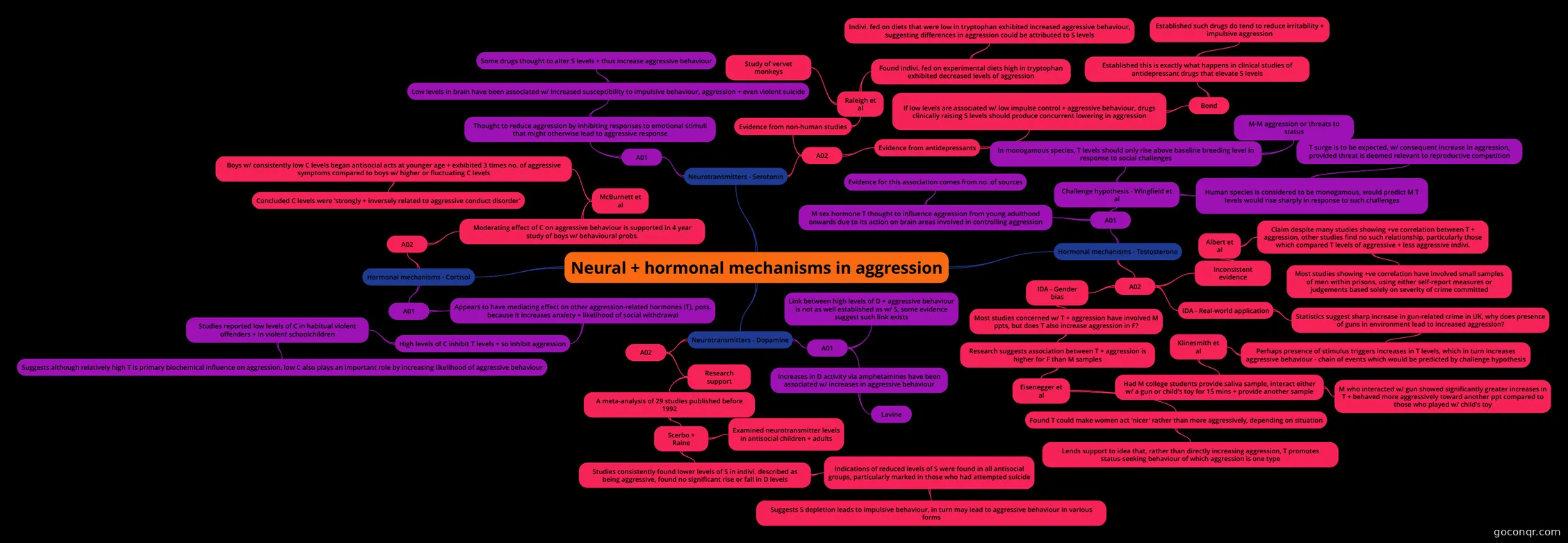
Mind map: Neural + hormonal mechanisms in aggression
Map content
Neural + hormonal mechanisms in aggression
Neurotransmitters - Serotonin
- A01
- Thought to reduce aggression by inhibiting responses to emotional stimuli that might otherwise lead to aggressive response
- Low levels in brain have been associated w/ increased susceptibility to impulsive behaviour, aggression + even violent suicide
- Some drugs thought to alter S levels + thus increase aggressive behaviour
- Low levels in brain have been associated w/ increased susceptibility to impulsive behaviour, aggression + even violent suicide
- Thought to reduce aggression by inhibiting responses to emotional stimuli that might otherwise lead to aggressive response
- A02
- Evidence from non-human studies
- Raleigh et al
- Study of vervet monkeys
- Found indivi. fed on experimental diets high in tryptophan exhibited decreased levels of aggression
- Indivi. fed on diets that were low in tryptophan exhibited increased aggressive behaviour, suggesting differences in aggression could be attributed to S levels
- Raleigh et al
- Evidence from antidepressants
- If low levels are associated w/ low impulse control + aggressive behaviour, drugs clinically raising S levels should produce concurrent lowering in aggression
- Bond
- Established this is exactly what happens in clinical studies of antidepressant drugs that elevate S levels
- Established such drugs do tend to reduce irritability + impulsive aggression
- Established this is exactly what happens in clinical studies of antidepressant drugs that elevate S levels
- Bond
- If low levels are associated w/ low impulse control + aggressive behaviour, drugs clinically raising S levels should produce concurrent lowering in aggression
- Evidence from non-human studies
- A01
Hormonal mechanisms - Testosterone
- A01
- M sex hormone T thought to influence aggression from young adulthood onwards due to its action on brain areas involved in controlling aggression
- Evidence for this association comes from no. of sources
- Challenge hypothesis - Wingfield et al
- In monogamous species, T levels should only rise above baseline breeding level in response to social challenges
- M-M aggression or threats to status
- Human species is considered to be monogamous, would predict M T levels would rise sharply in response to such challenges
- T surge is to be expected, w/ consequent increase in aggression, provided threat is deemed relevant to reproductive competition
- In monogamous species, T levels should only rise above baseline breeding level in response to social challenges
- M sex hormone T thought to influence aggression from young adulthood onwards due to its action on brain areas involved in controlling aggression
- A02
- Inconsistent evidence
- Albert et al
- Claim despite many studies showing +ve correlation between T + aggression, other studies find no such relationship, particularly those which compared T levels of aggressive + less aggressive indivi.
- Most studies showing +ve correlation have involved small samples of men within prisons, using either self-report measures or judgements based solely on severity of crime committed
- Claim despite many studies showing +ve correlation between T + aggression, other studies find no such relationship, particularly those which compared T levels of aggressive + less aggressive indivi.
- Albert et al
- IDA - Real-world application
- Statistics suggest sharp increase in gun-related crime in UK, why does presence of guns in environment lead to increased aggression?
- Perhaps presence of stimulus triggers increases in T levels, which in turn increases aggressive behaviour - chain of events which would be predicted by challenge hypothesis
- Klinesmith et al
- Had M college students provide saliva sample, interact either w/ a gun or child's toy for 15 mins + provide another sample
- M who interacted w/ gun showed significantly greater increases in T + behaved more aggressively toward another ppt compared to those who played w/ child's toy
- Had M college students provide saliva sample, interact either w/ a gun or child's toy for 15 mins + provide another sample
- Klinesmith et al
- Perhaps presence of stimulus triggers increases in T levels, which in turn increases aggressive behaviour - chain of events which would be predicted by challenge hypothesis
- Statistics suggest sharp increase in gun-related crime in UK, why does presence of guns in environment lead to increased aggression?
- IDA - Gender bias
- Most studies concerned w/ T + aggression have involved M ppts, but does T also increase aggression in F?
- Research suggests association between T + aggression is higher for F than M samples
- Eisenegger et al
- Found T could make women act 'nicer' rather than more aggressively, depending on situation
- Lends support to idea that, rather than directly increasing aggression, T promotes status-seeking behaviour of which aggression is one type
- Found T could make women act 'nicer' rather than more aggressively, depending on situation
- Eisenegger et al
- Research suggests association between T + aggression is higher for F than M samples
- Most studies concerned w/ T + aggression have involved M ppts, but does T also increase aggression in F?
- Inconsistent evidence
- A01
Neurotransmitters - Dopamine
- A01
- Link between high levels of D + aggressive behaviour is not as well established as w/ S, some evidence suggest such link exists
- Increases in D activity via amphetamines have been associated w/ increases in aggressive behaviour
- Lavine
- A02
- Research support
- A meta-analysis of 29 studies published before 1992
- Scerbo + Raine
- Examined neurotransmitter levels in antisocial children + adults
- Studies consistently found lower levels of S in indivi. described as being aggressive, found no significant rise or fall in D levels
- Indications of reduced levels of S were found in all antisocial groups, particularly marked in those who had attempted suicide
- Suggests S depletion leads to impulsive behaviour, in turn may lead to aggressive behaviour in various forms
- Indications of reduced levels of S were found in all antisocial groups, particularly marked in those who had attempted suicide
- Scerbo + Raine
- A meta-analysis of 29 studies published before 1992
- Research support
- A01
Hormonal mechanisms - Cortisol
- A01
- Appears to have mediating effect on other aggression-related hormones (T), poss. because it increases anxiety + likelihood of social withdrawal
- High levels of C inhibit T levels + so inhibit aggression
- Studies reported low levels of C in habitual violent offenders + in violent schoolchildren
- Suggests although relatively high T is primary biochemical influence on aggression, low C also plays an important role by increasing likelihood of aggressive behaviour
- Studies reported low levels of C in habitual violent offenders + in violent schoolchildren
- High levels of C inhibit T levels + so inhibit aggression
- Appears to have mediating effect on other aggression-related hormones (T), poss. because it increases anxiety + likelihood of social withdrawal
- A02
- Moderating effect of C on aggressive behaviour is supported in 4 year study of boys w/ behavioural probs.
- McBurnett et al
- Boys w/ consistently low C levels began antisocial acts at younger age + exhibited 3 times no. of aggressive symptoms compared to boys w/ higher or fluctuating C levels
- Concluded C levels were 'strongly + inversely related to aggressive conduct disorder'
- Boys w/ consistently low C levels began antisocial acts at younger age + exhibited 3 times no. of aggressive symptoms compared to boys w/ higher or fluctuating C levels
- McBurnett et al
- Moderating effect of C on aggressive behaviour is supported in 4 year study of boys w/ behavioural probs.
- A01
Information
- Description
- A mind map outlining the A01 and A02 points for an essay
- Created by
- bebe97
- Views
- 8
- Rating
More on Neural and hormonal mechanisms of aggression