
Mind map
Media: Audience
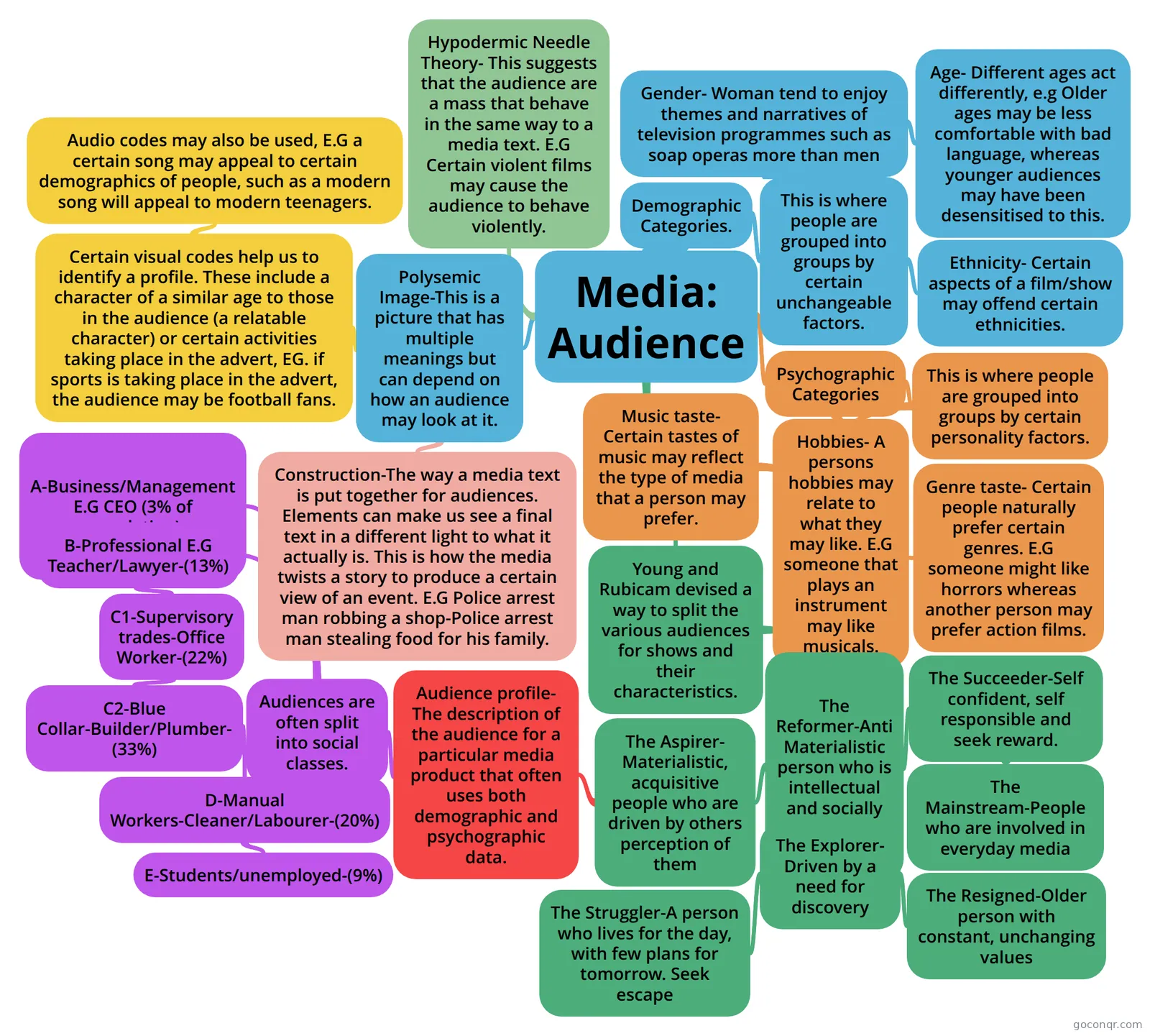
Mind map: Media audience
Map content
Media: Audience
Demographic Categories.
- This is where people are grouped into groups by certain unchangeable factors.
- Gender- Woman tend to enjoy themes and narratives of television programmes such as soap operas more than men
- Age- Different ages act differently, e.g Older ages may be less comfortable with bad language, whereas younger audiences may have been desensitised to this.
- Ethnicity- Certain aspects of a film/show may offend certain ethnicities.
- Gender- Woman tend to enjoy themes and narratives of television programmes such as soap operas more than men
- This is where people are grouped into groups by certain unchangeable factors.
Psychographic Categories
- This is where people are grouped into groups by certain personality factors.
- Music taste- Certain tastes of music may reflect the type of media that a person may prefer.
- Genre taste- Certain people naturally prefer certain genres. E.G someone might like horrors whereas another person may prefer action films.
- Music taste- Certain tastes of music may reflect the type of media that a person may prefer.
- Hobbies- A persons hobbies may relate to what they may like. E.G someone that plays an instrument may like musicals.
- This is where people are grouped into groups by certain personality factors.
Hypodermic Needle Theory- This suggests that the audience are a mass that behave in the same way to a media text. E.G Certain violent films may cause the audience to behave violently.
Young and Rubicam devised a way to split the various audiences for shows and their characteristics.
- The Reformer-Anti Materialistic person who is intellectual and socially aware
- The Succeeder-Self confident, self responsible and seek reward.
- The Mainstream-People who are involved in everyday media
- The Aspirer- Materialistic, acquisitive people who are driven by others perception of them
- Audience profile- The description of the audience for a particular media product that often uses both demographic and psychographic data.
- Audiences are often split into social classes.
- A-Business/Management E.G CEO (3% of population)
- B-Professional E.G Teacher/Lawyer-(13%)
- C1-Supervisory trades-Office Worker-(22%)
- C2-Blue Collar-Builder/Plumber- (33%)
- D-Manual Workers-Cleaner/Labourer-(20%)
- E-Students/unemployed-(9%)
- D-Manual Workers-Cleaner/Labourer-(20%)
- C2-Blue Collar-Builder/Plumber- (33%)
- C1-Supervisory trades-Office Worker-(22%)
- Audiences are often split into social classes.
- Audience profile- The description of the audience for a particular media product that often uses both demographic and psychographic data.
- The Explorer- Driven by a need for discovery
- The Resigned-Older person with constant, unchanging values
- The Struggler-A person who lives for the day, with few plans for tomorrow. Seek escape
- The Succeeder-Self confident, self responsible and seek reward.
- The Reformer-Anti Materialistic person who is intellectual and socially aware
Polysemic Image-This is a picture that has multiple meanings but can depend on how an audience may look at it.
- Construction-The way a media text is put together for audiences. Elements can make us see a final text in a different light to what it actually is. This is how the media twists a story to produce a certain view of an event. E.G Police arrest man robbing a shop-Police arrest man stealing food for his family.
- Certain visual codes help us to identify a profile. These include a character of a similar age to those in the audience (a relatable character) or certain activities taking place in the advert, EG. if sports is taking place in the advert, the audience may be football fans.
- Audio codes may also be used, E.G a certain song may appeal to certain demographics of people, such as a modern song will appeal to modern teenagers.
Information
- Description
- Mind Map on Media: Audience, created by James Burns on 02/05/2015.
- Created by
- James Burns
- Views
- 9
- Rating