
Mind map
Evolutionary Explanations of Food Preference
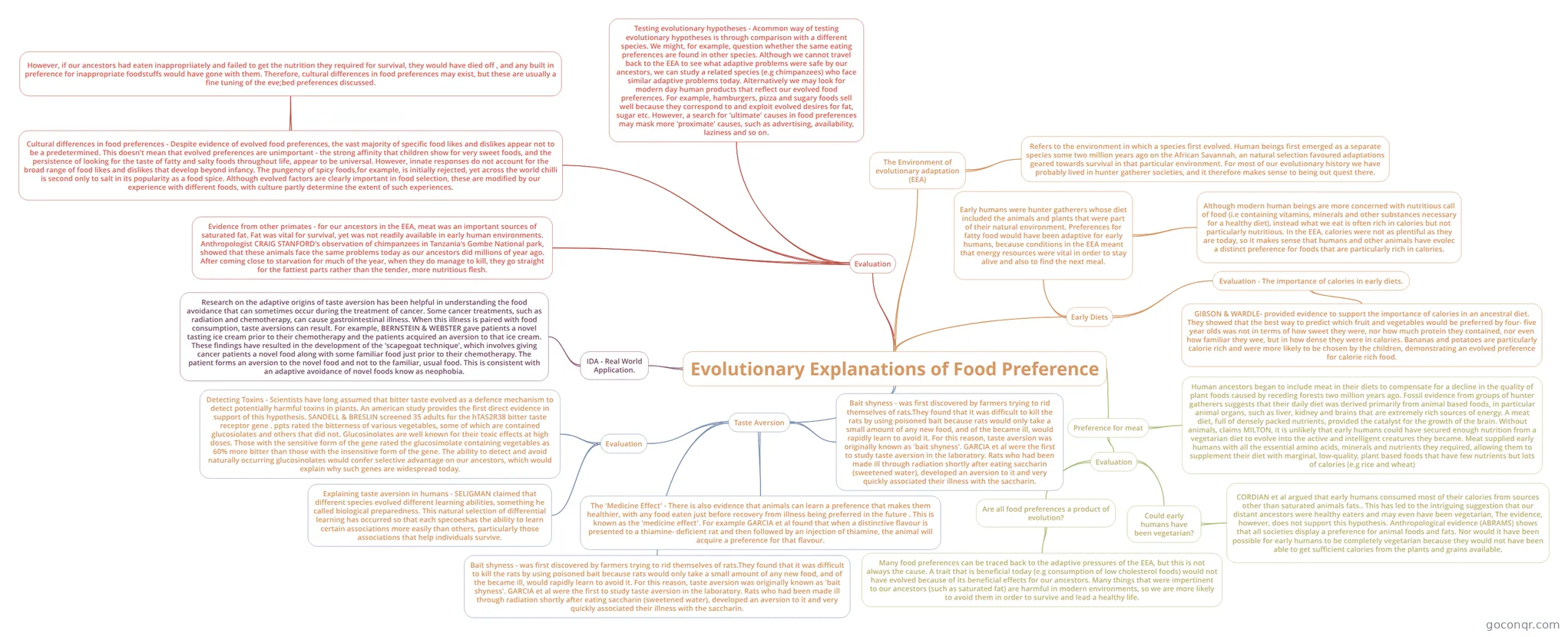
Mind map: Evolutionary Explanations of Food Preference
Map content
Evolutionary Explanations of Food Preference
The Environment of evolutionary adaptation (EEA)
- Refers to the environment in which a species first evolved. Human beings first emerged as a separate species some two million years ago on the African Savannah, an natural selection favoured adaptations geared towards survival in that particular environment. For most of our evolutionary history we have probably lived in hunter gatherer societies, and it therefore makes sense to being out quest there.
Early Diets
- Early humans were hunter gatherers whose diet included the animals and plants that were part of their natural environment. Preferences for fatty food would have been adaptive for early humans, because conditions in the EEA meant that energy resources were vital in order to stay alive and also to find the next meal.
- Although modern human beings are more concerned with nutritious call of food (i.e containing vitamins, minerals and other substances necessary for a healthy diet), instead what we eat is often rich in calories but not particularly nutritious. In the EEA, calories were not as plentiful as they are today, so it makes sense that humans and other animals have evolec a distinct preference for foods that are particularly rich in calories.
- Evaluation - The importance of calories in early diets.
- GIBSON & WARDLE- provided evidence to support the importance of calories in an ancestral diet. They showed that the best way to predict which fruit and vegetables would be preferred by four- five year olds was not in terms of how sweet they were, nor how much protein they contained, nor even how familiar they wee, but in how dense they were in calories. Bananas and potatoes are particularly calorie rich and were more likely to be chosen by the children, demonstrating an evolved preference for calorie rich food.
- Early humans were hunter gatherers whose diet included the animals and plants that were part of their natural environment. Preferences for fatty food would have been adaptive for early humans, because conditions in the EEA meant that energy resources were vital in order to stay alive and also to find the next meal.
Preference for meat
- Human ancestors began to include meat in their diets to compensate for a decline in the quality of plant foods caused by receding forests two million years ago. Fossil evidence from groups of hunter gatherers suggests that their daily diet was derived primarily from animal based foods, in particular animal organs, such as liver, kidney and brains that are extremely rich sources of energy. A meat diet, full of densely packed nutrients, provided the catalyst for the growth of the brain. Without animals, claims MILTON, it is unlikely that early humans could have secured enough nutrition from a vegetarian diet to evolve into the active and intelligent creatures they became. Meat supplied early humans with all the essential amino acids, minerals and nutrients they required, allowing them to supplement their diet with marginal, low-quality, plant based foods that have few nutrients but lots of calories (e.g rice and wheat)
- Evaluation
- Could early humans have been vegetarian?
- CORDIAN et al argued that early humans consumed most of their calories from sources other than saturated animals fats.. This has led to the intriguing suggestion that our distant ancestors were healthy eaters and may even have been vegetarian, The evidence, however, does not support this hypothesis. Anthropological evidence (ABRAMS) shows that all societies display a preference for animal foods and fats. Nor would it have been possible for early humans to be completely vegetarian because they would not have been able to get sufficient calories from the plants and grains available.
- Are all food preferences a product of evolution?
- Many food preferences can be traced back to the adaptive pressures of the EEA, but this is not always the cause. A trait that is beneficial today (e.g consumption of low cholesterol foods) would not have evolved because of its beneficial effects for our ancestors. Many things that were impertinent to our ancestors (such as saturated fat) are harmful in modern environments, so we are more likely to avoid them in order to survive and lead a healthy life.
- Could early humans have been vegetarian?
Taste Aversion
- Bait shyness - was first discovered by farmers trying to rid themselves of rats.They found that it was difficult to kill the rats by using poisoned bait because rats would only take a small amount of any new food, and of the became ill, would rapidly learn to avoid it. For this reason, taste aversion was originally known as 'bait shyness'. GARCIA et al were the first to study taste aversion in the laboratory. Rats who had been made ill through radiation shortly after eating saccharin (sweetened water), developed an aversion to it and very quickly associated their illness with the saccharin.
- Bait shyness - was first discovered by farmers trying to rid themselves of rats.They found that it was difficult to kill the rats by using poisoned bait because rats would only take a small amount of any new food, and of the became ill, would rapidly learn to avoid it. For this reason, taste aversion was originally known as 'bait shyness'. GARCIA et al were the first to study taste aversion in the laboratory. Rats who had been made ill through radiation shortly after eating saccharin (sweetened water), developed an aversion to it and very quickly associated their illness with the saccharin.
- The 'Medicine Effect' - There is also evidence that animals can learn a preference that makes them healthier, with any food eaten just before recovery from illness being preferred in the future . This is known as the 'medicine effect'. For example GARCIA et al found that when a distinctive flavour is presented to a thiamine- deficient rat and then followed by an injection of thiamine, the animal will acquire a preference for that flavour.
- Evaluation
- Explaining taste aversion in humans - SELIGMAN claimed that different species evolved different learning abilities, something he called biological preparedness. This natural selection of differential learning has occurred so that each specoeshas the ability to learn certain associations more easily than others, particularly those associations that help individuals survive.
- Detecting Toxins - Scientists have long assumed that bitter taste evolved as a defence mechanism to detect potentially harmful toxins in plants. An american study provides the first direct evidence in support of this hypothesis. SANDELL & BRESLIN screened 35 adults for the hTAS2R38 bitter taste receptor gene . ppts rated the bitterness of various vegetables, some of which are contained glucosiolates and others that did not. Glucosinolates are well known for their toxic effects at high doses. Those with the sensitive form of the gene rated the glucosimolate containing vegetables as 60% more bitter than those with the insensitive form of the gene. The ability to detect and avoid naturally occurring glucosinolates would confer selective advantage on our ancestors, which would explain why such genes are widespread today.
IDA - Real World Application.
- Research on the adaptive origins of taste aversion has been helpful in understanding the food avoidance that can sometimes occur during the treatment of cancer. Some cancer treatments, such as radiation and chemotherapy, can cause gastrointestinal illness. When this illness is paired with food consumption, taste aversions can result. For example, BERNSTEIN & WEBSTER gave patients a novel tasting ice cream prior to their chemotherapy and the patients acquired an aversion to that ice cream. These findings have resulted in the development of the 'scapegoat technique', which involves giving cancer patients a novel food along with some familiar food just prior to their chemotherapy. The patient forms an aversion to the novel food and not to the familiar, usual food. This is consistent with an adaptive avoidance of novel foods know as neophobia.
Evaluation
- Testing evolutionary hypotheses - Acommon way of testing evolutionary hypotheses is through comparison with a different species. We might, for example, question whether the same eating preferences are found in other species. Although we cannot travel back to the EEA to see what adaptive problems were safe by our ancestors, we can study a related species (e.g chimpanzees) who face similar adaptive problems today. Alternatively we may look for modern day human products that reflect our evolved food preferences. For example, hamburgers, pizza and sugary foods sell well because they correspond to and exploit evolved desires for fat, sugar etc. However, a search for 'ultimate' causes in food preferences may mask more 'proximate' causes, such as advertising, availability, laziness and so on.
- Evidence from other primates - for our ancestors in the EEA, meat was an important sources of saturated fat. Fat was vital for survival, yet was not readily available in early human environments. Anthropologist CRAIG STANFORD's observation of chimpanzees in Tanzania's Gombe National park, showed that these animals face the same problems today as our ancestors did millions of year ago. After coming close to starvation for much of the year, when they do manage to kill, they go straight for the fattiest parts rather than the tender, more nutritious flesh.
- Cultural differences in food preferences - Despite evidence of evolved food preferences, the vast majority of specific food likes and dislikes appear not to be a predetermined. This doesn't mean that evolved preferences are unimportant - the strong affinity that children show for very sweet foods, and the persistence of looking for the taste of fatty and salty foods throughout life, appear to be universal. However, innate responses do not account for the broad range of food likes and dislikes that develop beyond infancy. The pungency of spicy foods,for example, is initially rejected, yet across the world chilli is second only to salt in its popularity as a food spice. Although evolved factors are clearly important in food selection, these are modified by our experience with different foods, with culture partly determine the extent of such experiences.
- However, if our ancestors had eaten inappropriiately and failed to get the nutrition they required for survival, they would have died off , and any built in preference for inappropriate foodstuffs would have gone with them. Therefore, cultural differences in food preferences may exist, but these are usually a fine tuning of the eve;bed preferences discussed.
Information
- Description
- Alevel Psychology Mind Map on Evolutionary Explanations of Food Preference, created by grace51296 on 24/05/2015.
- Created by
- grace51296
- Views
- 0
- Rating