
Mind map
Psychological Explanations for Anorexia Nervosa
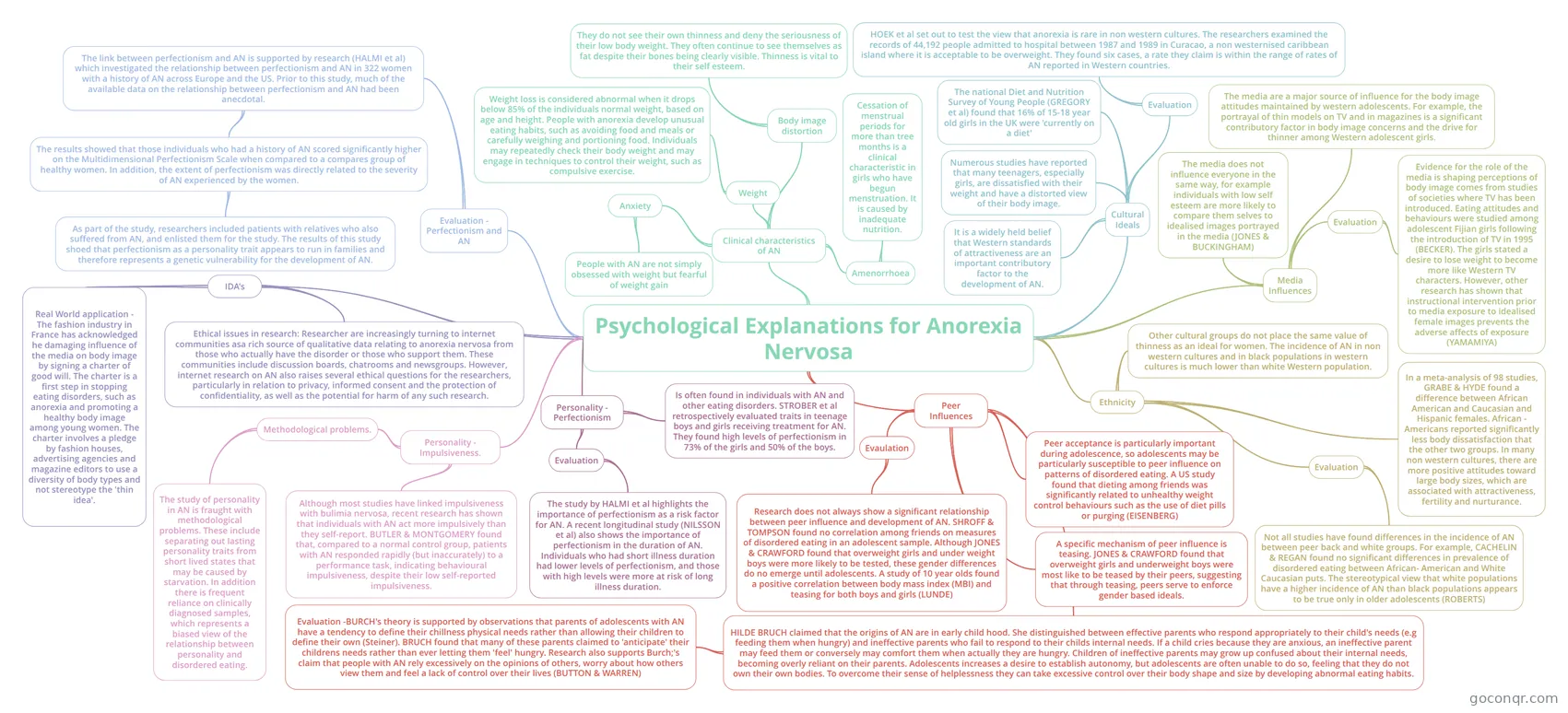
Mind map: Psychological explanations for anorexia nervosa
Map content
Psychological Explanations for Anorexia Nervosa
Clinical characteristics of AN
- Anxiety
- People with AN are not simply obsessed with weight but fearful of weight gain
- Weight
- Weight loss is considered abnormal when it drops below 85% of the individuals normal weight, based on age and height. People with anorexia develop unusual eating habits, such as avoiding food and meals or carefully weighing and portioning food. Individuals may repeatedly check their body weight and may engage in techniques to control their weight, such as compulsive exercise.
- Body image distortion
- They do not see their own thinness and deny the seriousness of their low body weight. They often continue to see themselves as fat despite their bones being clearly visible. Thinness is vital to their self esteem.
- Amenorrhoea
- Cessation of menstrual periods for more than tree months is a clinical characteristic in girls who have begun menstruation. It is caused by inadequate nutrition.
- Anxiety
Cultural Ideals
- It is a widely held belief that Western standards of attractiveness are an important contributory factor to the development of AN.
- Numerous studies have reported that many teenagers, especially girls, are dissatisfied with their weight and have a distorted view of their body image.
- The national Diet and Nutrition Survey of Young People (GREGORY et al) found that 16% of 15-18 year old girls in the UK were 'currently on a diet'
- Evaluation
- HOEK et al set out to test the view that anorexia is rare in non western cultures. The researchers examined the records of 44,192 people admitted to hospital between 1987 and 1989 in Curacao, a non westernised caribbean island where it is acceptable to be overweight. They found six cases, a rate they claim is within the range of rates of AN reported in Western countries.
Media Influences
- The media are a major source of influence for the body image attitudes maintained by western adolescents. For example, the portrayal of thin models on TV and in magazines is a significant contributory factor in body image concerns and the drive for thinner among Western adolescent girls.
- The media does not influence everyone in the same way, for example individuals with low self esteem are more likely to compare them selves to idealised images portrayed in the media (JONES & BUCKINGHAM)
- Evaluation
- Evidence for the role of the media is shaping perceptions of body image comes from studies of societies where TV has been introduced. Eating attitudes and behaviours were studied among adolescent Fijian girls following the introduction of TV in 1995 (BECKER). The girls stated a desire to lose weight to become more like Western TV characters. However, other research has shown that instructional intervention prior to media exposure to idealised female images prevents the adverse affects of exposure (YAMAMIYA)
Ethnicity
- Other cultural groups do not place the same value of thinness as an ideal for women. The incidence of AN in non western cultures and in black populations in western cultures is much lower than white Western population.
- In a meta-analysis of 98 studies, GRABE & HYDE found a difference between African American and Caucasian and Hispanic females. African - Americans reported significantly less body dissatisfaction that the other two groups. In many non western cultures, there are more positive attitudes toward large body sizes, which are associated with attractiveness, fertility and nurturance.
- Evaluation
- Not all studies have found differences in the incidence of AN between peer back and white groups. For example, CACHELIN & REGAN found no significant differences in prevalence of disordered eating between African- American and White Caucasian puts. The stereotypical view that white populations have a higher incidence of AN than black populations appears to be true only in older adolescents (ROBERTS)
Peer Influences
- Peer acceptance is particularly important during adolescence, so adolescents may be particularly susceptible to peer influence on patterns of disordered eating. A US study found that dieting among friends was significantly related to unhealthy weight control behaviours such as the use of diet pills or purging (EISENBERG)
- A specific mechanism of peer influence is teasing. JONES & CRAWFORD found that overweight girls and underweight boys were most like to be teased by their peers, suggesting that through teasing, peers serve to enforce gender based ideals.
- Evaulation
- Research does not always show a significant relationship between peer influence and development of AN. SHROFF & TOMPSON found no correlation among friends on measures of disordered eating in an adolescent sample. Although JONES & CRAWFORD found that overweight girls and under weight boys were more likely to be tested, these gender differences do no emerge until adolescents. A study of 10 year olds found a positive correlation between body mass index (MBI) and teasing for both boys and girls (LUNDE)
- HILDE BRUCH claimed that the origins of AN are in early child hood. She distinguished between effective parents who respond appropriately to their child's needs (e.g feeding them when hungry) and ineffective parents who fail to respond to their childs internal needs. If a child cries because they are anxious, an ineffective parent may feed them or conversely may comfort them when actually they are hungry. Children of ineffective parents may grow up confused about their internal needs, becoming overly reliant on their parents. Adolescents increases a desire to establish autonomy, but adolescents are often unable to do so, feeling that they do not own their own bodies. To overcome their sense of helplessness they can take excessive control over their body shape and size by developing abnormal eating habits.
- Evaluation -BURCH's theory is supported by observations that parents of adolescents with AN have a tendency to define their chillness physical needs rather than allowing their children to define their own (Steiner). BRUCH found that many of these parents claimed to 'anticipate' their childrens needs rather than ever letting them 'feel' hungry. Research also supports Burch;'s claim that people with AN rely excessively on the opinions of others, worry about how others view them and feel a lack of control over their lives (BUTTON & WARREN)
Personality - Perfectionism
- Is often found in individuals with AN and other eating disorders. STROBER et al retrospectively evaluated traits in teenage boys and girls receiving treatment for AN. They found high levels of perfectionism in 73% of the girls and 50% of the boys.
- Evaluation
- The study by HALMI et al highlights the importance of perfectionism as a risk factor for AN. A recent longitudinal study (NILSSON et al) also shows the importance of perfectionism in the duration of AN. Individuals who had short illness duration had lower levels of perfectionism, and those with high levels were more at risk of long illness duration.
Personality - Impulsiveness.
- Although most studies have linked impulsiveness with bulimia nervosa, recent research has shown that individuals with AN act more impulsively than they self-report. BUTLER & MONTGOMERY found that, compared to a normal control group, patients with AN responded rapidly (but inaccurately) to a performance task, indicating behavioural impulsiveness, despite their low self-reported impulsiveness.
- Methodological problems.
- The study of personality in AN is fraught with methodological problems. These include separating out lasting personality traits from short lived states that may be caused by starvation. In addition there is frequent reliance on clinically diagnosed samples, which represents a biased view of the relationship between personality and disordered eating.
IDA's
- Ethical issues in research: Researcher are increasingly turning to internet communities asa rich source of qualitative data relating to anorexia nervosa from those who actually have the disorder or those who support them. These communities include discussion boards, chatrooms and newsgroups. However, internet research on AN also raises several ethical questions for the researchers, particularly in relation to privacy, informed consent and the protection of confidentiality, as well as the potential for harm of any such research.
- Real World application - The fashion industry in France has acknowledged he damaging influence of the media on body image by signing a charter of good will. The charter is a first step in stopping eating disorders, such as anorexia and promoting a healthy body image among young women. The charter involves a pledge by fashion houses, advertising agencies and magazine editors to use a diversity of body types and not stereotype the 'thin idea'.
Evaluation - Perfectionism and AN
- The link between perfectionism and AN is supported by research (HALMI et al) which investigated the relationship between perfectionism and AN in 322 women with a history of AN across Europe and the US. Prior to this study, much of the available data on the relationship between perfectionism and AN had been anecdotal.
- The results showed that those individuals who had a history of AN scored significantly higher on the Multidimensional Perfectionism Scale when compared to a compares group of healthy women. In addition, the extent of perfectionism was directly related to the severity of AN experienced by the women.
- As part of the study, researchers included patients with relatives who also suffered from AN, and enlisted them for the study. The results of this study shoed that perfectionism as a personality trait appears to run in families and therefore represents a genetic vulnerability for the development of AN.
- The results showed that those individuals who had a history of AN scored significantly higher on the Multidimensional Perfectionism Scale when compared to a compares group of healthy women. In addition, the extent of perfectionism was directly related to the severity of AN experienced by the women.
- The link between perfectionism and AN is supported by research (HALMI et al) which investigated the relationship between perfectionism and AN in 322 women with a history of AN across Europe and the US. Prior to this study, much of the available data on the relationship between perfectionism and AN had been anecdotal.
Information
- Description
- Alevel Psychology Mind Map on Psychological Explanations for Anorexia Nervosa, created by grace51296 on 25/05/2015.
- Created by
- grace51296
- Views
- 0
- Rating