
Mind map
Neural & Hormonal Mechanisms in Agression
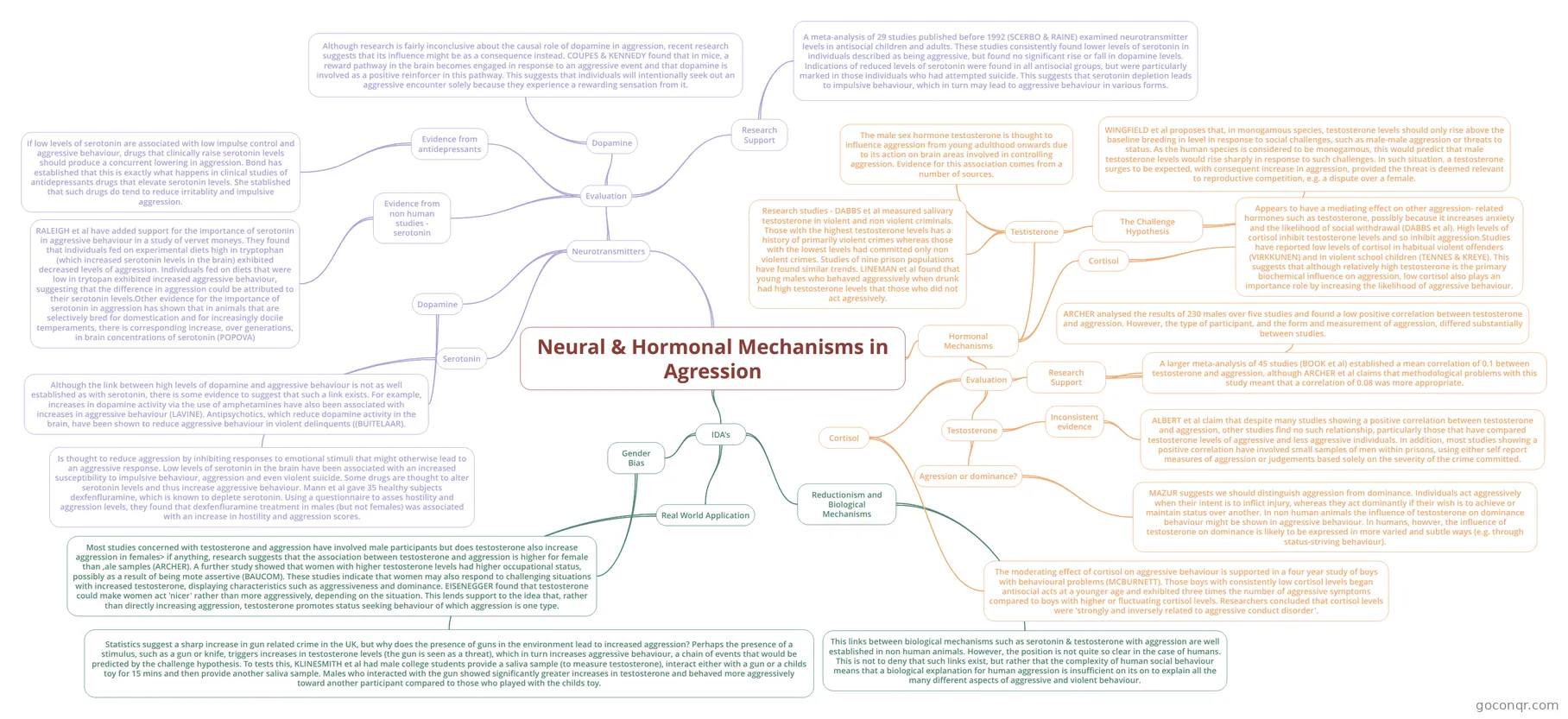
Mind map: Neural and hormonal mechanisms in aggression
Map content
Neural & Hormonal Mechanisms in Agression
Neurotransmitters
- Serotonin
- Is thought to reduce aggression by inhibiting responses to emotional stimuli that might otherwise lead to an aggressive response. Low levels of serotonin in the brain have been associated with an increased susceptibility to impulsive behaviour, aggression and even violent suicide. Some drugs are thought to alter serotonin levels and thus increase aggressive behaviour. Mann et al gave 35 healthy subjects dexfenfluramine, which is known to deplete serotonin. Using a questionnaire to asses hostility and aggression levels, they found that dexfenfluramine treatment in males (but not females) was associated with an increase in hostility and aggression scores.
- Dopamine
- Although the link between high levels of dopamine and aggressive behaviour is not as well established as with serotonin, there is some evidence to suggest that such a link exists. For example, increases in dopamine activity via the use of amphetamines have also been associated with increases in aggressive behaviour (LAVINE). Antipsychotics, which reduce dopamine activity in the brain, have been shown to reduce aggressive behaviour in violent delinquents ((BUITELAAR).
- Evaluation
- Evidence from non human studies - serotonin
- RALEIGH et al have added support for the importance of serotonin in aggressive behaviour in a study of vervet moneys. They found that individuals fed on experimental diets high in tryptophan (which increased serotonin levels in the brain) exhibited decreased levels of aggression. Individuals fed on diets that were low in trytopan exhibited increased aggressive behaviour, suggesting that the difference in aggression could be attributed to their serotonin levels.Other evidence for the importance of serotonin in aggression has shown that in animals that are selectively bred for domestication and for increasingly docile temperaments, there is corresponding increase, over generations, in brain concentrations of serotonin (POPOVA)
- Evidence from antidepressants
- If low levels of serotonin are associated with low impulse control and aggressive behaviour, drugs that clinically raise serotonin levels should produce a concurrent lowering in aggression. Bond has established that this is exactly what happens in clinical studies of antidepressants drugs that elevate serotonin levels. She stablished that such drugs do tend to reduce irritablity and impulsive aggression.
- Dopamine
- Although research is fairly inconclusive about the causal role of dopamine in aggression, recent research suggests that its influence might be as a consequence instead. COUPES & KENNEDY found that in mice, a reward pathway in the brain becomes engaged in response to an aggressive event and that dopamine is involved as a positive reinforcer in this pathway. This suggests that individuals will intentionally seek out an aggressive encounter solely because they experience a rewarding sensation from it.
- Research Support
- A meta-analysis of 29 studies published before 1992 (SCERBO & RAINE) examined neurotransmitter levels in antisocial children and adults. These studies consistently found lower levels of serotonin in individuals described as being aggressive, but found no significant rise or fall in dopamine levels. Indications of reduced levels of serotonin were found in all antisocial groups, but were particularly marked in those individuals who had attempted suicide. This suggests that serotonin depletion leads to impulsive behaviour, which in turn may lead to aggressive behaviour in various forms.
- Evidence from non human studies - serotonin
- Serotonin
Hormonal Mechanisms
- Testisterone
- The male sex hormone testosterone is thought to influence aggression from young adulthood onwards due to its action on brain areas involved in controlling aggression. Evidence for this association comes from a number of sources.
- Research studies - DABBS et al measured salivary testosterone in violent and non violent criminals. Those with the highest testosterone levels has a history of primarily violent crimes whereas those with the lowest levels had committed only non violent crimes. Studies of nine prison populations have found similar trends. LINEMAN et al found that young males who behaved aggressively when drunk had high testosterone levels that those who did not act agressively.
- The Challenge Hypothesis
- WINGFIELD et al proposes that, in monogamous species, testosterone levels should only rise above the baseline breeding in level in response to social challenges, such as male-male aggression or threats to status. As the human species is considered to be monogamous, this would predict that male testosterone levels would rise sharply in response to such challenges. In such situation, a testosterone surges to be expected, with consequent increase in aggression, provided the threat is deemed relevant to reproductive competition, e.g. a dispute over a female.
- Cortisol
- Appears to have a mediating effect on other aggression- related hormones such as testosterone, possibly because it increases anxiety and the likelihood of social withdrawal (DABBS et al). High levels of cortisol inhibit testosterone levels and so inhibit aggression.Studies have reported low levels of cortisol in habitual violent offenders (VIRKKUNEN) and in violent school children (TENNES & KREYE). This suggests that although relatively high testosterone is the primary biochemical influence on aggression, low cortisol also plays an importance role by increasing the likelihood of aggressive behaviour.
- Evaluation
- Research Support
- ARCHER analysed the results of 230 males over five studies and found a low positive correlation between testosterone and aggression. However, the type of participant, and the form and measurement of aggression, differed substantially between studies.
- A larger meta-analysis of 45 studies (BOOK et al) established a mean correlation of 0.1 between testosterone and aggression, although ARCHER et al claims that methodological problems with this study meant that a correlation of 0.08 was more appropriate.
- Testosterone
- Inconsistent evidence
- ALBERT et al claim that despite many studies showing a positive correlation between testosterone and aggression, other studies find no such relationship, particularly those that have compared testosterone levels of aggressive and less aggressive individuals. In addition, most studies showing a positive correlation have involved small samples of men within prisons, using either self report measures of aggression or judgements based solely on the severity of the crime committed.
- Agression or dominance?
- MAZUR suggests we should distinguish aggression from dominance. Individuals act aggressively when their intent is to inflict injury, whereas they act dominantly if their wish is to achieve or maintain status over another. In non human animals the influence of testosterone on dominance behaviour might be shown in aggressive behaviour. In humans, howver, the influence of testosterone on dominance is likely to be expressed in more varied and subtle ways (e.g. through status-striving behaviour).
- Inconsistent evidence
- Cortisol
- The moderating effect of cortisol on aggressive behaviour is supported in a four year study of boys with behavioural problems (MCBURNETT). Those boys with consistently low cortisol levels began antisocial acts at a younger age and exhibited three times the number of aggressive symptoms compared to boys with higher or fluctuating cortisol levels. Researchers concluded that cortisol levels were 'strongly and inversely related to aggressive conduct disorder'.
- Research Support
- Testisterone
IDA's
- Reductionism and Biological Mechanisms
- This links between biological mechanisms such as serotonin & testosterone with aggression are well established in non human animals. However, the position is not quite so clear in the case of humans. This is not to deny that such links exist, but rather that the complexity of human social behaviour means that a biological explanation for human aggression is insufficient on its on to explain all the many different aspects of aggressive and violent behaviour.
- Real World Application
- Statistics suggest a sharp increase in gun related crime in the UK, but why does the presence of guns in the environment lead to increased aggression? Perhaps the presence of a stimulus, such as a gun or knife, triggers increases in testosterone levels (the gun is seen as a threat), which in turn increases aggressive behaviour, a chain of events that would be predicted by the challenge hypothesis. To tests this, KLINESMITH et al had male college students provide a saliva sample (to measure testosterone), interact either with a gun or a childs toy for 15 mins and then provide another saliva sample. Males who interacted with the gun showed significantly greater increases in testosterone and behaved more aggressively toward another participant compared to those who played with the childs toy.
- Gender Bias
- Most studies concerned with testosterone and aggression have involved male participants but does testosterone also increase aggression in females> if anything, research suggests that the association between testosterone and aggression is higher for female than ,ale samples (ARCHER). A further study showed that women with higher testosterone levels had higher occupational status, possibly as a result of being mote assertive (BAUCOM). These studies indicate that women may also respond to challenging situations with increased testosterone, displaying characteristics such as aggressiveness and dominance. EISENEGGER found that testosterone could make women act 'nicer' rather than more aggressively, depending on the situation. This lends support to the idea that, rather than directly increasing aggression, testosterone promotes status seeking behaviour of which aggression is one type.
- Reductionism and Biological Mechanisms
Information
- Description
- Alevel Psychology Mind Map on Neural & Hormonal Mechanisms in Agression, created by grace51296 on 30/05/2015.
- Created by
- grace51296
- Views
- 6
- Rating
More on Neural and hormonal mechanisms of aggression