
Mind map
Evolutionary Explanations of Human Aggression
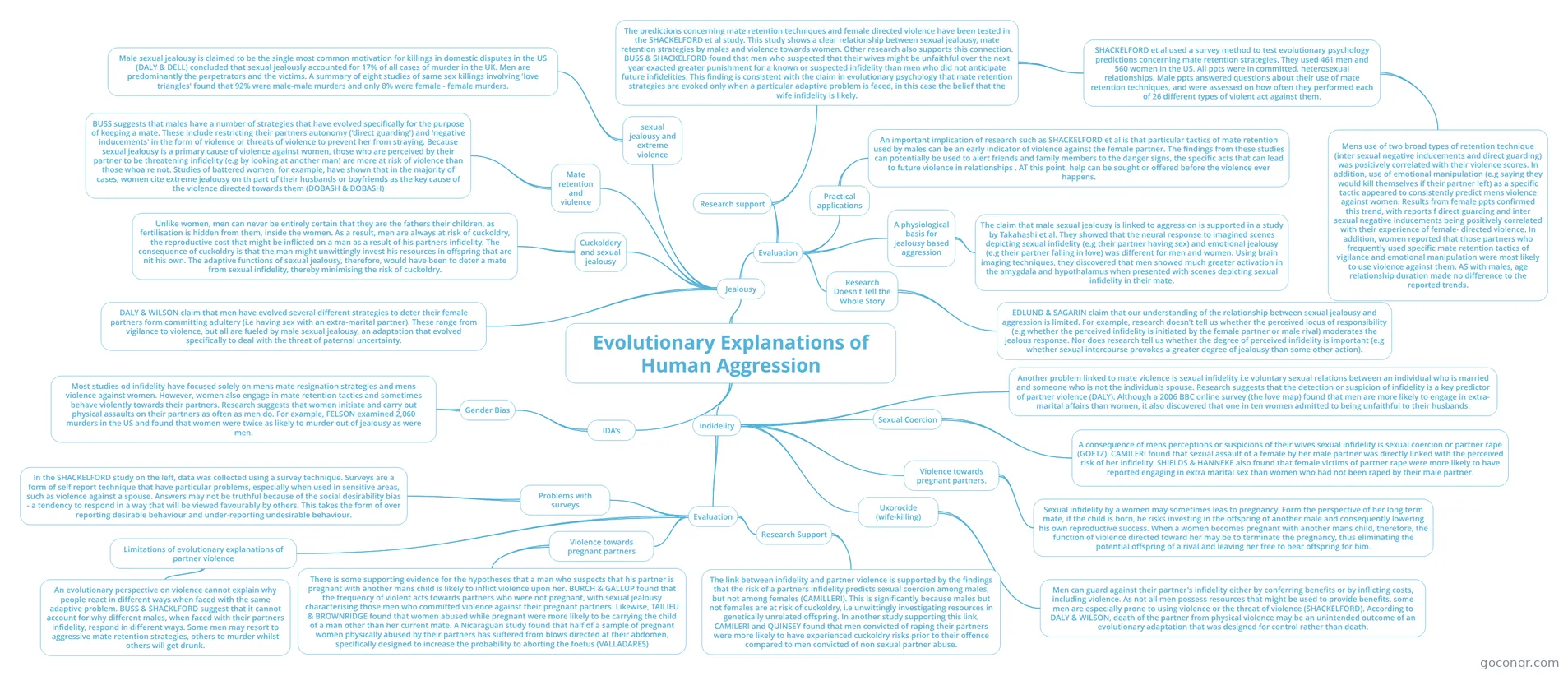
Mind map: Evolutionary explanations of human aggression
Map content
Evolutionary Explanations of Human Aggression
Jealousy
- DALY & WILSON claim that men have evolved several different strategies to deter their female partners form committing adultery (i.e having sex with an extra-marital partner). These range from vigilance to violence, but all are fueled by male sexual jealousy, an adaptation that evolved specifically to deal with the threat of paternal uncertainty.
- Cuckoldery and sexual jealousy
- Unlike women, men can never be entirely certain that they are the fathers their children, as fertilisation is hidden from them, inside the women. As a result, men are always at risk of cuckoldry, the reproductive cost that might be inflicted on a man as a result of his partners infidelity. The consequence of cuckoldry is that the man might unwittingly invest his resources in offspring that are nit his own. The adaptive functions of sexual jealousy, therefore, would have been to deter a mate from sexual infidelity, thereby minimising the risk of cuckoldry.
- Mate retention and violence
- BUSS suggests that males have a number of strategies that have evolved specifically for the purpose of keeping a mate. These include restricting their partners autonomy ('direct guarding') and 'negative inducements' in the form of violence or threats of violence to prevent her from straying. Because sexual jealousy is a primary cause of violence against women, those who are perceived by their partner to be threatening infidelity (e.g by looking at another man) are more at risk of violence than those whoa re not. Studies of battered women, for example, have shown that in the majority of cases, women cite extreme jealousy on th part of their husbands or boyfriends as the key cause of the violence directed towards them (DOBASH & DOBASH)
- sexual jealousy and extreme violence
- Male sexual jealousy is claimed to be the single most common motivation for killings in domestic disputes in the US (DALY & DELL) concluded that sexual jealously accounted for 17% of all cases of murder in the UK. Men are predominantly the perpetrators and the victims. A summary of eight studies of same sex killings involving 'love triangles' found that 92% were male-male murders and only 8% were female - female murders.
- Evaluation
- Research support
- The predictions concerning mate retention techniques and female directed violence have been tested in the SHACKELFORD et al study. This study shows a clear relationship between sexual jealousy, mate retention strategies by males and violence towards women. Other research also supports this connection. BUSS & SHACKELFORD found that men who suspected that their wives might be unfaithful over the next year exacted greater punishment for a known or suspected infidelity than men who did not anticipate future infidelities. This finding is consistent with the claim in evolutionary psychology that mate retention strategies are evoked only when a particular adaptive problem is faced, in this case the belief that the wife infidelity is likely.
- SHACKELFORD et al used a survey method to test evolutionary psychology predictions concerning mate retention strategies. They used 461 men and 560 women in the US. All ppts were in committed, heterosexual relationships. Male ppts answered questions about their use of mate retention techniques, and were assessed on how often they performed each of 26 different types of violent act against them.
- Mens use of two broad types of retention technique (inter sexual negative inducements and direct guarding) was positively correlated with their violence scores. In addition, use of emotional manipulation (e.g saying they would kill themselves if their partner left) as a specific tactic appeared to consistently predict mens violence against women. Results from female ppts confirmed this trend, with reports f direct guarding and inter sexual negative inducements being positively correlated with their experience of female- directed violence. In addition, women reported that those partners who frequently used specific mate retention tactics of vigilance and emotional manipulation were most likely to use violence against them. AS with males, age relationship duration made no difference to the reported trends.
- SHACKELFORD et al used a survey method to test evolutionary psychology predictions concerning mate retention strategies. They used 461 men and 560 women in the US. All ppts were in committed, heterosexual relationships. Male ppts answered questions about their use of mate retention techniques, and were assessed on how often they performed each of 26 different types of violent act against them.
- The predictions concerning mate retention techniques and female directed violence have been tested in the SHACKELFORD et al study. This study shows a clear relationship between sexual jealousy, mate retention strategies by males and violence towards women. Other research also supports this connection. BUSS & SHACKELFORD found that men who suspected that their wives might be unfaithful over the next year exacted greater punishment for a known or suspected infidelity than men who did not anticipate future infidelities. This finding is consistent with the claim in evolutionary psychology that mate retention strategies are evoked only when a particular adaptive problem is faced, in this case the belief that the wife infidelity is likely.
- Practical applications
- An important implication of research such as SHACKELFORD et al is that particular tactics of mate retention used by males can be an early indicator of violence against the female partner. The findings from these studies can potentially be used to alert friends and family members to the danger signs, the specific acts that can lead to future violence in relationships . AT this point, help can be sought or offered before the violence ever happens.
- A physiological basis for jealousy based aggression
- The claim that male sexual jealousy is linked to aggression is supported in a study by Takahashi et al. They showed that the neural response to imagined scenes depicting sexual infidelity (e.g their partner having sex) and emotional jealousy (e.g their partner falling in love) was different for men and women. Using brain imaging techniques, they discovered that men showed much greater activation in the amygdala and hypothalamus when presented with scenes depicting sexual infidelity in their mate.
- Research Doesn't Tell the Whole Story
- EDLUND & SAGARIN claim that our understanding of the relationship between sexual jealousy and aggression is limited. For example, research doesn't tell us whether the perceived locus of responsibility (e.g whether the perceived infidelity is initiated by the female partner or male rival) moderates the jealous response. Nor does research tell us whether the degree of perceived infidelity is important (e.g whether sexual intercourse provokes a greater degree of jealousy than some other action).
- Research support
Indidelity
- Another problem linked to mate violence is sexual infidelity i.e voluntary sexual relations between an individual who is married and someone who is not the individuals spouse. Research suggests that the detection or suspicion of infidelity is a key predictor of partner violence (DALY). Although a 2006 BBC online survey (the love map) found that men are more likely to engage in extra- marital affairs than women, it also discovered that one in ten women admitted to being unfaithful to their husbands.
- Sexual Coercion
- A consequence of mens perceptions or suspicions of their wives sexual infidelity is sexual coercion or partner rape (GOETZ). CAMILERI found that sexual assault of a female by her male partner was directly linked with the perceived risk of her infidelity. SHIELDS & HANNEKE also found that female victims of partner rape were more likely to have reported engaging in extra marital sex than women who had not been raped by their male partner.
- Violence towards pregnant partners.
- Sexual infidelity by a women may sometimes leas to pregnancy. Form the perspective of her long term mate, if the child is born, he risks investing in the offspring of another male and consequently lowering his own reproductive success. When a women becomes pregnant with another mans child, therefore, the function of violence directed toward her may be to terminate the pregnancy, thus eliminating the potential offspring of a rival and leaving her free to bear offspring for him.
- Uxorocide (wife-killing)
- Men can guard against their partner's infidelity either by conferring benefits or by inflicting costs, including violence. As not all men possess resources that might be used to provide benefits, some men are especially prone to using violence or the threat of violence (SHACKELFORD). According to DALY & WILSON, death of the partner from physical violence may be an unintended outcome of an evolutionary adaptation that was designed for control rather than death.
- Evaluation
- Research Support
- The link between infidelity and partner violence is supported by the findings that the risk of a partners infidelity predicts sexual coercion among males, but not among females (CAMILLERI). This is significantly because males but not females are at risk of cuckoldry, i.e unwittingly investigating resources in genetically unrelated offspring. In another study supporting this link, CAMILERI and QUINSEY found that men convicted of raping their partners were more likely to have experienced cuckoldry risks prior to their offence compared to men convicted of non sexual partner abuse.
- Violence towards pregnant partners
- There is some supporting evidence for the hypotheses that a man who suspects that his partner is pregnant with another mans child is likely to inflict violence upon her. BURCH & GALLUP found that the frequency of violent acts towards partners who were not pregnant, with sexual jealousy characterising those men who committed violence against their pregnant partners. Likewise, TAILIEU & BROWNRIDGE found that women abused while pregnant were more likely to be carrying the child of a man other than her current mate. A Nicaraguan study found that half of a sample of pregnant women physically abused by their partners has suffered from blows directed at their abdomen, specifically designed to increase the probability to aborting the foetus (VALLADARES)
- Limitations of evolutionary explanations of partner violence
- An evolutionary perspective on violence cannot explain why people react in different ways when faced with the same adaptive problem. BUSS & SHACKLFORD suggest that it cannot account for why different males, when faced with their partners infidelity, respond in different ways. Some men may resort to aggressive mate retention strategies, others to murder whilst others will get drunk.
- Problems with surveys
- In the SHACKELFORD study on the left, data was collected using a survey technique. Surveys are a form of self report technique that have particular problems, especially when used in sensitive areas, such as violence against a spouse. Answers may not be truthful because of the social desirability bias - a tendency to respond in a way that will be viewed favourably by others. This takes the form of over reporting desirable behaviour and under-reporting undesirable behaviour.
- Research Support
IDA's
- Gender Bias
- Most studies od infidelity have focused solely on mens mate resignation strategies and mens violence against women. However, women also engage in mate retention tactics and sometimes behave violently towards their partners. Research suggests that women initiate and carry out physical assaults on their partners as often as men do. For example, FELSON examined 2,060 murders in the US and found that women were twice as likely to murder out of jealousy as were men.
- Gender Bias
Information
- Description
- Alevel Psychology Mind Map on Evolutionary Explanations of Human Aggression, created by grace51296 on 30/05/2015.
- Created by
- grace51296
- Views
- 1
- Rating
More on Evolutionary explanations of aggression