
Mind map
Memory
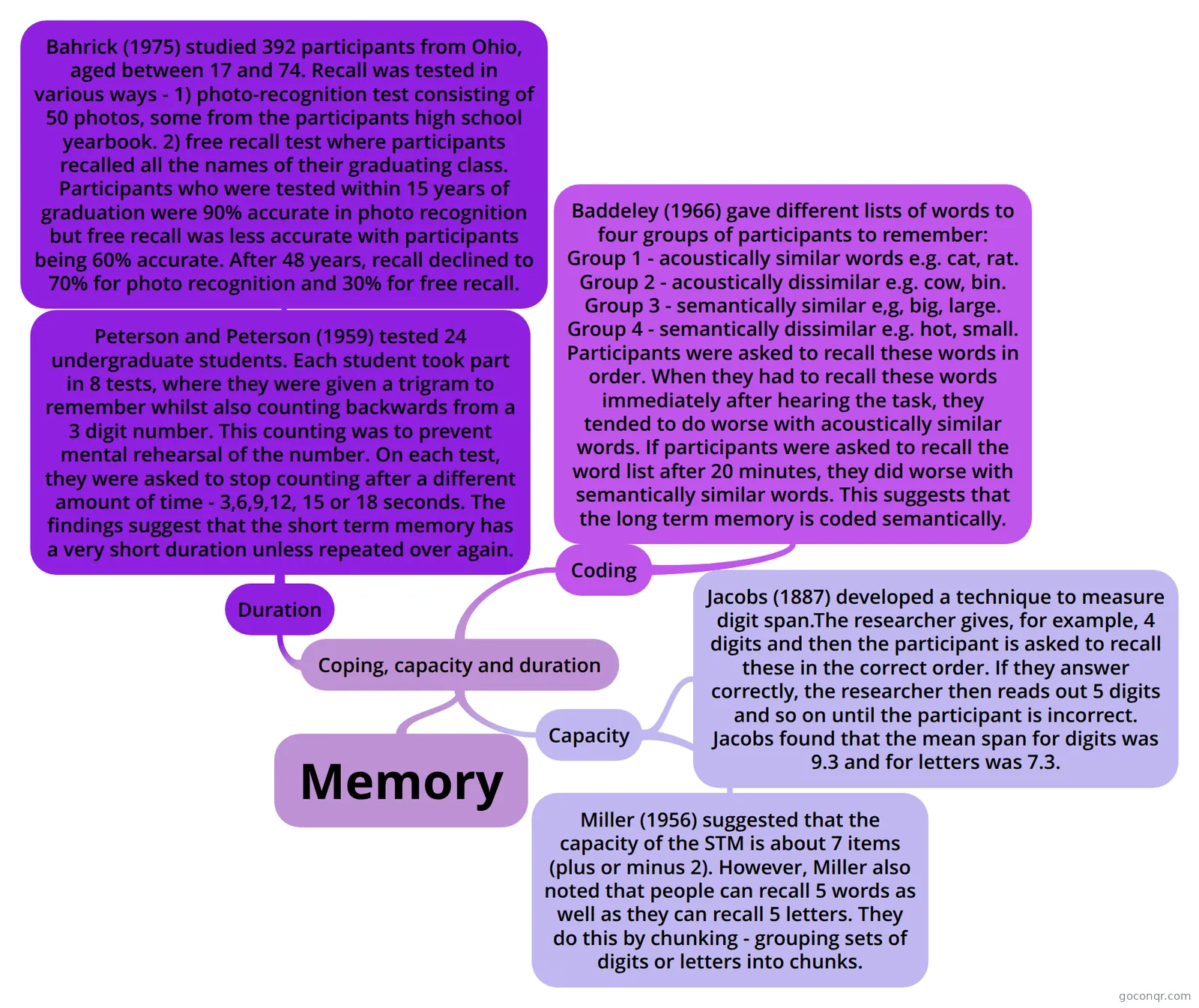
Mind map: Memory
Map content
Memory
Coping, capacity and duration
- Coding
- Baddeley (1966) gave different lists of words to four groups of participants to remember: Group 1 - acoustically similar words e.g. cat, rat. Group 2 - acoustically dissimilar e.g. cow, bin. Group 3 - semantically similar e,g, big, large. Group 4 - semantically dissimilar e.g. hot, small. Participants were asked to recall these words in order. When they had to recall these words immediately after hearing the task, they tended to do worse with acoustically similar words. If participants were asked to recall the word list after 20 minutes, they did worse with semantically similar words. This suggests that the long term memory is coded semantically.
- Capacity
- Jacobs (1887) developed a technique to measure digit span.The researcher gives, for example, 4 digits and then the participant is asked to recall these in the correct order. If they answer correctly, the researcher then reads out 5 digits and so on until the participant is incorrect. Jacobs found that the mean span for digits was 9.3 and for letters was 7.3.
- Miller (1956) suggested that the capacity of the STM is about 7 items (plus or minus 2). However, Miller also noted that people can recall 5 words as well as they can recall 5 letters. They do this by chunking - grouping sets of digits or letters into chunks.
- Duration
- Peterson and Peterson (1959) tested 24 undergraduate students. Each student took part in 8 tests, where they were given a trigram to remember whilst also counting backwards from a 3 digit number. This counting was to prevent mental rehearsal of the number. On each test, they were asked to stop counting after a different amount of time - 3,6,9,12, 15 or 18 seconds. The findings suggest that the short term memory has a very short duration unless repeated over again.
- Bahrick (1975) studied 392 participants from Ohio, aged between 17 and 74. Recall was tested in various ways - 1) photo-recognition test consisting of 50 photos, some from the participants high school yearbook. 2) free recall test where participants recalled all the names of their graduating class. Participants who were tested within 15 years of graduation were 90% accurate in photo recognition but free recall was less accurate with participants being 60% accurate. After 48 years, recall declined to 70% for photo recognition and 30% for free recall.
- Coding
Information
- Description
- A level Psychology Mind Map on Memory, created by Joy Harvey-Hill on 15/06/2021.
- Created by
- Joy Harvey-Hill
- Views
- 0
- Rating