
Mind map
memory
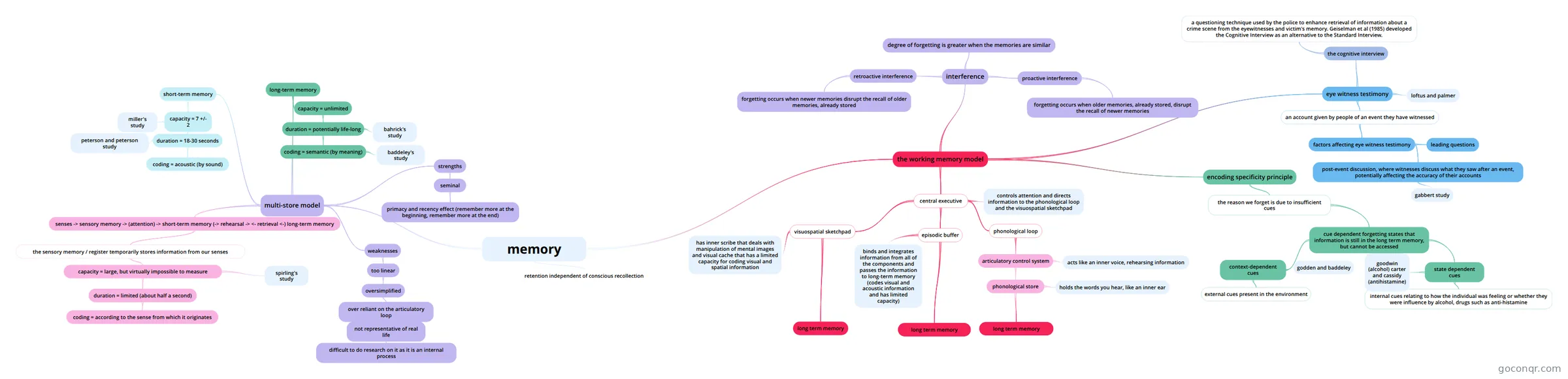
Mind map: Memory
Map content
memory
retention independent of conscious recollection
multi-store model
- senses -> sensory memory -> (attention) -> short-term memory (-> rehearsal -> <- retrieval <-) long-term memory
- the sensory memory / register temporarily stores information from our senses
- capacity = large, but virtually impossible to measure
- duration = limited (about half a second)
- coding = according to the sense from which it originates
- spirling's study
- duration = limited (about half a second)
- capacity = large, but virtually impossible to measure
- the sensory memory / register temporarily stores information from our senses
- short-term memory
- capacity = 7 +/- 2
- duration = 18-30 seconds
- coding = acoustic (by sound)
- peterson and peterson study
- miller's study
- duration = 18-30 seconds
- capacity = 7 +/- 2
- long-term memory
- capacity = unlimited
- duration = potentially life-long
- coding = semantic (by meaning)
- baddeley's study
- bahrick's study
- coding = semantic (by meaning)
- duration = potentially life-long
- capacity = unlimited
- weaknesses
- too linear
- oversimplified
- over reliant on the articulatory loop
- not representative of real life
- difficult to do research on it as it is an internal process
- not representative of real life
- over reliant on the articulatory loop
- oversimplified
- too linear
- strengths
- seminal
- primacy and recency effect (remember more at the beginning, remember more at the end)
- seminal
- senses -> sensory memory -> (attention) -> short-term memory (-> rehearsal -> <- retrieval <-) long-term memory
the working memory model
- central executive
- visuospatial sketchpad
- long term memory
- has inner scribe that deals with manipulation of mental images and visual cache that has a limited capacity for coding visual and spatial information
- phonological loop
- articulatory control system
- phonological store
- long term memory
- holds the words you hear, like an inner ear
- acts like an inner voice, rehearsing information
- phonological store
- articulatory control system
- episodic buffer
- long term memory
- binds and integrates information from all of the components and passes the information to long-term memory (codes visual and acoustic information and has limited capacity)
- controls attention and directs information to the phonological loop and the visuospatial sketchpad
- visuospatial sketchpad
- interference
- proactive interference
- forgetting occurs when older memories, already stored, disrupt the recall of newer memories
- degree of forgetting is greater when the memories are similar
- retroactive interference
- forgetting occurs when newer memories disrupt the recall of older memories, already stored
- proactive interference
- encoding specificity principle
- the reason we forget is due to insufficient cues
- cue dependent forgetting states that information is still in the long term memory, but cannot be accessed
- context-dependent cues
- external cues present in the environment
- godden and baddeley
- state dependent cues
- internal cues relating to how the individual was feeling or whether they were influence by alcohol, drugs such as anti-histamine
- goodwin (alcohol) carter and cassidy (antihistamine)
- context-dependent cues
- cue dependent forgetting states that information is still in the long term memory, but cannot be accessed
- the reason we forget is due to insufficient cues
- eye witness testimony
- an account given by people of an event they have witnessed
- factors affecting eye witness testimony
- leading questions
- post-event discussion, where witnesses discuss what they saw after an event, potentially affecting the accuracy of their accounts
- gabbert study
- factors affecting eye witness testimony
- loftus and palmer
- the cognitive interview
- a questioning technique used by the police to enhance retrieval of information about a crime scene from the eyewitnesses and victim's memory. Geiselman et al (1985) developed the Cognitive Interview as an alternative to the Standard Interview.
- an account given by people of an event they have witnessed
- central executive
Information
- Description
- AS level Psychology Mind Map on memory, created by Klara Mathilda on 01/02/2022.
- Created by
- Klara Mathilda
- Views
- 1
- Rating