
Mind map
LT5 - Cultural Variations in Attachment
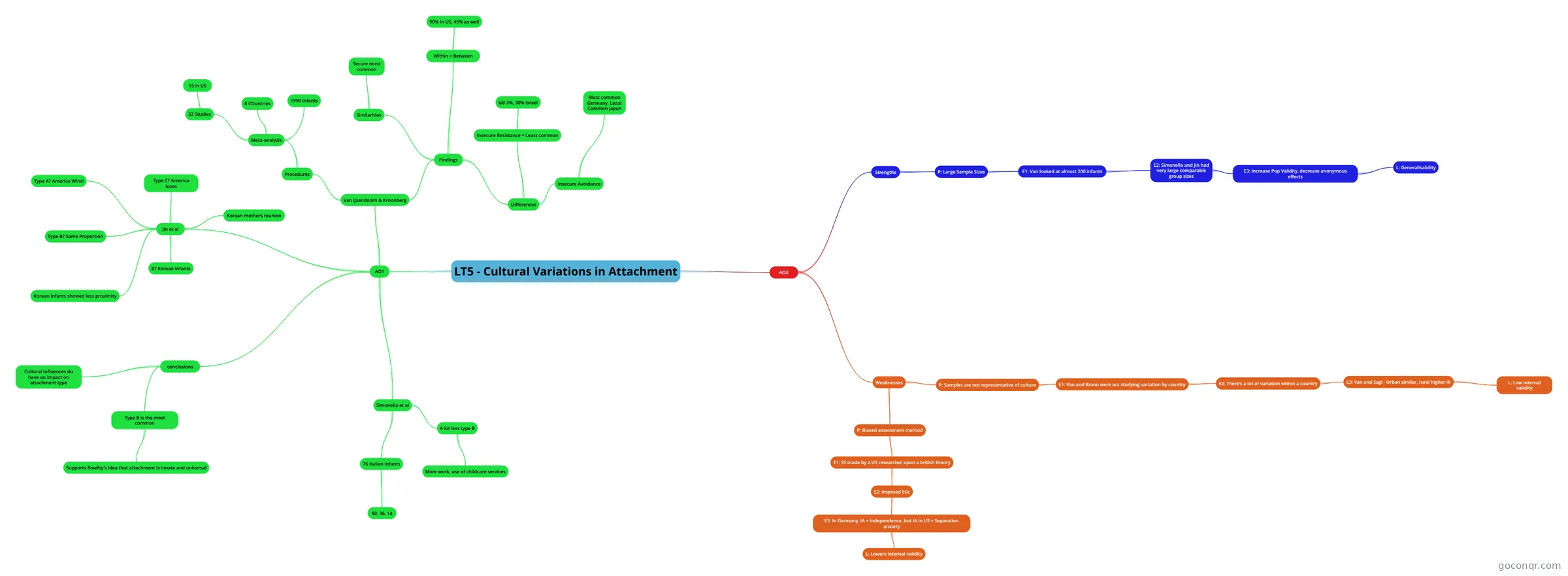
Mind map: Cultural Variations in Attachment
Map content
LT5 - Cultural Variations in Attachment
AO1
- Van Ijxendoorn & Kroonberg
- Procedures
- Meta-analysis
- 32 Studies
- 15 in US
- 8 COuntries
- 1990 Infants
- 32 Studies
- Meta-analysis
- Findings
- Similarities
- Secure most common
- Differences
- Insecure Resistance = Least common
- GB 3%, 30% Israel
- Insecure Avoidance
- Most common Germany, Least Common Japan
- Insecure Resistance = Least common
- Within > Between
- 90% in US, 45% as well
- Similarities
- Procedures
- Jin et al
- 87 Korean Infants
- Type B? Same Proportion
- Type A? America Wins!
- Type C? America loses
- Korean infants showed less proximity
- Korean mothers reunion
- conclusions
- Type B is the most common
- Supports Bowlby's idea that attachment is innate and universal
- Cultural influences do have an impact on attachment type
- Type B is the most common
- Simonella et al
- 76 Italian Infants
- 50, 36, 14
- A lot less type B
- More work, use of childcare services
- 76 Italian Infants
- Van Ijxendoorn & Kroonberg
AO3
- Weaknesses
- P: Samples are not representative of culture
- E1: Van and Kroon were acc studying variation by country
- E2: There's a lot of variation within a country
- E3: Van and Sagi - Urban similar, rural higher IR
- L: Low internal validity
- E3: Van and Sagi - Urban similar, rural higher IR
- E2: There's a lot of variation within a country
- E1: Van and Kroon were acc studying variation by country
- P: Biased assessment method
- E1: SS made by a US researcher upon a british theory
- E2: Imposed Etic
- E3: In Germany, IA = Independence, but IA in US = Separation anxiety
- L: Lowers internal validity
- E3: In Germany, IA = Independence, but IA in US = Separation anxiety
- E2: Imposed Etic
- E1: SS made by a US researcher upon a british theory
- P: Samples are not representative of culture
- Strengths
- P: Large Sample Sizes
- E1: Van looked at almost 200 infants
- E2: Simonella and Jin had very large comparable group sizes
- E3: Increase Pop Validity, decrease anonymous effects
- L: Generalisability
- E3: Increase Pop Validity, decrease anonymous effects
- E2: Simonella and Jin had very large comparable group sizes
- E1: Van looked at almost 200 infants
- P: Large Sample Sizes
- Weaknesses
Information
- Description
- A level Psychology (U6 MOCKS - ATTACHMENT) Mind Map on LT5 - Cultural Variations in Attachment, created by Kiran Bacchus on 18/02/2022.
- Created by
- Kiran Bacchus
- Views
- 0
- Rating