
Mind map
RELATIONSHIPS
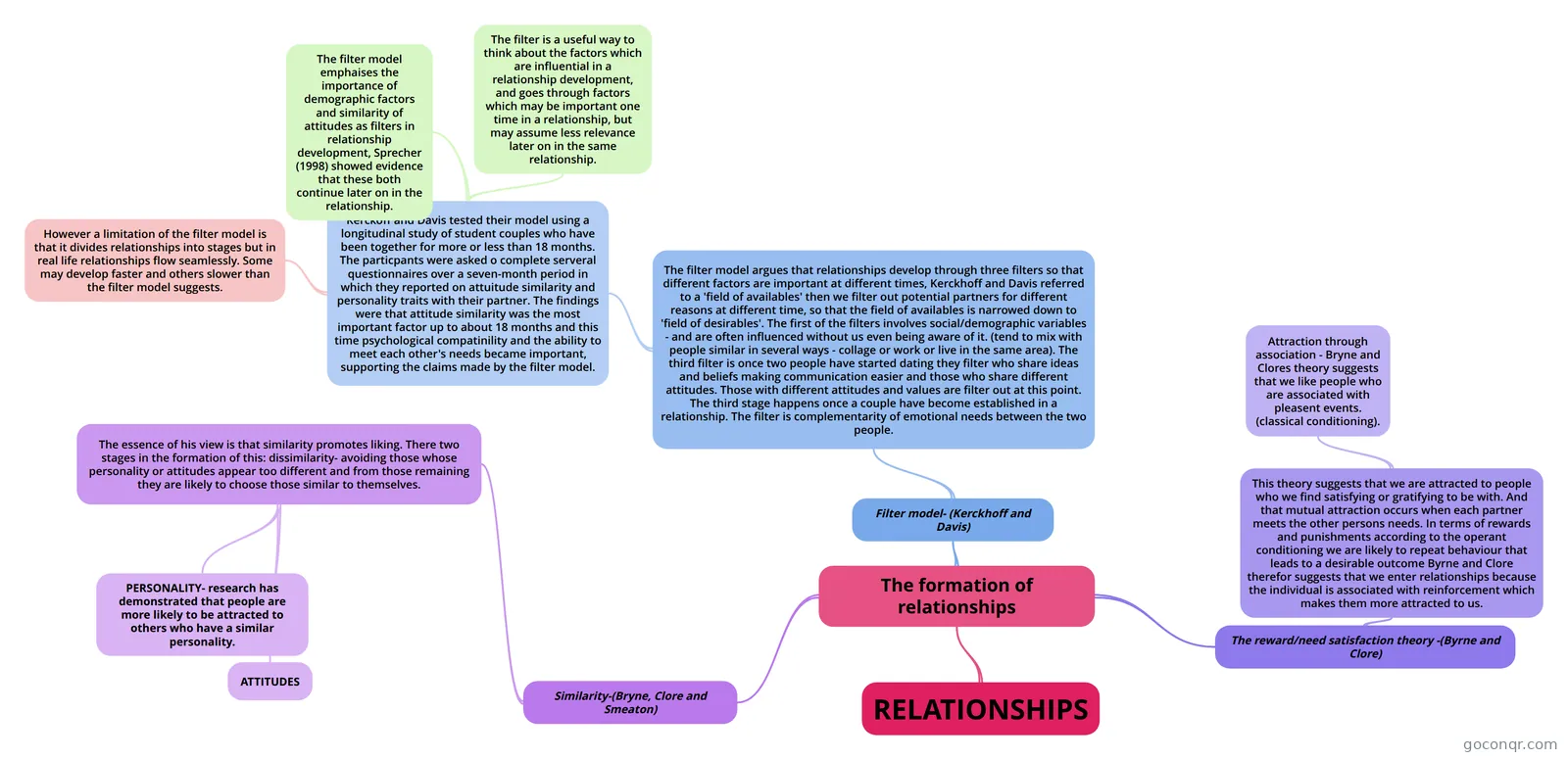
Mind map: Relationships
Map content
RELATIONSHIPS
The formation of relationships
- The reward/need satisfaction theory -(Byrne and Clore)
- This theory suggests that we are attracted to people who we find satisfying or gratifying to be with. And that mutual attraction occurs when each partner meets the other persons needs. In terms of rewards and punishments according to the operant conditioning we are likely to repeat behaviour that leads to a desirable outcome Byrne and Clore therefor suggests that we enter relationships because the individual is associated with reinforcement which makes them more attracted to us.
- Attraction through association - Bryne and Clores theory suggests that we like people who are associated with pleasent events. (classical conditioning).
- This theory suggests that we are attracted to people who we find satisfying or gratifying to be with. And that mutual attraction occurs when each partner meets the other persons needs. In terms of rewards and punishments according to the operant conditioning we are likely to repeat behaviour that leads to a desirable outcome Byrne and Clore therefor suggests that we enter relationships because the individual is associated with reinforcement which makes them more attracted to us.
- Similarity-(Bryne, Clore and Smeaton)
- The essence of his view is that similarity promotes liking. There two stages in the formation of this: dissimilarity- avoiding those whose personality or attitudes appear too different and from those remaining they are likely to choose those similar to themselves.
- ATTITUDES
- PERSONALITY- research has demonstrated that people are more likely to be attracted to others who have a similar personality.
- The essence of his view is that similarity promotes liking. There two stages in the formation of this: dissimilarity- avoiding those whose personality or attitudes appear too different and from those remaining they are likely to choose those similar to themselves.
- Filter model- (Kerckhoff and Davis)
- The filter model argues that relationships develop through three filters so that different factors are important at different times, Kerckhoff and Davis referred to a 'field of availables' then we filter out potential partners for different reasons at different time, so that the field of availables is narrowed down to 'field of desirables'. The first of the filters involves social/demographic variables - and are often influenced without us even being aware of it. (tend to mix with people similar in several ways - collage or work or live in the same area). The third filter is once two people have started dating they filter who share ideas and beliefs making communication easier and those who share different attitudes. Those with different attitudes and values are filter out at this point. The third stage happens once a couple have become established in a relationship. The filter is complementarity of emotional needs between the two people.
- Kerckoff and Davis tested their model using a longitudinal study of student couples who have been together for more or less than 18 months. The particpants were asked o complete serveral questionnaires over a seven-month period in which they reported on attuitude similarity and personality traits with their partner. The findings were that attitude similarity was the most important factor up to about 18 months and this time psychological compatinility and the ability to meet each other's needs became important, supporting the claims made by the filter model.
- The filter is a useful way to think about the factors which are influential in a relationship development, and goes through factors which may be important one time in a relationship, but may assume less relevance later on in the same relationship.
- The filter model emphaises the importance of demographic factors and similarity of attitudes as filters in relationship development, Sprecher (1998) showed evidence that these both continue later on in the relationship.
- However a limitation of the filter model is that it divides relationships into stages but in real life relationships flow seamlessly. Some may develop faster and others slower than the filter model suggests.
- Kerckoff and Davis tested their model using a longitudinal study of student couples who have been together for more or less than 18 months. The particpants were asked o complete serveral questionnaires over a seven-month period in which they reported on attuitude similarity and personality traits with their partner. The findings were that attitude similarity was the most important factor up to about 18 months and this time psychological compatinility and the ability to meet each other's needs became important, supporting the claims made by the filter model.
- The filter model argues that relationships develop through three filters so that different factors are important at different times, Kerckhoff and Davis referred to a 'field of availables' then we filter out potential partners for different reasons at different time, so that the field of availables is narrowed down to 'field of desirables'. The first of the filters involves social/demographic variables - and are often influenced without us even being aware of it. (tend to mix with people similar in several ways - collage or work or live in the same area). The third filter is once two people have started dating they filter who share ideas and beliefs making communication easier and those who share different attitudes. Those with different attitudes and values are filter out at this point. The third stage happens once a couple have become established in a relationship. The filter is complementarity of emotional needs between the two people.
- The reward/need satisfaction theory -(Byrne and Clore)
Information
- Description
- Mind Map on RELATIONSHIPS, created by scu on 14/11/2013.
- Created by
- scu
- Views
- 48
- Rating
More on Relationship formation and attraction