
Mind map
Virtual Relationships in Social Media
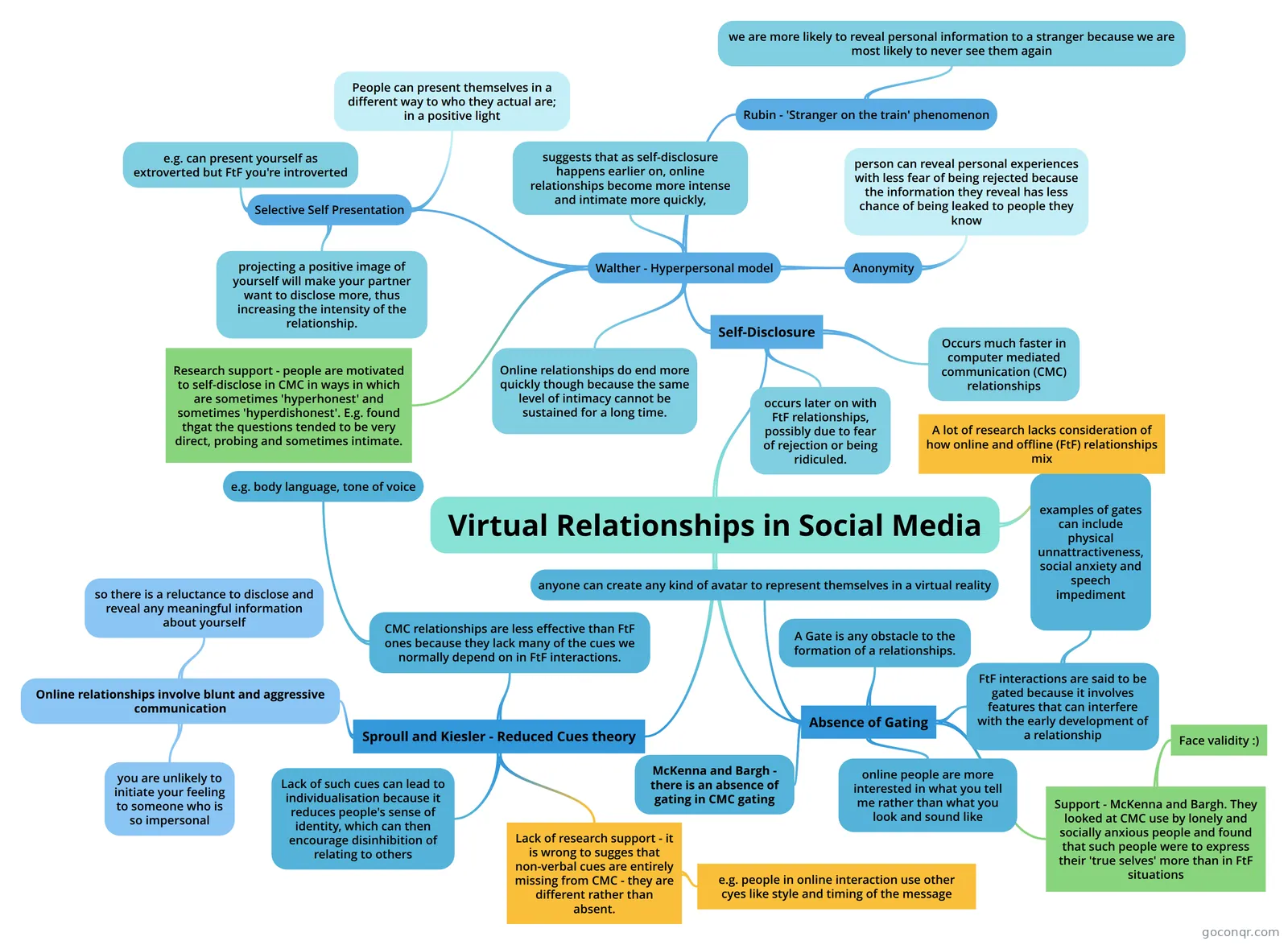
Mind map: Virtual Relationships in Social Media
Map content
Virtual Relationships in Social Media
Self-Disclosure
- Occurs much faster in computer mediated communication (CMC) relationships
- occurs later on with FtF relationships, possibly due to fear of rejection or being ridiculed.
- Walther - Hyperpersonal model
- Anonymity
- person can reveal personal experiences with less fear of being rejected because the information they reveal has less chance of being leaked to people they know
- suggests that as self-disclosure happens earlier on, online relationships become more intense and intimate more quickly,
- Online relationships do end more quickly though because the same level of intimacy cannot be sustained for a long time.
- Selective Self Presentation
- People can present themselves in a different way to who they actual are; in a positive light
- projecting a positive image of yourself will make your partner want to disclose more, thus increasing the intensity of the relationship.
- e.g. can present yourself as extroverted but FtF you're introverted
- Rubin - 'Stranger on the train' phenomenon
- we are more likely to reveal personal information to a stranger because we are most likely to never see them again
- Research support - people are motivated to self-disclose in CMC in ways in which are sometimes 'hyperhonest' and sometimes 'hyperdishonest'. E.g. found thgat the questions tended to be very direct, probing and sometimes intimate.
- Anonymity
Sproull and Kiesler - Reduced Cues theory
- CMC relationships are less effective than FtF ones because they lack many of the cues we normally depend on in FtF interactions.
- e.g. body language, tone of voice
- Online relationships involve blunt and aggressive communication
- so there is a reluctance to disclose and reveal any meaningful information about yourself
- you are unlikely to initiate your feeling to someone who is so impersonal
- Lack of such cues can lead to individualisation because it reduces people's sense of identity, which can then encourage disinhibition of relating to others
- Lack of research support - it is wrong to sugges that non-verbal cues are entirely missing from CMC - they are different rather than absent.
- e.g. people in online interaction use other cyes like style and timing of the message
- CMC relationships are less effective than FtF ones because they lack many of the cues we normally depend on in FtF interactions.
Absence of Gating
- A Gate is any obstacle to the formation of a relationships.
- FtF interactions are said to be gated because it involves features that can interfere with the early development of a relationship
- examples of gates can include physical unnattractiveness, social anxiety and speech impediment
- McKenna and Bargh - there is an absence of gating in CMC gating
- online people are more interested in what you tell me rather than what you look and sound like
- anyone can create any kind of avatar to represent themselves in a virtual reality
- Support - McKenna and Bargh. They looked at CMC use by lonely and socially anxious people and found that such people were to express their 'true selves' more than in FtF situations
- Face validity :)
A lot of research lacks consideration of how online and offline (FtF) relationships mix
Information
- Description
- A level Psychology Mind Map on Virtual Relationships in Social Media, created by Caitlin Hazelton on 19/04/2022.
- Created by
- Caitlin Hazelton
- Views
- 5
- Rating