
Mind map
Accuracy of eyewitness testimony
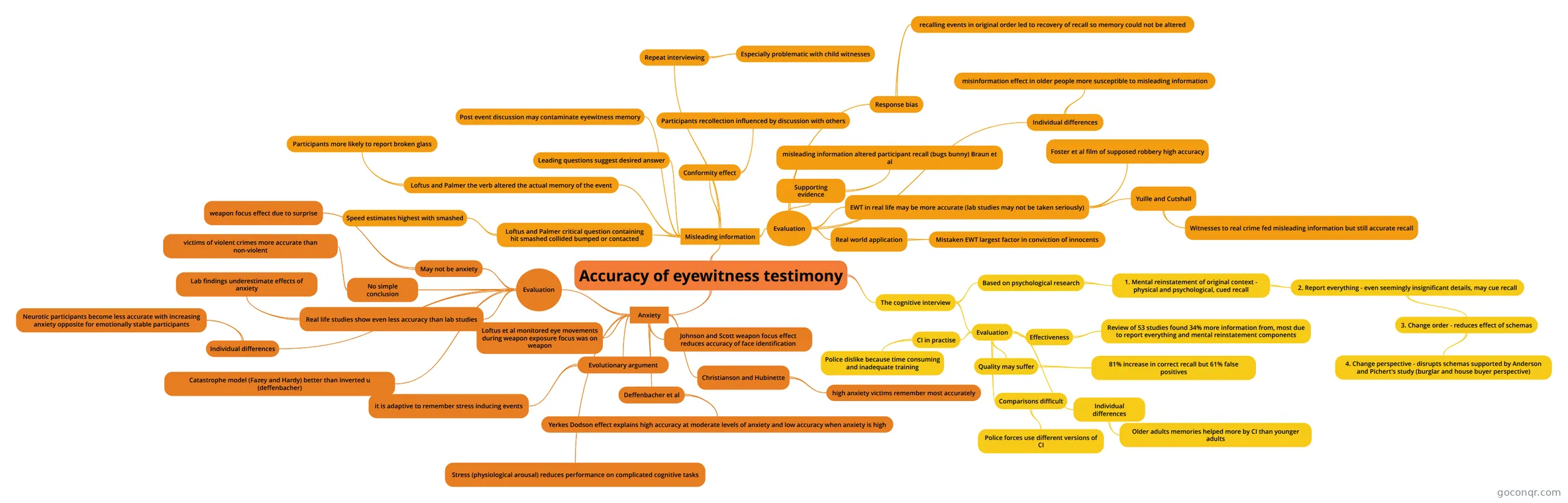
Mind map: Accuracy of eyewitness testimony
Map content
Accuracy of eyewitness testimony
Misleading information
- Leading questions suggest desired answer
- Loftus and Palmer critical question containing hit smashed collided bumped or contacted
- Speed estimates highest with smashed
- Loftus and Palmer the verb altered the actual memory of the event
- Participants more likely to report broken glass
- Post event discussion may contaminate eyewitness memory
- Conformity effect
- Participants recollection influenced by discussion with others
- Repeat interviewing
- Especially problematic with child witnesses
- Evaluation
- Supporting evidence
- misleading information altered participant recall (bugs bunny) Braun et al
- EWT in real life may be more accurate (lab studies may not be taken seriously)
- Foster et al film of supposed robbery high accuracy
- Yuille and Cutshall
- Witnesses to real crime fed misleading information but still accurate recall
- Real world application
- Mistaken EWT largest factor in conviction of innocents
- Individual differences
- misinformation effect in older people more susceptible to misleading information
- Response bias
- recalling events in original order led to recovery of recall so memory could not be altered
- Supporting evidence
Anxiety
- Stress (physiological arousal) reduces performance on complicated cognitive tasks
- Johnson and Scott weapon focus effect reduces accuracy of face identification
- Loftus et al monitored eye movements during weapon exposure focus was on weapon
- Evolutionary argument
- it is adaptive to remember stress inducing events
- Christianson and Hubinette
- high anxiety victims remember most accurately
- Deffenbacher et al
- Yerkes Dodson effect explains high accuracy at moderate levels of anxiety and low accuracy when anxiety is high
- Evaluation
- May not be anxiety
- weapon focus effect due to surprise
- Real life studies show even less accuracy than lab studies
- Lab findings underestimate effects of anxiety
- No simple conclusion
- victims of violent crimes more accurate than non-violent
- Individual differences
- Neurotic participants become less accurate with increasing anxiety opposite for emotionally stable participants
- Catastrophe model (Fazey and Hardy) better than inverted u (deffenbacher)
- May not be anxiety
The cognitive interview
- Based on psychological research
- 1. Mental reinstatement of original context - physical and psychological, cued recall
- 2. Report everything - even seemingly insignificant details, may cue recall
- 3. Change order - reduces effect of schemas
- 4. Change perspective - disrupts schemas supported by Anderson and Pichert's study (burglar and house buyer perspective)
- 3. Change order - reduces effect of schemas
- 2. Report everything - even seemingly insignificant details, may cue recall
- 1. Mental reinstatement of original context - physical and psychological, cued recall
- Evaluation
- Effectiveness
- Review of 53 studies found 34% more information from, most due to report everything and mental reinstatement components
- Quality may suffer
- 81% increase in correct recall but 61% false positives
- CI in practise
- Police dislike because time consuming and inadequate training
- Comparisons difficult
- Police forces use different versions of CI
- Individual differences
- Older adults memories helped more by CI than younger adults
- Effectiveness
- Based on psychological research
Information
- Description
- A level Psychology (Memory ) Mind Map on Accuracy of eyewitness testimony, created by Annabelle Usher on 06/06/2022.
- Created by
- Annabelle Usher
- Views
- 0
- Rating