
Mind map
Group Displays as an Adaptive Response (A01)
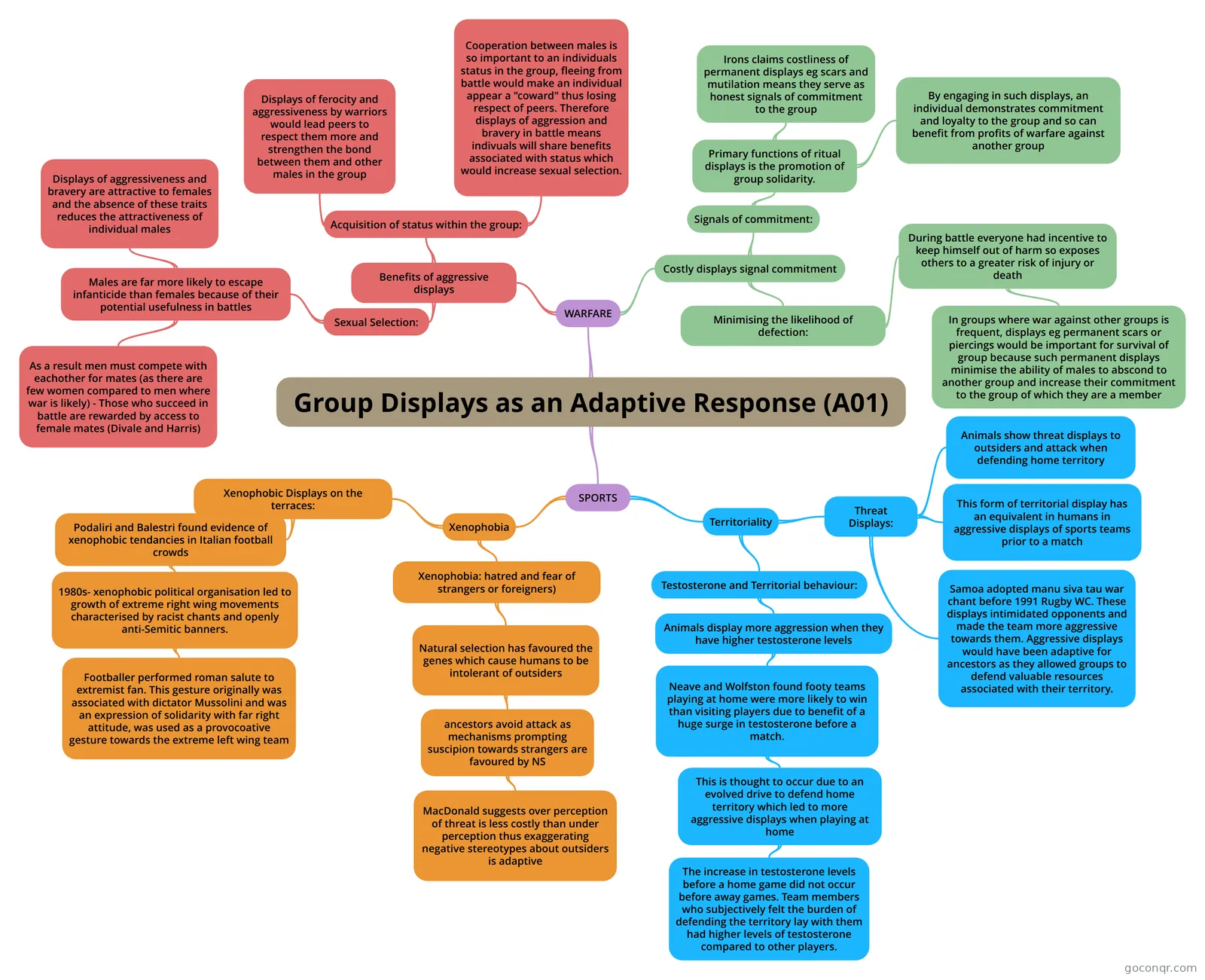
Mind map: Group displays as an adaptive response
Map content
Group Displays as an Adaptive Response (A01)
SPORTS
- Xenophobia
- Xenophobic Displays on the terraces:
- Podaliri and Balestri found evidence of xenophobic tendancies in Italian football crowds
- 1980s- xenophobic political organisation led to growth of extreme right wing movements characterised by racist chants and openly anti-Semitic banners.
- Footballer performed roman salute to extremist fan. This gesture originally was associated with dictator Mussolini and was an expression of solidarity with far right attitude, was used as a provocoative gesture towards the extreme left wing team
- 1980s- xenophobic political organisation led to growth of extreme right wing movements characterised by racist chants and openly anti-Semitic banners.
- Podaliri and Balestri found evidence of xenophobic tendancies in Italian football crowds
- Xenophobia: hatred and fear of strangers or foreigners)
- Natural selection has favoured the genes which cause humans to be intolerant of outsiders
- ancestors avoid attack as mechanisms prompting suscipion towards strangers are favoured by NS
- MacDonald suggests over perception of threat is less costly than under perception thus exaggerating negative stereotypes about outsiders is adaptive
- ancestors avoid attack as mechanisms prompting suscipion towards strangers are favoured by NS
- Natural selection has favoured the genes which cause humans to be intolerant of outsiders
- Xenophobic Displays on the terraces:
- Territoriality
- Threat Displays:
- Animals show threat displays to outsiders and attack when defending home territory
- This form of territorial display has an equivalent in humans in aggressive displays of sports teams prior to a match
- Samoa adopted manu siva tau war chant before 1991 Rugby WC. These displays intimidated opponents and made the team more aggressive towards them. Aggressive displays would have been adaptive for ancestors as they allowed groups to defend valuable resources associated with their territory.
- Testosterone and Territorial behaviour:
- Animals display more aggression when they have higher testosterone levels
- Neave and Wolfston found footy teams playing at home were more likely to win than visiting players due to benefit of a huge surge in testosterone before a match.
- This is thought to occur due to an evolved drive to defend home territory which led to more aggressive displays when playing at home
- The increase in testosterone levels before a home game did not occur before away games. Team members who subjectively felt the burden of defending the territory lay with them had higher levels of testosterone compared to other players.
- This is thought to occur due to an evolved drive to defend home territory which led to more aggressive displays when playing at home
- Neave and Wolfston found footy teams playing at home were more likely to win than visiting players due to benefit of a huge surge in testosterone before a match.
- Animals display more aggression when they have higher testosterone levels
- Threat Displays:
- Xenophobia
WARFARE
- Benefits of aggressive displays
- Sexual Selection:
- Males are far more likely to escape infanticide than females because of their potential usefulness in battles
- As a result men must compete with eachother for mates (as there are few women compared to men where war is likely) - Those who succeed in battle are rewarded by access to female mates (Divale and Harris)
- Displays of aggressiveness and bravery are attractive to females and the absence of these traits reduces the attractiveness of individual males
- Males are far more likely to escape infanticide than females because of their potential usefulness in battles
- Acquisition of status within the group:
- Displays of ferocity and aggressiveness by warriors would lead peers to respect them more and strengthen the bond between them and other males in the group
- Cooperation between males is so important to an individuals status in the group, fleeing from battle would make an individual appear a "coward" thus losing respect of peers. Therefore displays of aggression and bravery in battle means indivuals will share benefits associated with status which would increase sexual selection.
- Sexual Selection:
- Costly displays signal commitment
- Signals of commitment:
- Primary functions of ritual displays is the promotion of group solidarity.
- Irons claims costliness of permanent displays eg scars and mutilation means they serve as honest signals of commitment to the group
- By engaging in such displays, an individual demonstrates commitment and loyalty to the group and so can benefit from profits of warfare against another group
- Primary functions of ritual displays is the promotion of group solidarity.
- Minimising the likelihood of defection:
- During battle everyone had incentive to keep himself out of harm so exposes others to a greater risk of injury or death
- In groups where war against other groups is frequent, displays eg permanent scars or piercings would be important for survival of group because such permanent displays minimise the ability of males to abscond to another group and increase their commitment to the group of which they are a member
- During battle everyone had incentive to keep himself out of harm so exposes others to a greater risk of injury or death
- Signals of commitment:
- Benefits of aggressive displays
Information
- Description
- A-Level Psychology (AGGRESSION) Mind Map on Group Displays as an Adaptive Response (A01), created by shannonk2 on 14/10/2015.
- Created by
- shannonk2
- Views
- 2
- Rating
More on Evolutionary explanations of group displays