
Mind map
Child Psychology
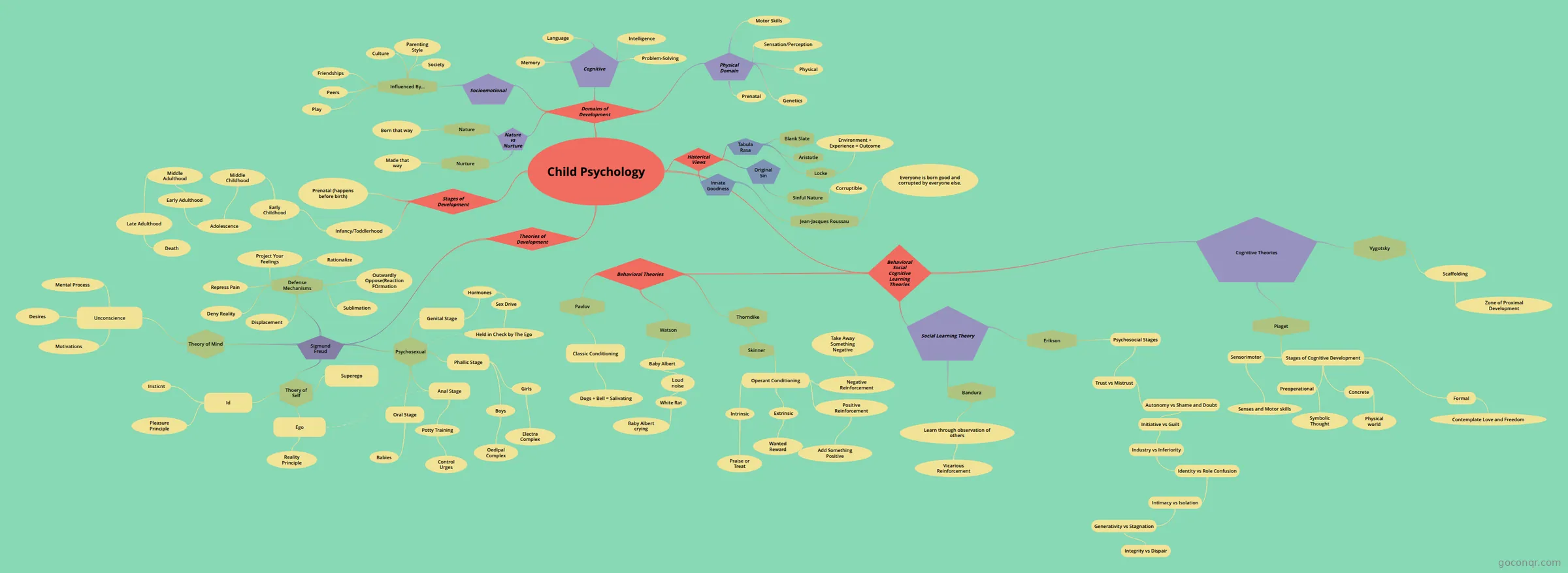
Mind map: Child psychology
Map content
Child Psychology
Historical Views
- Tabula Rasa
- Blank Slate
- Aristotle
- 384-322 Believer in Tabula Rasa or "Blank Slate."
- Locke
- 1632-1704 Believed children are shaped by their experiences. Children learn from observing the parental unit.
- Environment + Experience = Outcome
- Original Sin
- Sinful Nature
- The spirit is willing but the flesh is weak.
- Corruptible
- Sinful Nature
- Innate Goodness
- Jean-Jacques Roussau
- 1712-1778. French philosopher. Believed children were born "good" and then corrupted by society.
- Everyone is born good and corrupted by everyone else.
- Jean-Jacques Roussau
- Tabula Rasa
Domains of Development
- All three domains of development work together. This means that a child needs to develop the physical ability to complete a task and the cognitive ability to figure out how to complete the task. The socioemotional development will an effect on what the task is or looks like.
- Physical Domain
- Genetics
- Prenatal
- Physical
- Sensation/Perception
- Motor Skills
- Cognitive
- Memory
- Language
- Intelligence
- Problem-Solving
- Socioemotional
- Influenced By...
- Parenting Style
- Culture
- Friendships
- Peers
- Play
- Society
- Influenced By...
- Nature vs Nurture
- This is an old debate. Was Ted Bundy born a killer or was he made into a killer? We may never know. I would say both have merit.
- Nurture
- Made that way
- Think of Bronfenbrenner's ecological theory. Our environment is extremely impactful on who we become.
- Made that way
- Nature
- Born that way
Stages of Development
- Prenatal (happens before birth)
- Understanding of nutrition and environmental factors (teratogens) is important. Health of the mother is the main concern.
- Infancy/Toddlerhood
- Good ears and bad eyes. Has a large amount of growth and change in a short period of time. Typically, changes happen within the first two years of life.
- Early Childhood
- Another time of rapid growth and change.
- Middle Childhood
- More independent. Assessment of academic and physical skills. Learning of relationships outside of the family and home.
- Adolescence
- Physical growth. Sexual maturation and puberty. Begin to deal in abstract thought. Feelings of invincibility put this age group at greater risk for STDs and accidental death.
- Early Adulthood
- 20s and 30s Physiological peak. At risk for substance abuse and violent crime.
- Middle Adulthood
- 30s to 60s. Middle Adulthood peak productivity.
- Late Adulthood
- Young Old (still productive) Old Old (Risk of Disease increases)
- Death
- Nothing to add...your dead.
- Prenatal (happens before birth)
Theories of Development
- Sigmund Freud
- 1856-1939 Neurologist. Freud had a great impact on the field of psychopathology and development. The reason for copious amounts of research.
- Theory of Mind
- Unconscience
- Mental Process
- Desires
- Motivations
- Unconscience
- Psychosexual
- Oral Stage
- Individuals can become "stuck" in this stage. We see this in compulsive chewers or nail biters.
- Babies
- Babis explore the world by putting everything in their mouths.
- Anal Stage
- Ego is developing
- Potty Training
- Control Urges
- Phallic Stage
- Boys
- Oedipal Complex
- Freud believed that little boys in this stage are sexually attracted to their mothers. Knowing they can not compete with their fathers they mimic the father and learn masculine traits and their role as a man.
- Oedipal Complex
- Girls
- Electra Complex
- Feud believed little girls in this stage are sexually attracted to their fathers. Knowing they cannot compete with their mothers they learn to be like her and thus learn their role in society. He also believed they suffered from "penis envy."
- Electra Complex
- Boys
- Genital Stage
- Hormones
- Sex Drive
- Held in Check by The Ego
- Sex Drive
- Hormones
- Oral Stage
- Thoery of Self
- Id
- Insticnt
- Pleasure Principle
- Something is good because it feels good. Something is bad if it feels bad.
- Ego
- This is the mediator between the Id and the superego. To Freud the ego is a good thing. It allows us to accept reality.
- Reality Principle
- Superego
- Develops from a basis of societal and moral guidelines or rules. When this is violated it creates a feeling of guilt.
- Id
- Defense Mechanisms
- Freud suggested that desires, fears, anxieties, and motivations are the reasons for our actions. We may not always be aware of theses feelings. He believed that when unwanted or painful memories surfaced we developed certain defenses to cope with them.
- Outwardly Oppose(Reaction FOrmation
- Rationalize
- Project Your Feelings
- Repress Pain
- Deny Reality
- Sublimation
- Displacement
- Sigmund Freud
Behavioral Social Cognitive Learning Theories
- Behavioral Theories
- Pavlov
- 1880-1937 Found that he could make dogs salivate with a bell while studying digestion. Through association we can develop instinctive reactions.
- Classic Conditioning
- Is learned and connects us to past memories, good or bad, creating a "trained" response. The smell of a camp fire takes me back to childhood memories of camping.
- Dogs + Bell = Salivating
- Watson
- Popular in the 1920s. Believed most emotional reactions, such as fear, were classically conditioned. Found that baby Albert continued to reach for the white rat until loud noises were introduced with the rat. Albert would then associate the loud noise with the rat and began to cry when the rat was introduced. Albert was now afriad of the rat.
- Baby Albert
- Loud noise
- White Rat
- Baby Albert crying
- White Rat
- Loud noise
- Thorndike
- 1874-1949 law of Effect. A person will repeat an action if it had positive results.
- Skinner
- 1904-1990 Expanded on Thorndike.
- Operant Conditioning
- Behavior is repeated if reinforced (rewarded)
- Intrinsic
- Praise or Treat
- Extrinsic
- Wanted Reward
- Positive Reinforcement
- Add Something Positive
- Negative Reinforcement
- Take Away Something Negative
- Pavlov
- Social Learning Theory
- Bandura
- Learn through observation of others
- In new environments we learn our roles by what we observe or have observed from other in the same or similar situations.
- Vicarious Reinforcement
- Learn through observation of others
- Erikson
- 1902-1994 A student of Freud. Expanded on his theory of psychosexual development. Emphasized the importance of Parenting culture and motivations.
- Psychosocial Stages
- Trust vs Mistrust
- Age 0-1. If needs are met consistently in order to feel the world is trust worthy.
- Autonomy vs Shame and Doubt
- Age 1-2. New freedom in mobility. Learns basic independence.
- Initiative vs Guilt
- Age 3-5. Initiates activities and want to do things for themselves more often.
- Industry vs Inferiority
- Age 6-11. Focus on accomplishment and comparing themselves to their peers.
- Identity vs Role Confusion
- Age Teenagers. Experiment with ideas and beliefs.
- Intimacy vs Isolation
- Age 20s-30s. Typically first experiment with intimate long-term relationships.
- Generativity vs Stagnation
- Age 40s-60s. A focus on contributing to society by being productive at work and at home.
- Integrity vs Dispair
- Age: Late Adulthood. Look back on life hoping that we lived well and were guided by our beliefs.
- Trust vs Mistrust
- Bandura
- Cognitive Theories
- Piaget
- 1896-1980 Extremely influential in cognitive theory and education. Believed children would fit new information into their preexisting schema and either assimilate with existing knowledge or accommodate the new information.
- Stages of Cognitive Development
- Sensorimotor
- Experiences the world through their senses and use of motor skills.
- Senses and Motor skills
- Preoperational
- Learns symbols and words. Thinks of the world symbolically.
- Symbolic Thought
- Concrete
- Use of logic in the physical world.
- Physical world
- Formal
- Use of logic in the abstract and physical world.
- Contemplate Love and Freedom
- Sensorimotor
- Vygotsky
- Influential in education even today.
- Scaffolding
- Showing, helping and guiding a child as they learn. Allowing the child to learn while being supported.
- Zone of Proximal Development
- Piaget
- Behavioral Theories
Information
- Description
- Child Psychology and Developmental Theories.
- Created by
- Steven Jinright
- Views
- 21
- Rating