
Mind map
Nature Vs Nurture (AO1)
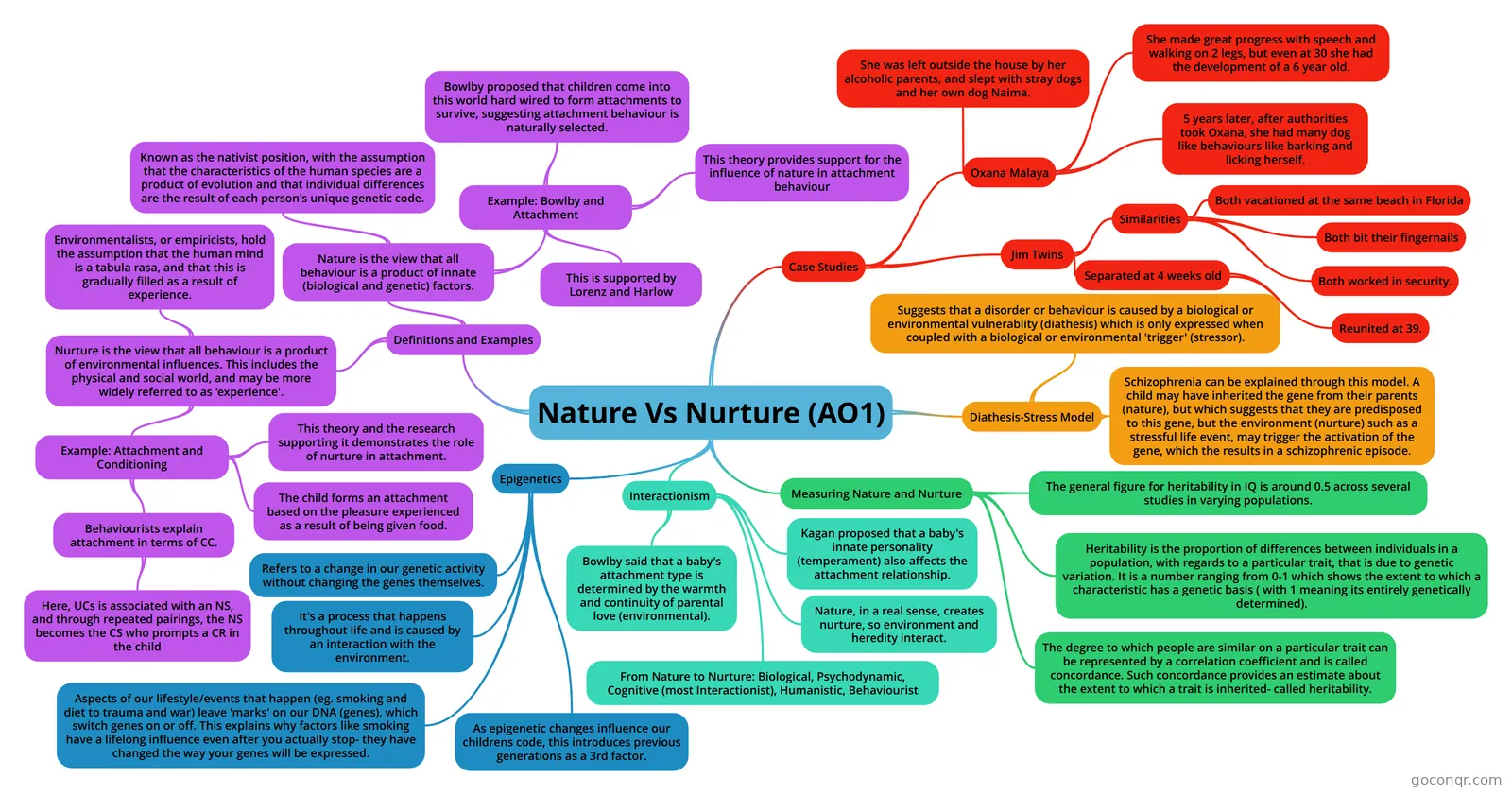
Mind map: Nature Vs Nurture (AO1)
Map content
Nature Vs Nurture (AO1)
Definitions and Examples
- Nature is the view that all behaviour is a product of innate (biological and genetic) factors.
- Known as the nativist position, with the assumption that the characteristics of the human species are a product of evolution and that individual differences are the result of each person's unique genetic code.
- Example: Bowlby and Attachment
- Bowlby proposed that children come into this world hard wired to form attachments to survive, suggesting attachment behaviour is naturally selected.
- This is supported by Lorenz and Harlow
- This theory provides support for the influence of nature in attachment behaviour
- Nurture is the view that all behaviour is a product of environmental influences. This includes the physical and social world, and may be more widely referred to as 'experience'.
- Environmentalists, or empiricists, hold the assumption that the human mind is a tabula rasa, and that this is gradually filled as a result of experience.
- Example: Attachment and Conditioning
- Behaviourists explain attachment in terms of CC.
- Here, UCs is associated with an NS, and through repeated pairings, the NS becomes the CS who prompts a CR in the child
- The child forms an attachment based on the pleasure experienced as a result of being given food.
- This theory and the research supporting it demonstrates the role of nurture in attachment.
- Behaviourists explain attachment in terms of CC.
- Nature is the view that all behaviour is a product of innate (biological and genetic) factors.
Measuring Nature and Nurture
- The degree to which people are similar on a particular trait can be represented by a correlation coefficient and is called concordance. Such concordance provides an estimate about the extent to which a trait is inherited- called heritability.
- Heritability is the proportion of differences between individuals in a population, with regards to a particular trait, that is due to genetic variation. It is a number ranging from 0-1 which shows the extent to which a characteristic has a genetic basis ( with 1 meaning its entirely genetically determined).
- The general figure for heritability in IQ is around 0.5 across several studies in varying populations.
Diathesis-Stress Model
- Suggests that a disorder or behaviour is caused by a biological or environmental vulnerablity (diathesis) which is only expressed when coupled with a biological or environmental 'trigger' (stressor).
- Schizophrenia can be explained through this model. A child may have inherited the gene from their parents (nature), but which suggests that they are predisposed to this gene, but the environment (nurture) such as a stressful life event, may trigger the activation of the gene, which the results in a schizophrenic episode.
Epigenetics
- Refers to a change in our genetic activity without changing the genes themselves.
- It's a process that happens throughout life and is caused by an interaction with the environment.
- Aspects of our lifestyle/events that happen (eg. smoking and diet to trauma and war) leave 'marks' on our DNA (genes), which switch genes on or off. This explains why factors like smoking have a lifelong influence even after you actually stop- they have changed the way your genes will be expressed.
- As epigenetic changes influence our childrens code, this introduces previous generations as a 3rd factor.
Case Studies
- Oxana Malaya
- She was left outside the house by her alcoholic parents, and slept with stray dogs and her own dog Naima.
- 5 years later, after authorities took Oxana, she had many dog like behaviours like barking and licking herself.
- She made great progress with speech and walking on 2 legs, but even at 30 she had the development of a 6 year old.
- Jim Twins
- Separated at 4 weeks old
- Reunited at 39.
- Similarities
- Both vacationed at the same beach in Florida
- Both bit their fingernails
- Both worked in security.
- Separated at 4 weeks old
- Oxana Malaya
Interactionism
- Bowlby said that a baby's attachment type is determined by the warmth and continuity of parental love (environmental).
- Kagan proposed that a baby's innate personality (temperament) also affects the attachment relationship.
- Nature, in a real sense, creates nurture, so environment and heredity interact.
- From Nature to Nurture: Biological, Psychodynamic, Cognitive (most Interactionist), Humanistic, Behaviourist
Information
- Description
- A level Psychology Mind Map on Nature Vs Nurture (AO1), created by Isaac MacKinnon on 09/09/2024.
- Created by
- Isaac MacKinnon
- Views
- 0
- Rating