
Mind map
Bacteriophages II
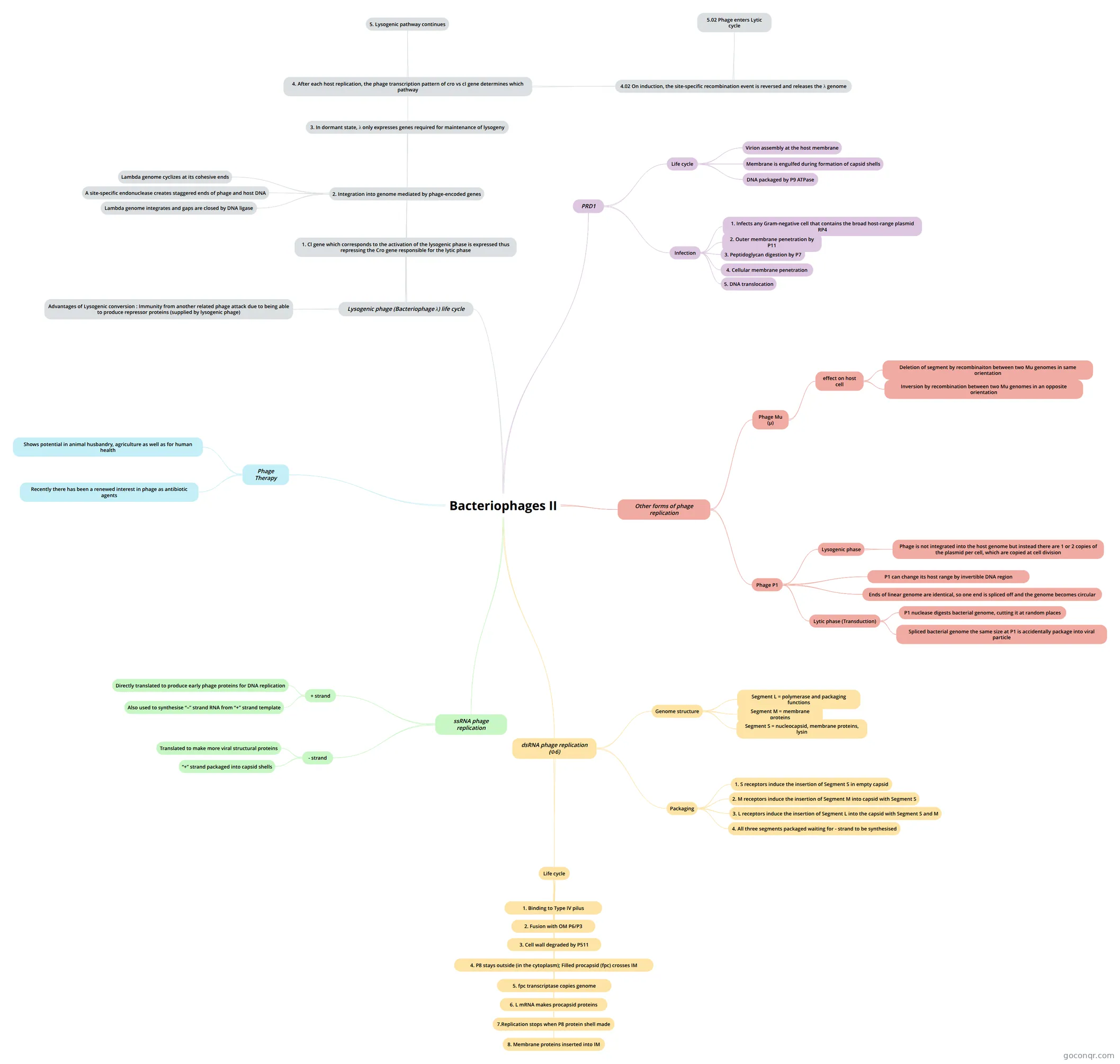
Mind map: Bacteriophages II
Map content
Bacteriophages II
Phage Therapy
- Shows potential in animal husbandry, agriculture as well as for human health
- Recently there has been a renewed interest in phage as antibiotic agents
ssRNA phage replication
- + strand
- Directly translated to produce early phage proteins for DNA replication
- Also used to synthesise “–” strand RNA from “+” strand template
- - strand
- Translated to make more viral structural proteins
- “+” strand packaged into capsid shells
- + strand
dsRNA phage replication (Ф6)
- Packaging
- 1. S receptors induce the insertion of Segment S in empty capsid
- 2. M receptors induce the insertion of Segment M into capsid with Segment S
- 3. L receptors induce the insertion of Segment L into the capsid with Segment S and M
- 4. All three segments packaged waiting for - strand to be synthesised
- Life cycle
- 1. Binding to Type IV pilus
- 2. Fusion with OM P6/P3
- 3. Cell wall degraded by P511
- 4. P8 stays outside (in the cytoplasm); Filled procapsid (fpc) crosses IM
- 5. fpc transcriptase copies genome
- 6. L mRNA makes procapsid proteins
- 7.Replication stops when P8 protein shell made
- 8. Membrane proteins inserted into IM
- Genome structure
- Segment L = polymerase and packaging functions
- Segment M = membrane proteins
- Segment S = nucleocapsid, membrane proteins, lysin
- Packaging
PRD1
- Life cycle
- Virion assembly at the host membrane
- Membrane is engulfed during formation of capsid shells
- DNA packaged by P9 ATPase
- Infection
- 1. Infects any Gram-negative cell that contains the broad host-range plasmid RP4
- 2. Outer membrane penetration by P11
- 3. Peptidoglycan digestion by P7
- 4. Cellular membrane penetration
- 5. DNA translocation
- Life cycle
Other forms of phage replication
- Phage P1
- Ends of linear genome are identical, so one end is spliced off and the genome becomes circular
- Lytic phase (Transduction)
- P1 nuclease digests bacterial genome, cutting it at random places
- Spliced bacterial genome the same size at P1 is accidentally package into viral particle
- Lysogenic phase
- Phage is not integrated into the host genome but instead there are 1 or 2 copies of the plasmid per cell, which are copied at cell division
- P1 can change its host range by invertible DNA region
- Phage Mu (µ)
- effect on host cell
- Deletion of segment by recombinaiton between two Mu genomes in same orientation
- Inversion by recombination between two Mu genomes in an opposite orientation
- effect on host cell
- Phage P1
Lysogenic phage (Bacteriophage λ) life cycle
- Advantages of Lysogenic conversion : Immunity from another related phage attack due to being able to produce repressor proteins (supplied by lysogenic phage)
- 1. Cl gene which corresponds to the activation of the lysogenic phase is expressed thus repressing the Cro gene responsible for the lytic phase
- 2. Integration into genome mediated by phage-encoded genes
- Lambda genome cyclizes at its cohesive ends
- A site-specific endonuclease creates staggered ends of phage and host DNA
- Lambda genome integrates and gaps are closed by DNA ligase
- 3. In dormant state, λ only expresses genes required for maintenance of lysogeny
- 4. After each host replication, the phage transcription pattern of cro vs cI gene determines which pathway
- 4.02 On induction, the site-specific recombination event is reversed and releases the λ genome
- 5.02 Phage enters Lytic cycle
- 5. Lysogenic pathway continues
- 4.02 On induction, the site-specific recombination event is reversed and releases the λ genome
Information
- Description
- University Virology (Week 8) Mind Map on Bacteriophages II, created by Tommy Shelby on 20/11/2015.
- Created by
- Tommy Shelby
- Views
- 1
- Rating