
Mind map
Trivers' Theory
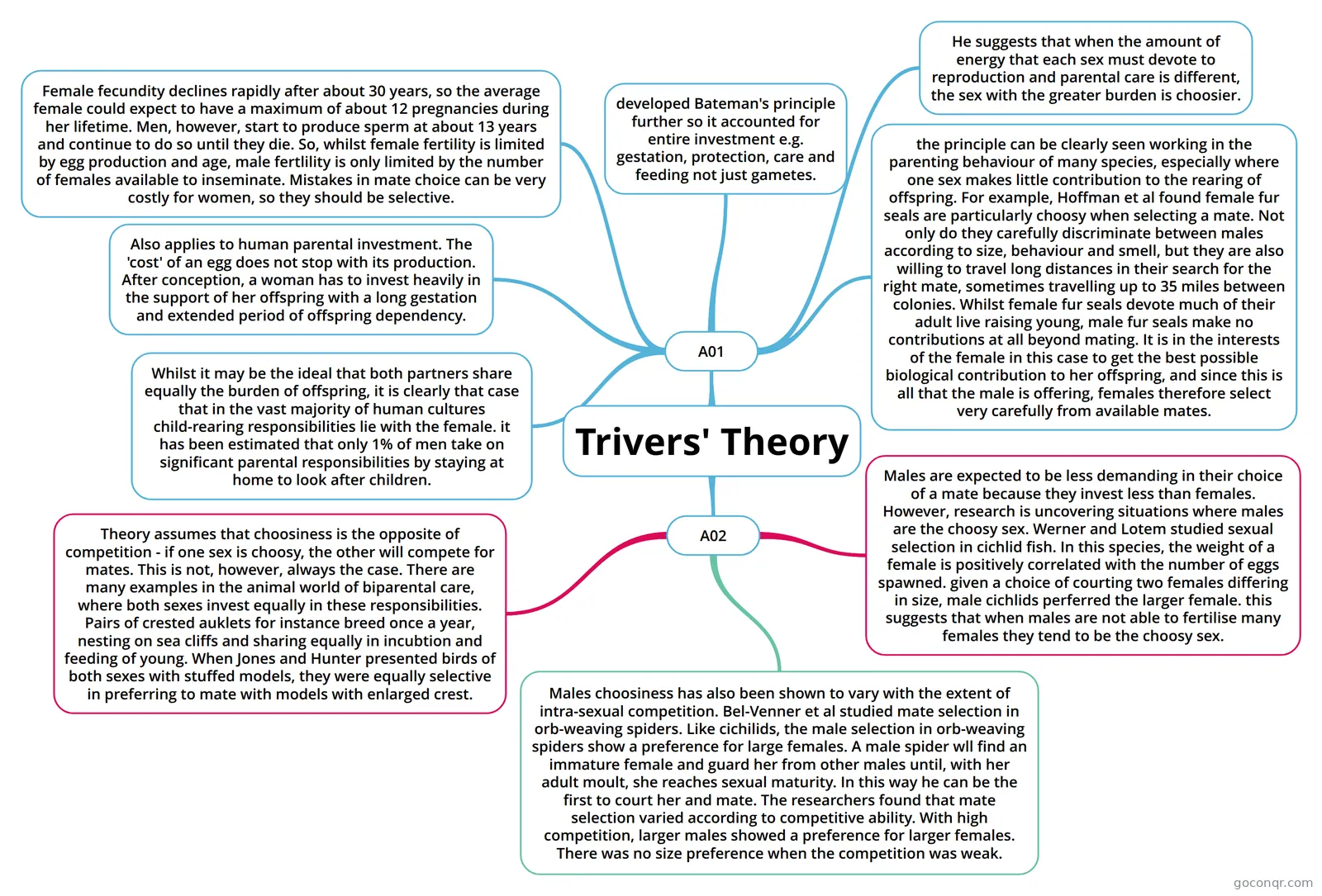
Mind map: Trivers' theory
Map content
Trivers' Theory
A01
- developed Bateman's principle further so it accounted for entire investment e.g. gestation, protection, care and feeding not just gametes.
- He suggests that when the amount of energy that each sex must devote to reproduction and parental care is different, the sex with the greater burden is choosier.
- the principle can be clearly seen working in the parenting behaviour of many species, especially where one sex makes little contribution to the rearing of offspring. For example, Hoffman et al found female fur seals are particularly choosy when selecting a mate. Not only do they carefully discriminate between males according to size, behaviour and smell, but they are also willing to travel long distances in their search for the right mate, sometimes travelling up to 35 miles between colonies. Whilst female fur seals devote much of their adult live raising young, male fur seals make no contributions at all beyond mating. It is in the interests of the female in this case to get the best possible biological contribution to her offspring, and since this is all that the male is offering, females therefore select very carefully from available mates.
- Also applies to human parental investment. The 'cost' of an egg does not stop with its production. After conception, a woman has to invest heavily in the support of her offspring with a long gestation and extended period of offspring dependency.
- Whilst it may be the ideal that both partners share equally the burden of offspring, it is clearly that case that in the vast majority of human cultures child-rearing responsibilities lie with the female. it has been estimated that only 1% of men take on significant parental responsibilities by staying at home to look after children.
- Female fecundity declines rapidly after about 30 years, so the average female could expect to have a maximum of about 12 pregnancies during her lifetime. Men, however, start to produce sperm at about 13 years and continue to do so until they die. So, whilst female fertility is limited by egg production and age, male fertlility is only limited by the number of females available to inseminate. Mistakes in mate choice can be very costly for women, so they should be selective.
A02
- Males are expected to be less demanding in their choice of a mate because they invest less than females. However, research is uncovering situations where males are the choosy sex. Werner and Lotem studied sexual selection in cichlid fish. In this species, the weight of a female is positively correlated with the number of eggs spawned. given a choice of courting two females differing in size, male cichlids perferred the larger female. this suggests that when males are not able to fertilise many females they tend to be the choosy sex.
- Males choosiness has also been shown to vary with the extent of intra-sexual competition. Bel-Venner et al studied mate selection in orb-weaving spiders. Like cichilids, the male selection in orb-weaving spiders show a preference for large females. A male spider wll find an immature female and guard her from other males until, with her adult moult, she reaches sexual maturity. In this way he can be the first to court her and mate. The researchers found that mate selection varied according to competitive ability. With high competition, larger males showed a preference for larger females. There was no size preference when the competition was weak.
- Theory assumes that choosiness is the opposite of competition - if one sex is choosy, the other will compete for mates. This is not, however, always the case. There are many examples in the animal world of biparental care, where both sexes invest equally in these responsibilities. Pairs of crested auklets for instance breed once a year, nesting on sea cliffs and sharing equally in incubtion and feeding of young. When Jones and Hunter presented birds of both sexes with stuffed models, they were equally selective in preferring to mate with models with enlarged crest.
Information
- Description
- A-Level Psychology (Printed) Mind Map on Trivers' Theory, created by Sophie Edroff on 02/12/2015.
- Created by
- Sophie Edroff
- Views
- 0
- Rating