
Mind map
Memory
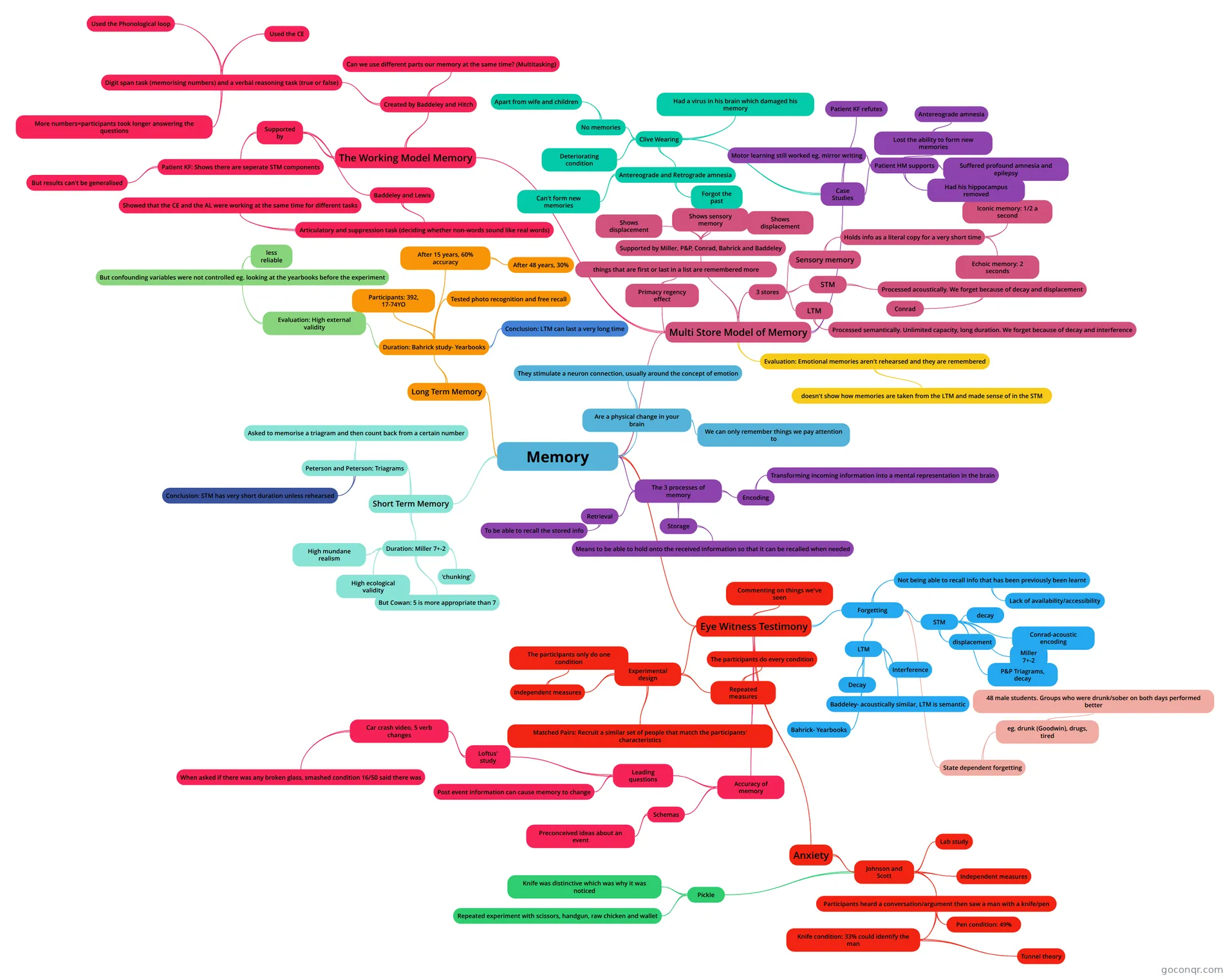
Mind map: Memory
Map content
Memory
Are a physical change in your brain
- They stimulate a neuron connection, usually around the concept of emotion
- We can only remember things we pay attention to
The 3 processes of memory
- Encoding
- Transforming incoming information into a mental representation in the brain
- Storage
- Means to be able to hold onto the received information so that it can be recalled when needed
- Retrieval
- To be able to recall the stored info
- Encoding
Long Term Memory
- Duration: Bahrick study- Yearbooks
- Participants: 392, 17-74YO
- Tested photo recognition and free recall
- After 15 years, 60% accuracy
- After 48 years, 30%
- Conclusion: LTM can last a very long time
- Evaluation: High external validity
- But confounding variables were not controlled eg. looking at the yearbooks before the experiment
- less reliable
- But confounding variables were not controlled eg. looking at the yearbooks before the experiment
- Duration: Bahrick study- Yearbooks
Short Term Memory
- Duration: Miller 7+-2
- 'chunking'
- High ecological validity
- High mundane realism
- But Cowan: 5 is more appropriate than 7
- Peterson and Peterson: Triagrams
- Asked to memorise a triagram and then count back from a certain number
- Conclusion: STM has very short duration unless rehearsed
- Duration: Miller 7+-2
Multi Store Model of Memory
- 3 stores
- Sensory memory
- Holds info as a literal copy for a very short time
- Iconic memory: 1/2 a second
- Echoic memory: 2 seconds
- Holds info as a literal copy for a very short time
- STM
- Processed acoustically. We forget because of decay and displacement
- Conrad
- Processed acoustically. We forget because of decay and displacement
- LTM
- Processed semantically. Unlimited capacity, long duration. We forget because of decay and interference
- Sensory memory
- Evaluation: Emotional memories aren't rehearsed and they are remembered
- doesn't show how memories are taken from the LTM and made sense of in the STM
- Supported by Miller, P&P, Conrad, Bahrick and Baddeley
- Shows displacement
- Shows displacement
- Shows sensory memory
- Primacy regency effect
- things that are first or last in a list are remembered more
- Case Studies
- Patient HM supports
- Suffered profound amnesia and epilepsy
- Had his hippocampus removed
- Lost the ability to form new memories
- Antereograde amnesia
- Motor learning still worked eg. mirror writing
- Patient KF refutes
- Clive Wearing
- Had a virus in his brain which damaged his memory
- No memories
- Apart from wife and children
- Deteriorating condition
- Antereograde and Retrograde amnesia
- Forgot the past
- Can't form new memories
- Patient HM supports
- The Working Model Memory
- Created by Baddeley and Hitch
- Can we use different parts our memory at the same time? (Multitasking)
- Digit span task (memorising numbers) and a verbal reasoning task (true or false)
- More numbers=participants took longer answering the questions
- Used the CE
- Used the Phonological loop
- Supported by
- Patient KF: Shows there are seperate STM components
- But results can't be generalised
- Baddeley and Lewis
- Articulatory and suppression task (deciding whether non-words sound like real words)
- Showed that the CE and the AL were working at the same time for different tasks
- Articulatory and suppression task (deciding whether non-words sound like real words)
- Patient KF: Shows there are seperate STM components
- Created by Baddeley and Hitch
- 3 stores
Eye Witness Testimony
- Experimental design
- Independent measures
- Avoids order effects More time consuming Participant variables
- The participants only do one condition
- Repeated measures
- Less time consuming Risk of order effects
- The participants do every condition
- Matched Pairs: Recruit a similar set of people that match the participants' characteristics
- Reduces participant variables No order effects Time consuming Impossible to match people exactly
- Independent measures
- Forgetting
- Not being able to recall info that has been previously been learnt
- Lack of availability/accessibility
- STM
- decay
- displacement
- Conrad-acoustic encoding
- Miller 7+-2
- P&P Triagrams, decay
- LTM
- Interference
- Decay
- Baddeley- acoustically similar, LTM is semantic
- Bahrick- Yearbooks
- State dependent forgetting
- eg. drunk (Goodwin), drugs, tired
- 48 male students. Groups who were drunk/sober on both days performed better
- eg. drunk (Goodwin), drugs, tired
- Not being able to recall info that has been previously been learnt
- Commenting on things we've seen
- Accuracy of memory
- Leading questions
- Post event information can cause memory to change
- Loftus' study
- Car crash video, 5 verb changes
- Smashed Collided Bumped Hit Contacted
- When asked if there was any broken glass, smashed condition 16/50 said there was
- Car crash video, 5 verb changes
- Schemas
- Preconceived ideas about an event
- Leading questions
- Anxiety
- Johnson and Scott
- Lab study
- Independent measures
- Participants heard a conversation/argument then saw a man with a knife/pen
- Knife condition: 33% could identify the man
- Tunnel theory
- Pen condition: 49%
- Knife condition: 33% could identify the man
- Pickle
- Knife was distinctive which was why it was noticed
- Repeated experiment with scissors, handgun, raw chicken and wallet
- Johnson and Scott
- Experimental design
Information
- Description
- A-Level Psychology Mind Map on Memory, created by jayme99 on 18/12/2015.
- Created by
- jayme99
- Views
- 0
- Rating