
Mind map
EWT
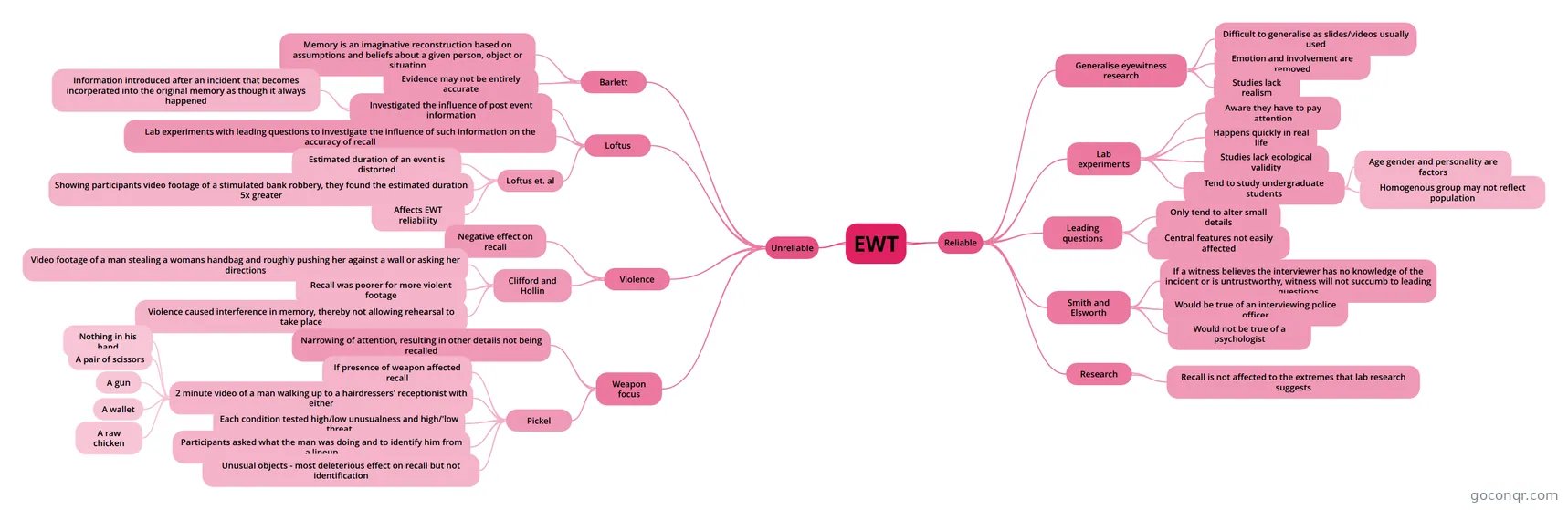
Mind map: EWT eyewitness testimony
Map content
EWT
Reliable
- Generalise eyewitness research
- Difficult to generalise as slides/videos usually used
- Emotion and involvement are removed
- Studies lack realism
- Lab experiments
- Aware they have to pay attention
- Happens quickly in real life
- Studies lack ecological validity
- Tend to study undergraduate students
- Age gender and personality are factors
- Homogenous group may not reflect population
- Leading questions
- Only tend to alter small details
- Central features not easily affected
- Smith and Elsworth
- If a witness believes the interviewer has no knowledge of the incident or is untrustworthy, witness will not succumb to leading questions
- Would be true of an interviewing police officer
- Would not be true of a psychologist
- Research
- Recall is not affected to the extremes that lab research suggests
- Generalise eyewitness research
Unreliable
- Barlett
- Memory is an imaginative reconstruction based on assumptions and beliefs about a given person, object or situation
- Evidence may not be entirely accurate
- Loftus
- Investigated the influence of post event information
- Information introduced after an incident that becomes incorperated into the original memory as though it always happened
- Lab experiments with leading questions to investigate the influence of such information on the accuracy of recall
- Loftus et. al
- Estimated duration of an event is distorted
- Showing participants video footage of a stimulated bank robbery, they found the estimated duration 5x greater
- Affects EWT reliability
- Investigated the influence of post event information
- Violence
- Negative effect on recall
- Clifford and Hollin
- Video footage of a man stealing a womans handbag and roughly pushing her against a wall or asking her directions
- Recall was poorer for more violent footage
- Violence caused interference in memory, thereby not allowing rehearsal to take place
- Weapon focus
- Narrowing of attention, resulting in other details not being recalled
- Pickel
- If presence of weapon affected recall
- 2 minute video of a man walking up to a hairdressers' receptionist with either
- Nothing in his hand
- A pair of scissors
- A gun
- A wallet
- A raw chicken
- Each condition tested high/low unusualness and high/'low threat
- Participants asked what the man was doing and to identify him from a lineup
- Unusual objects - most deleterious effect on recall but not identification
- Barlett
Information
- Description
- Psychology (Cognative) Mind Map on EWT, created by Beth Ritchie on 01/07/2014.
- Created by
- Beth Ritchie
- Views
- 38
- Tags
- Rating