
Mind map
LOFTUS & PALMER (1974) EYEWITNESS TESTIMONY
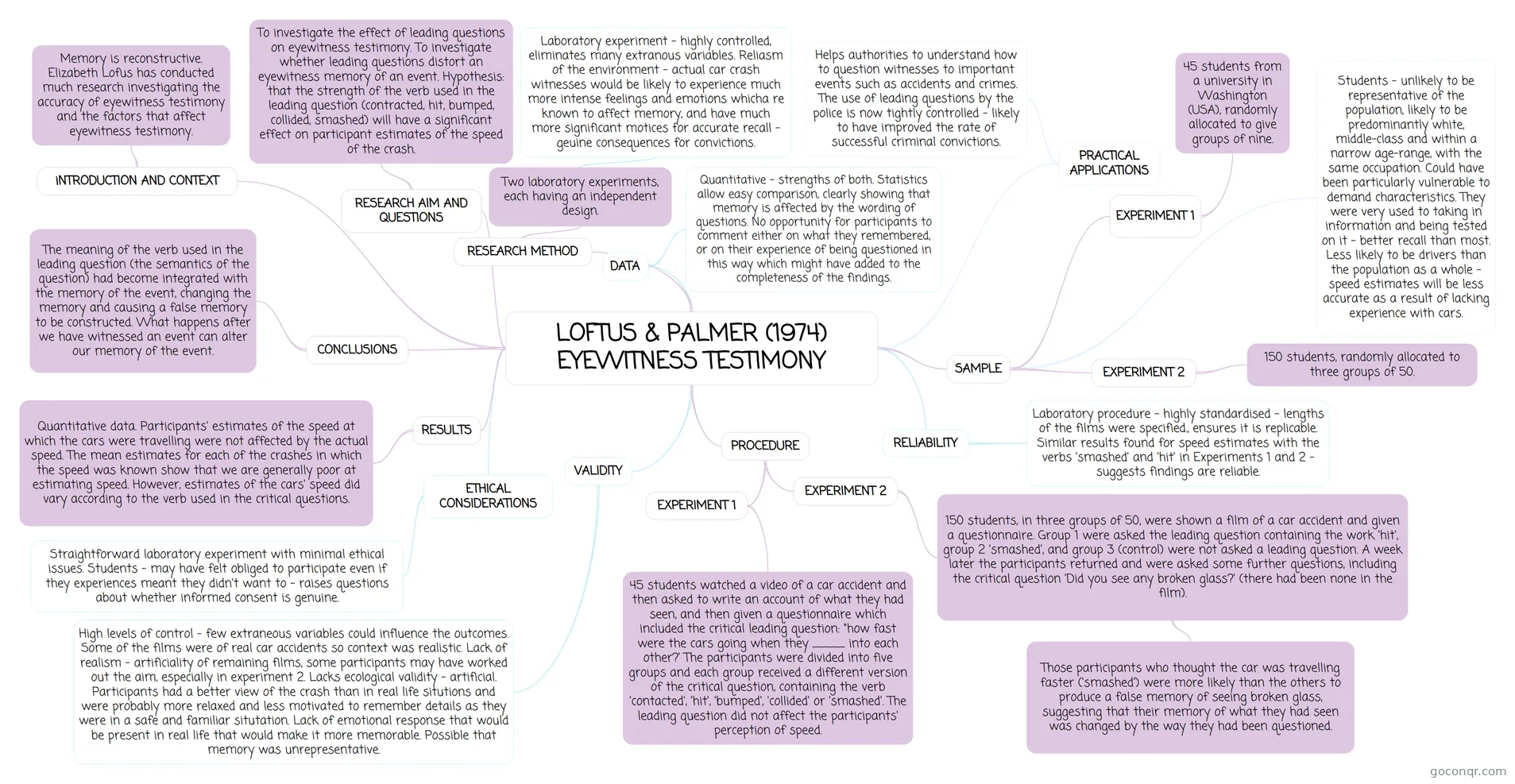
Mind map: Loftus & Palmer (1974) eyewitness testimony
Map content
LOFTUS & PALMER (1974) EYEWITNESS TESTIMONY
iNTRODUCTION AND CONTEXT
- Memory is reconstructive. Elizabeth Lofus has conducted much research investigating the accuracy of eyewitness testimony and the factors that affect eyewitness testimony.
RESEARCH AIM AND QUESTIONS
- To investigate the effect of leading questions on eyewitness testimony. To investigate whether leading questions distort an eyewitness memory of an event. Hypothesis: that the strength of the verb used in the leading question (contracted, hit, bumped, collided, smashed) will have a significant effect on participant estimates of the speed of the crash.
RESEARCH METHOD
- Two laboratory experiments, each having an independent design.
- Laboratory experiment - highly controlled, eliminates many extranous variables. Reliasm of the environment - actual car crash witnesses would be likely to experience much more intense feelings and emotions whicha re known to affect memory, and have much more significant motices for accurate recall - geuine consequences for convictions.
- Two laboratory experiments, each having an independent design.
SAMPLE
- EXPERIMENT 1
- 45 students from a university in Washington (USA), randomly allocated to give groups of nine.
- EXPERIMENT 2
- 150 students, randomly allocated to three groups of 50.
- Students - unlikely to be representative of the population, likely to be predominantly white, middle-class and within a narrow age-range, with the same occupation. Could have been particularly vulnerable to demand characteristics. They were very used to taking in information and being tested on it - better recall than most. Less likely to be drivers than the population as a whole - speed estimates will be less accurate as a result of lacking experience with cars.
- EXPERIMENT 1
PROCEDURE
- EXPERIMENT 1
- 45 students watched a video of a car accident and then asked to write an account of what they had seen, and then given a questionnaire which included the critical leading question: "how fast were the cars going when they ____ into each other?' The participants were divided into five groups and each group received a different version of the critical question, containing the verb 'contacted', 'hit', 'bumped', 'collided' or 'smashed'. The leading question did not affect the participants' perception of speed.
- EXPERIMENT 2
- 150 students, in three groups of 50, were shown a film of a car accident and given a questionnaire. Group 1 were asked the leading question containing the work 'hit', group 2 'smashed', and group 3 (control) were not asked a leading question. A week later the participants returned and were asked some further questions, including the critical question 'Did you see any broken glass?' (there had been none in the film).
- Those participants who thought the car was travelling faster ('smashed') were more likely than the others to produce a false memory of seeing broken glass, suggesting that their memory of what they had seen was changed by the way they had been questioned.
- 150 students, in three groups of 50, were shown a film of a car accident and given a questionnaire. Group 1 were asked the leading question containing the work 'hit', group 2 'smashed', and group 3 (control) were not asked a leading question. A week later the participants returned and were asked some further questions, including the critical question 'Did you see any broken glass?' (there had been none in the film).
- EXPERIMENT 1
RESULTS
- Quantitative data. Participants' estimates of the speed at which the cars were travelling were not affected by the actual speed. The mean estimates for each of the crashes in which the speed was known show that we are generally poor at estimating speed. However, estimates of the cars' speed did vary according to the verb used in the critical questions.
CONCLUSIONS
- The meaning of the verb used in the leading question (the semantics of the question) had become integrated with the memory of the event, changing the memory and causing a false memory to be constructed. What happens after we have witnessed an event can alter our memory of the event.
DATA
- Quantitative - strengths of both. Statistics allow easy comparison, clearly showing that memory is affected by the wording of questions. No opportunity for participants to comment either on what they remembered, or on their experience of being questioned in this way which might have added to the completeness of the findings.
ETHICAL CONSIDERATIONS
- Straightforward laboratory experiment with minimal ethical issues. Students - may have felt obliged to participate even if they experiences meant they didn't want to - raises questions about whether informed consent is genuine.
VALIDITY
- High levels of control - few extraneous variables could influence the outcomes. Some of the films were of real car accidents so context was realistic. Lack of realism - artificiality of remaining films, some participants may have worked out the aim, especially in experiment 2. Lacks ecological validity - artificial. Participants had a better view of the crash than in real life situtions and were probably more relaxed and less motivated to remember details as they were in a safe and familiar situtation. Lack of emotional response that would be present in real life that would make it more memorable. Possible that memory was unrepresentative.
RELIABILITY
- Laboratory procedure - highly standardised - lengths of the films were specified., ensures it is replicable. Similar results found for speed estimates with the verbs 'smashed' and 'hit' in Experiments 1 and 2 - suggests findings are reliable.
PRACTICAL APPLICATIONS
- Helps authorities to understand how to question witnesses to important events such as accidents and crimes. The use of leading questions by the police is now tightly controlled - likely to have improved the rate of successful criminal convictions.
Information
- Description
- A-Level Psychology (COGNITIVE PSYCHOLOGY) Mind Map on LOFTUS & PALMER (1974) EYEWITNESS TESTIMONY, created by Beth Tonks on 03/04/2016.
- Created by
- Beth Tonks
- Views
- 11
- Rating