
Mind map
Loftus and Palmer (1974)
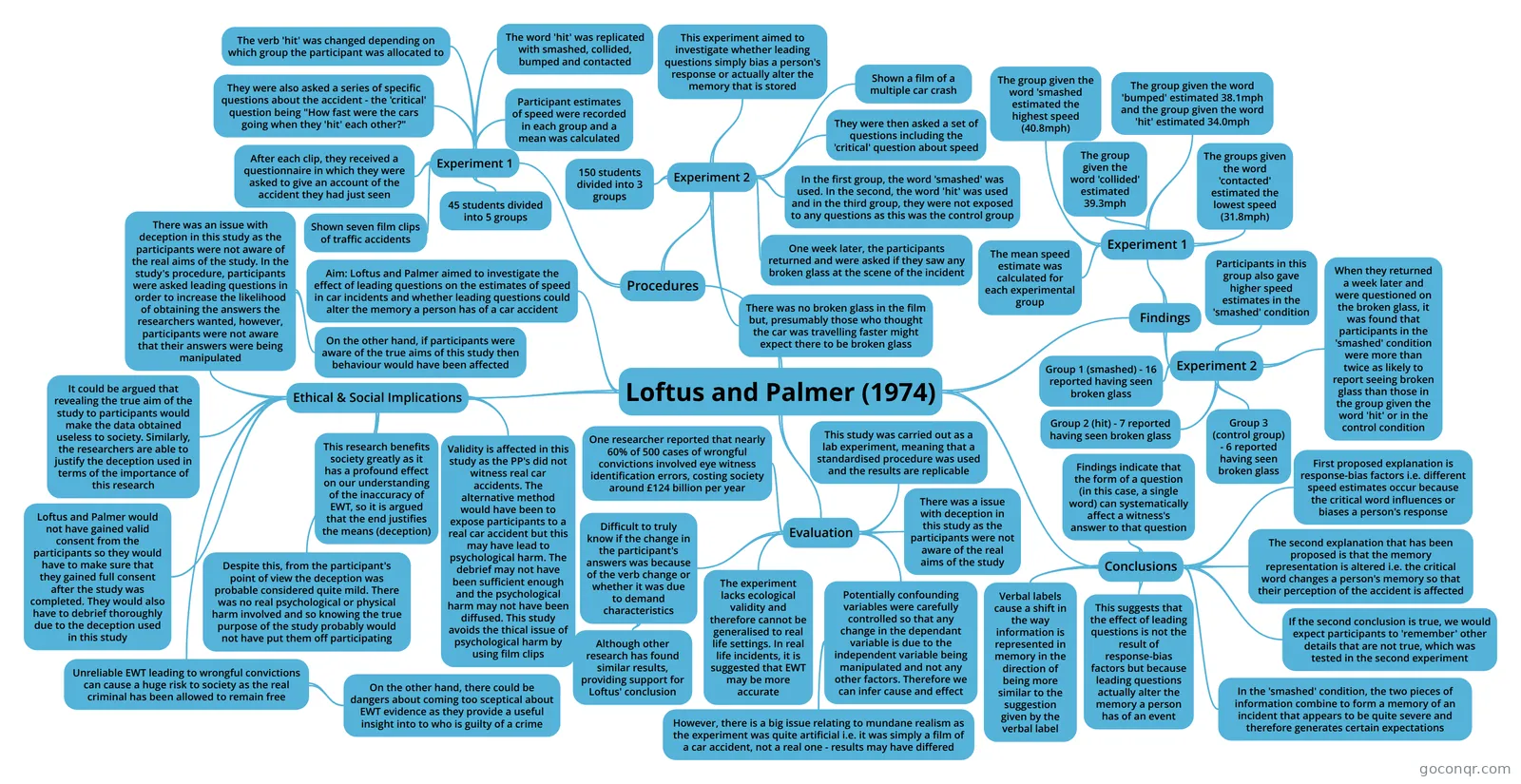
Mind map: Loftus and Palmer (1974)
Map content
Loftus and Palmer (1974)
Aim: Loftus and Palmer aimed to investigate the effect of leading questions on the estimates of speed in car incidents and whether leading questions could alter the memory a person has of a car accident
Procedures
- Experiment 1
- 45 students divided into 5 groups
- Shown seven film clips of traffic accidents
- After each clip, they received a questionnaire in which they were asked to give an account of the accident they had just seen
- They were also asked a series of specific questions about the accident - the 'critical' question being "How fast were the cars going when they 'hit' each other?"
- The verb 'hit' was changed depending on which group the participant was allocated to
- The word 'hit' was replicated with smashed, collided, bumped and contacted
- Participant estimates of speed were recorded in each group and a mean was calculated
- Experiment 2
- 150 students divided into 3 groups
- This experiment aimed to investigate whether leading questions simply bias a person's response or actually alter the memory that is stored
- Shown a film of a multiple car crash
- They were then asked a set of questions including the 'critical' question about speed
- In the first group, the word 'smashed' was used. In the second, the word 'hit' was used and in the third group, they were not exposed to any questions as this was the control group
- One week later, the participants returned and were asked if they saw any broken glass at the scene of the incident
- There was no broken glass in the film but, presumably those who thought the car was travelling faster might expect there to be broken glass
- Experiment 1
Findings
- Experiment 1
- The mean speed estimate was calculated for each experimental group
- The group given the word 'smashed estimated the highest speed (40.8mph)
- The group given the word 'collided' estimated 39.3mph
- The group given the word 'bumped' estimated 38.1mph and the group given the word 'hit' estimated 34.0mph
- The groups given the word 'contacted' estimated the lowest speed (31.8mph)
- Experiment 2
- Participants in this group also gave higher speed estimates in the 'smashed' condition
- When they returned a week later and were questioned on the broken glass, it was found that participants in the 'smashed' condition were more than twice as likely to report seeing broken glass than those in the group given the word 'hit' or in the control condition
- Group 1 (smashed) - 16 reported having seen broken glass
- Group 2 (hit) - 7 reported having seen broken glass
- Group 3 (control group) - 6 reported having seen broken glass
- Experiment 1
Conclusions
- Findings indicate that the form of a question (in this case, a single word) can systematically affect a witness's answer to that question
- First proposed explanation is response-bias factors i.e. different speed estimates occur because the critical word influences or biases a person's response
- The second explanation that has been proposed is that the memory representation is altered i.e. the critical word changes a person's memory so that their perception of the accident is affected
- If the second conclusion is true, we would expect participants to 'remember' other details that are not true, which was tested in the second experiment
- In the 'smashed' condition, the two pieces of information combine to form a memory of an incident that appears to be quite severe and therefore generates certain expectations
- This suggests that the effect of leading questions is not the result of response-bias factors but because leading questions actually alter the memory a person has of an event
- Verbal labels cause a shift in the way information is represented in memory in the direction of being more similar to the suggestion given by the verbal label
Evaluation
- This study was carried out as a lab experiment, meaning that a standardised procedure was used and the results are replicable
- Potentially confounding variables were carefully controlled so that any change in the dependant variable is due to the independent variable being manipulated and not any other factors. Therefore we can infer cause and effect
- However, there is a big issue relating to mundane realism as the experiment was quite artificial i.e. it was simply a film of a car accident, not a real one - results may have differed
- There was a issue with deception in this study as the participants were not aware of the real aims of the study
- The experiment lacks ecological validity and therefore cannot be generalised to real life settings. In real life incidents, it is suggested that EWT may be more accurate
- Difficult to truly know if the change in the participant's answers was because of the verb change or whether it was due to demand characteristics
- Although other research has found similar results, providing support for Loftus' conclusion
- One researcher reported that nearly 60% of 500 cases of wrongful convictions involved eye witness identification errors, costing society around £124 billion per year
Ethical & Social Implications
- Loftus and Palmer would not have gained valid consent from the participants so they would have to make sure that they gained full consent after the study was completed. They would also have to debrief thoroughly due to the deception used in this study
- There was an issue with deception in this study as the participants were not aware of the real aims of the study. In the study's procedure, participants were asked leading questions in order to increase the likelihood of obtaining the answers the researchers wanted, however, participants were not aware that their answers were being manipulated
- On the other hand, if participants were aware of the true aims of this study then behaviour would have been affected
- It could be argued that revealing the true aim of the study to participants would make the data obtained useless to society. Similarly, the researchers are able to justify the deception used in terms of the importance of this research
- This research benefits society greatly as it has a profound effect on our understanding of the inaccuracy of EWT, so it is argued that the end justifies the means (deception)
- Unreliable EWT leading to wrongful convictions can cause a huge risk to society as the real criminal has been allowed to remain free
- On the other hand, there could be dangers about coming too sceptical about EWT evidence as they provide a useful insight into to who is guilty of a crime
- Despite this, from the participant's point of view the deception was probable considered quite mild. There was no real psychological or physical harm involved and so knowing the true purpose of the study probably would not have put them off participating
- Validity is affected in this study as the PP's did not witness real car accidents. The alternative method would have been to expose participants to a real car accident but this may have lead to psychological harm. The debrief may not have been sufficient enough and the psychological harm may not have been diffused. This study avoids the thical issue of psychological harm by using film clips
Information
- Description
- AS - Level Psychology (Cognitive Approach) Mind Map on Loftus and Palmer (1974), created by Siobhan Stagg on 14/04/2016.
- Created by
- Siobhan Stagg
- Views
- 1
- Rating