
Mind map
LEARNING EXPLANATIONS OF ADDICTION
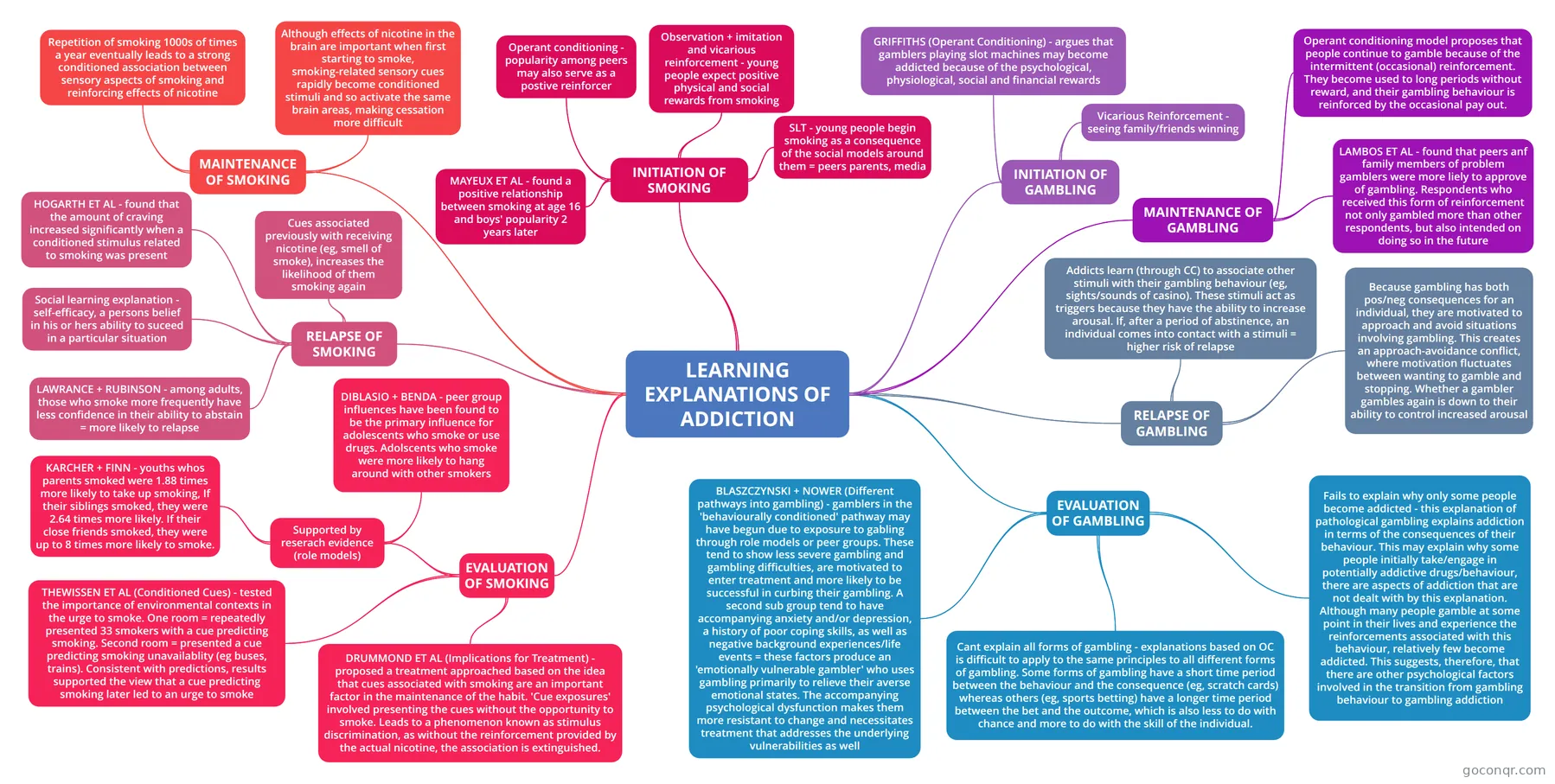
Mind map: Learning explanations of addiction
Map content
LEARNING EXPLANATIONS OF ADDICTION
INITIATION OF SMOKING
- SLT - young people begin smoking as a consequence of the social models around them = peers parents, media
- Observation + imitation and vicarious reinforcement - young people expect positive physical and social rewards from smoking
- Operant conditioning - popularity among peers may also serve as a postive reinforcer
- MAYEUX ET AL - found a positive relationship between smoking at age 16 and boys' popularity 2 years later
MAINTENANCE OF SMOKING
- Repetition of smoking 1000s of times a year eventually leads to a strong conditioned association between sensory aspects of smoking and reinforcing effects of nicotine
- Although effects of nicotine in the brain are important when first starting to smoke, smoking-related sensory cues rapidly become conditioned stimuli and so activate the same brain areas, making cessation more difficult
RELAPSE OF SMOKING
- Cues associated previously with receiving nicotine (eg, smell of smoke), increases the likelihood of them smoking again
- HOGARTH ET AL - found that the amount of craving increased significantly when a conditioned stimulus related to smoking was present
- Social learning explanation - self-efficacy, a persons belief in his or hers ability to suceed in a particular situation
- LAWRANCE + RUBINSON - among adults, those who smoke more frequently have less confidence in their ability to abstain = more likely to relapse
EVALUATION OF SMOKING
- Supported by reserach evidence (role models)
- DIBLASIO + BENDA - peer group influences have been found to be the primary influence for adolescents who smoke or use drugs. Adolscents who smoke were more likely to hang around with other smokers
- KARCHER + FINN - youths whos parents smoked were 1.88 times more likely to take up smoking, If their siblings smoked, they were 2.64 times more likely. If their close friends smoked, they were up to 8 times more likely to smoke.
- THEWISSEN ET AL (Conditioned Cues) - tested the importance of environmental contexts in the urge to smoke. One room = repeatedly presented 33 smokers with a cue predicting smoking. Second room = presented a cue predicting smoking unavailablity (eg buses, trains). Consistent with predictions, results supported the view that a cue predicting smoking later led to an urge to smoke
- DRUMMOND ET AL (Implications for Treatment) - proposed a treatment approached based on the idea that cues associated with smoking are an important factor in the maintenance of the habit. 'Cue exposures' involved presenting the cues without the opportunity to smoke. Leads to a phenomenon known as stimulus discrimination, as without the reinforcement provided by the actual nicotine, the association is extinguished.
- Supported by reserach evidence (role models)
INITIATION OF GAMBLING
- GRIFFITHS (Operant Conditioning) - argues that gamblers playing slot machines may become addicted because of the psychological, physiological, social and financial rewards
- Vicarious Reinforcement - seeing family/friends winning
MAINTENANCE OF GAMBLING
- Operant conditioning model proposes that people continue to gamble because of the intermittent (occasional) reinforcement. They become used to long periods without reward, and their gambling behaviour is reinforced by the occasional pay out.
- LAMBOS ET AL - found that peers anf family members of problem gamblers were more liely to approve of gambling. Respondents who received this form of reinforcement not only gambled more than other respondents, but also intended on doing so in the future
RELAPSE OF GAMBLING
- Addicts learn (through CC) to associate other stimuli with their gambling behaviour (eg, sights/sounds of casino). These stimuli act as triggers because they have the ability to increase arousal. If, after a period of abstinence, an individual comes into contact with a stimuli = higher risk of relapse
- Because gambling has both pos/neg consequences for an individual, they are motivated to approach and avoid situations involving gambling. This creates an approach-avoidance conflict, where motivation fluctuates between wanting to gamble and stopping. Whether a gambler gambles again is down to their ability to control increased arousal
EVALUATION OF GAMBLING
- Cant explain all forms of gambling - explanations based on OC is difficult to apply to the same principles to all different forms of gambling. Some forms of gambling have a short time period between the behaviour and the consequence (eg, scratch cards) whereas others (eg, sports betting) have a longer time period between the bet and the outcome, which is also less to do with chance and more to do with the skill of the individual.
- BLASZCZYNSKI + NOWER (Different pathways into gambling) - gamblers in the 'behaviourally conditioned' pathway may have begun due to exposure to gabling through role models or peer groups. These tend to show less severe gambling and gambling difficulties, are motivated to enter treatment and more likely to be successful in curbing their gambling. A second sub group tend to have accompanying anxiety and/or depression, a history of poor coping skills, as well as negative background experiences/life events = these factors produce an 'emotionally vulnerable gambler' who uses gambling primarily to relieve their averse emotional states. The accompanying psychological dysfunction makes them more resistant to change and necessitates treatment that addresses the underlying vulnerabilities as well
- Fails to explain why only some people become addicted - this explanation of pathological gambling explains addiction in terms of the consequences of their behaviour. This may explain why some people initially take/engage in potentially addictive drugs/behaviour, there are aspects of addiction that are not dealt with by this explanation. Although many people gamble at some point in their lives and experience the reinforcements associated with this behaviour, relatively few become addicted. This suggests, therefore, that there are other psychological factors involved in the transition from gambling behaviour to gambling addiction
Information
- Description
- A-Level Psychology Mind Map on LEARNING EXPLANATIONS OF ADDICTION, created by Zoe Burton on 25/04/2016.
- Created by
- Zoe Burton
- Views
- 4
- Rating